





Gevorg Tamamyan, Chair of the Department of Hematology and Pediatric Oncology at Yerevan State Medical University and Editor-in-Chief of OncoDaily, shared a post on LinkedIn։
“I wrote this in 2016, when I was in Paris. It was in Armenian language. Now in Paris again and I decided to publish it in English.
Our friend Claude helped to translate it!
Direction: Paris
July 23 – 24, 2016, Paris
Paris began with my head hitting the overhead luggage compartment, while the French neighbor sitting across from me – back turned against the direction of travel, alongside his wife – was attempting, with an unwavering gaze, to explain the differences between French and Korean culture to a Korean student. The woman seated opposite me, a Swiss traveler by all appearances, who had boarded at the sixth platform of the small Karlsruhe station together with me, finally stirred from her sleep.
At the approaches to Paris Est, where the express train arrived, a blonde Parisian woman was waiting beyond the doors for her beloved – wearing apricot-colored women’s shoes. Around the ankle of her right foot, just where the shoe’s edge ended, a tattoo coiled like barbed wire. Had the station not been in Paris, that tattoo might have led me to think the girl had spent some difficult days in a Siberian prison camp…
On the left side of the hall stood an African pastor dressed all in black, and right beside him, a woman from the Indian subcontinent in a white sari. For a moment it seemed as though they had arrived for an interfaith summit on religious harmony to be held in Paris. Around the two religious figures darted a Frenchwoman’s pair of mischievous children. And in front of the Brioche Dorée sandwich kiosk, a passenger was waiting his turn – shorts, long curly hair.
Direction: Marie-Montrouge, next stop: Odéon. I was quite certain that the three people sitting across from me were all French, and they were arranged in ascending order of age. On the left sat a fair-haired girl of no more than twenty-five, with green eyes and ring stones of the same shade, anxiously checking her phone for messages. Beside her sat a woman nearing fifty – her fingers adorned with rings of many colors and shapes, her hair half gold and half black, her blouse drawing particular attention to her figure. Seeing this woman, I thought it might actually be possible to prove the hypothesis put forward by various writers – that Frenchwomen age with great difficulty. Next to the woman sat a white-haired man in a striped shirt and jeans, who was in all likelihood an engineer – on his way home after a long week of work, leafing through the pages of a book on his iPad. As the train approached the Odéon stop, the girl with the small piercing glinting to the left of her nose was typing faster on her phone, occasionally sighing and glancing up at the departure board. She was, without a word needed, beautiful – and some fortunate soul had already managed to slip that much-awaited ring onto her finger. Then came Saint-Michel station, the girl stepped off, and the engineer in the striped shirt would go on staring after her for quite some time.
15 Rue de Quatre-Vents. As you come out of the metro station, the façade of a brown building – number 55 – unfolds before you: the École des Arts. To the right is a café with a Café Society poster, which at first I took to be the café’s name, but later, on the Paris-Kyiv flight magazine, I discovered it was actually the poster for a recently released film. On the poster was a collage of a red-lipped woman, a golden tear running down her cheek.
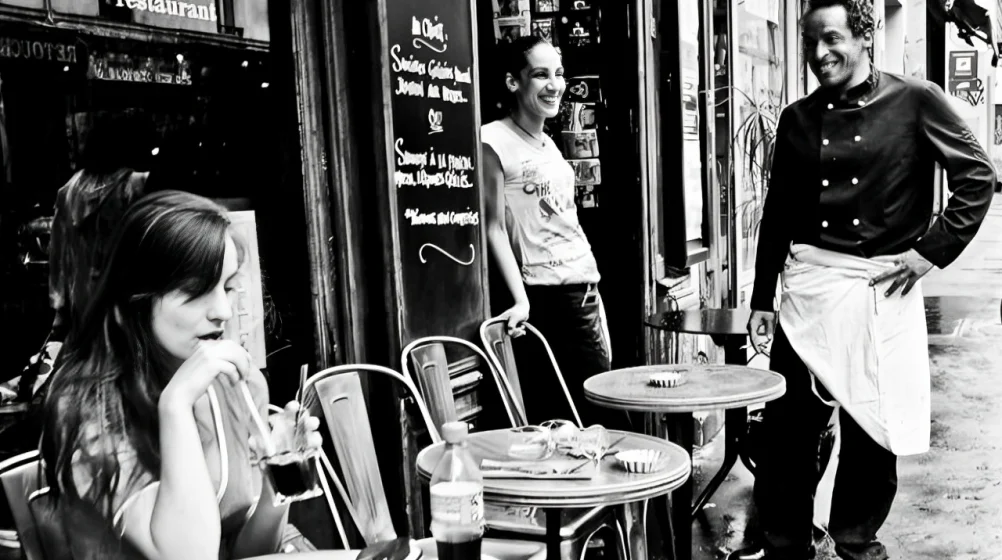
On the red chairs of the Danton café, facing the street, the Parisians were savoring their Saturday evening rest, rolling the last drops of beer with quiet contentment. The ground floors of the narrow street were a succession of restaurants and shops of every kind. There was the small wine bar, beside which a little boutique sat – French in fashion, but bearing a promising Italian name. After it came the vegetable stand and then the hotel, which from the outside resembled one of those old Yerevan buildings plastered in stucco, its ground-floor windows shielded from outside by black iron grilles.
I had asked in advance to be given a room with a pleasant view, but the hotel staff informed me that, regrettably, no such rooms were available, and instead they had assigned me a specially decorated suite. When I stepped inside, at first glance it seemed to me the room’s furnishings and design had been the work of the not-entirely-unknown Italian, Tinto Brass. The room was small – about fifteen square meters. In the center stood an enormous round bed, if one could even call it a bed – it looked like an eighteenth-century antique on the outside, as though it had been borrowed from one of the nearby museums. To the right was the washbasin; to the left, wardrobes decorated as though they were the back of a Moulin Rouge dancer, draped in a pink corset. Facing the bed stood an oval white bathtub. The walls were covered in patterns reminiscent of the turn-of-the-century brothels one sees in films. There were also small reproductions of anonymous Renaissance portraits – hung in the space between the bed and the washbasin.
There were two of them. Both wore early-summer floral dresses that recalled the French provinces of the 1950s. One girl had short hair, the other’s was slightly longer. The first had a professional camera hanging from her neck.
– “Excuse me, I can see you’re a photographer,”
I said to the short-haired one, who laughed. “Would you mind taking my picture?”
– “Of course,” she said, smiling, took my phone and positioned herself to shoot from below – but when she raised her arm, the abundance of hair beneath it produced in me such an unpleasant sensation that I forgot I was hungry… Still, the photo turned out rather well.
The Seine flowed quietly along the banks of Notre-Dame de Paris. On both sides of the river, couples and solitary passers-by lined the walls. From the right, round lanterns were strung one after another, destined to be reflected in the river’s waters come nightfall. Then came the Bateaux Mouches tour boat, laden with tourists who had arrived in hope of becoming a small piece of this magnificent city’s story…
The sun was descending slowly, gilding the domes and façade of Notre-Dame de Paris in gold. From the direction of the Saint-Michel statue, an ambulance came wailing past.
After a long search, I finally found a place that did not forbid cigar smoking, and where one could simultaneously enjoy seafood and beer. The café was situated on the left bank of the Seine, looking directly toward the Cathedral. At last a spot freed up – between a family taking selfies and a young woman sipping wine and smoking a cigarette. The bald waiter made every effort to direct me to the table by the door, but I proved more stubborn. The girl – or more precisely, the young woman – finished her wine, settled the bill, blew her nose with considerable force, and began checking her phone. My table received a one-liter Belgian beer and French-style snails.
Silvia was from Rome. She was in Paris studying French. She had spent the last two weeks here and still had as many left. And now she was sitting and waiting for her Brazilian and Arab friends, who seemed to have gotten lost along the way. In the meantime, she decided to order another glass of Chardonnay. The waiter collected a small dish that looked like an ashtray, which turned out, in fact, to be meant for closing the bill – and I, without a hint of embarrassment, had been leaving my cigar ash in it. Silvia, meanwhile, was nervously playing with her hair.
– “Do you speak English?” – “Yes – where are you from?” She pointed her finger at me and looked with a meaningful expression.
– “From Armenia. And you?”
– “Italy…”
She asked in a way that made me think, before my answer came, she had believed she had found a compatriot.
– “And what are you doing here?” – “I’m studying French. What about you?”
– “I’m attempting to write a short piece about Paris,”
I laughed.
– “So you’re a writer?”
– “I wouldn’t say that. I’m actually a doctor. I just try to write in my free time, and now and then I step away from reality like this.”
– “Interesting… I sing sometimes, too.” – “Is that so… And what do you sing, if it’s not a secret? Al Bano and Romina Power, perhaps?”
I knew perfectly well that most Italians are not devoted fans of those singers – whose songs I happen to enjoy quite a lot – and I had already anticipated what her answer would be.
– “Oh, no. Mostly American songs. The Beatles, for example. Or Hotel California.”
– “I could have guessed even if you hadn’t told me,” I said – and truthfully, that repertoire suited the Italian woman’s appearance precisely. “Are you familiar with Paris?” – “I wouldn’t say I know it well, but I know a few things.” – “In that case, please tell me – where should I go to be able to write about Paris in a more beautiful way?”
She thought for a moment, began playing with her hair more restlessly, then continued:
– “Montmartre – without a doubt, Montmartre. That is the place where art becomes mixed up with the color of Paris itself.”
– “And could I find works by roaming painters there?” – “Absolutely – that is certainly the place you need.” – “And what are you doing tomorrow? Perhaps you’d come with me?” – “Ah – I’m sorry, I’d be delighted, but my parents are here and I’m showing them Paris. I don’t know how I’ll manage. Today I took them to Montmartre, tomorrow I’m not sure how it will go.” – “Very well – I’ll give you my card. If you find yourself free, write to me. I’d be glad to enjoy a glass of wine with you…”
My beer was slowly making its way toward its end. The couple at the next table ordered their second round. The girl had propped her legs on the chair across from her and, fingers playing at her lips, was listening to the young man’s stories in a language I couldn’t understand.
– “Silvia – which are your favorite cities, besides Rome, of course?” – “Well – Barcelona, without a doubt. And Dublin.” – “Dublin? I had often heard people say they love Barcelona, but Dublin – that’s a first. Could it have something to do with Joyce?” I laughed.
She laughed too.
– “Dublin is actually a very interesting city. People there are kind. They finish work at five and from then on start enjoying the varieties of alcohol… and everyone is happy.”
– “That makes it a little clearer now,” we laughed again. “And what do you think of Sicily? Have you ever been?” – “Yes, I’ve been. It’s a beautiful place, but I wouldn’t live there. I’m fond of big cities…”
Silvia’s friends never did find the café situated on the left bank of the Seine, looking straight at the nighttime illumination of Notre-Dame de Paris – and she, left with no choice, decided to go out and meet them.
The walk back to the hotel felt shorter – the alcohol had found its way home. The lively cafés and bars of the Latin Quarter were slowly drawing their curtains. The wine bar near the Odéon metro – where the perpetually young forever gathered on their feet – was already empty…
Sunday in Paris began with a considerable delay. The one liter of beer consumed the evening before had made its point. The narrow road led toward the Luxembourg Gardens. On both sides of the street, cars of various makes and years were parked – their unifying characteristic being their small size. A little further along stood the florist’s tiny shop, past which a Chinese student cycled. Paris was still asleep and, most likely, only the florist had woken early and opened the shop’s multicolored shutters. Closed was the hairdresser’s, its display window showing photographs of Frenchwomen with interesting hairstyles. Closed too was the design boutique next door – Press Station, a rather eloquent name. Across the street, from the door of a building most likely constructed at the start of the previous century, a tousle-haired man in his fifties emerged, walking his dog. Then came the Tournon café, whose subtitle – bar à vins – made clear that Saturday evening’s drinking had been rather spirited, and now, behind closed doors, the wooden chairs rested stacked upon one another on the tabletops. Rue de Tournon ended before the Senate building, on which was emblazoned: LIBERTÉ, ÉGALITÉ, FRATERNITÉ. On the small square a plaque announced: Pierre Dux, born 1908, died 1990, French comedian…
The Luxembourg Gardens, adjoining the Senate, were full that morning of joggers out for their run, and for a moment I regretted not having joined their ranks. The construction work at the right side of the entrance cast no shadow whatsoever over the seemingly boundless green that spread to the left and before you, interrupted here and there by various statues. Along the circular path, metal chairs and benches were arranged – on one of which a Buddhist in black was spending his Sunday morning. And then the flowers began to appear… violet, pink… roses of every variety, lined along the entire length of the path… birds trilled softly… On a height to the left stood a sculpture that brought to mind the Hellenistic period of Arthur Borges, behind which the dome of a church could be made out. Beside the statue of Saint Geneviève, a painter in a green cap had secured her canvas to the ground and was preparing, no doubt, to portray the American couple seated across from her – sunk into their phones on a bench, taking a sun bath after their morning run. Surprisingly, the next statue was of Mary, Queen of Scots, frozen with an unsparing expression on a white pedestal. In the distance, the top of the Eiffel Tower was visible. A Black jazz musician – legs propped on the bench ahead of him, gaze fixed on the pool in the center of the garden, surrounded by palm trees – was conducting an imaginary piano in the air with the movements of his hands… A little further along, a white-haired woman already past a hundred had turned her face to the sun and was smiling an absentminded smile, lost in some quiet thought of her own…
The crowns of the trees, planted in rows, had been trimmed in such a way that they recalled the main Frankfurt train station – trains ready to depart from parallel platforms. Inside the wagon-like canopies of foliage, families, couples, and solitary travelers like myself were savoring their Sunday rest. A full-figured Parisienne, offering her assets to the world’s contemplation, lay on her stomach leafing through a glossy magazine. By the fountain, another blonde had leaned her back against a bench.
“Beautiful one – are you alone?”
After that question, she would probably have looked up at my eyes in surprise, then removed her earphones – and from those earphones, I imagine, the melodies of Nirvana would have drifted out. And I would be compelled to repeat my question, but this time I would no longer have the courage, and I would ask instead:
“Excuse me – which direction is the Eiffel Tower?”
She would laugh, I’m sure – understanding what I had really meant to ask – but from politeness, she would point me toward the Eiffel Tower and go on listening to her music, while I would turn my steps in the direction indicated.
To the left of the path, all the chairs are empty, and for a moment there comes a desire to fill them – they resemble a theater left without its audience…
In one part of the outdoor sports ground, young people were playing basketball, while in the area below, three small boys had improvised a football goal out of chairs…
In the second floor of a five-story building at 34 Rue Bonaparte, an elderly white-haired man of aristocratic bearing was smoking. That was the Hôtel Saint-Germain-des-Prés. The road led toward the Louvre. A little further along, on building number sixteen, the reminder of Liberty, Equality, and Fraternity was again displayed, and the French tricolor was flying. This was where the Académie Nationale de Médecine was located.
Along the bank of the Seine, across from the Institut de France, antique booksellers had arranged themselves in their rows. On the bridge connecting the two banks, an itinerant violinist was playing some familiar French melody.
– “Excuse me – how does one get to Montmartre?”
I asked a self-assured girl in a black skirt walking alongside the Louvre. – “One moment – let me check my map…” but when I noticed the abundance of hair on her arms, I immediately regretted having asked.
The city was resting, while the Seine that day was restless. Beneath the bridge, a Black man and his blonde companion had settled in, filling the entire surroundings with the “sobering” scent of marijuana… The curly-haired mistress of the Édith Piaf river boat interrupted my sun-bathing pleasure and docked directly in front of my feet…
At the intersection of Montmartre and Étienne Marcel streets, in the front row of a small café, a dark-haired Spanish woman in oval sunglasses was smoking a cigarette. I sometimes marvel at how such beautiful women can wear those kinds of sandals – in the most literal sense: thick cork soles and coarse leather uppers. A sporty friend of mine used to wear such sandals, and now this Spanish woman… The sight also recalled an episode from years ago, when, returning home one evening in a European city, a blue-eyed young woman confessed that she used to love those sandals very much – for the comfort – which immediately altered my mood regarding how to continue the evening, and I asked her to drop me in front of my building, never inviting her inside. And the woman never did understand what the problem had been…
Passing by Café La Bocca, my attention was immediately caught – and I was made to turn back – by a burst of laughter cutting through the air. When I turned, I saw a girl performing gymnastics beside a table, while her friends laughed insatiably… she had probably lost a bet. I think such follies are also a small piece of Paris’s charm.
Coming toward me was a Parisian who looked exactly like Karl Marx. With one hand he was discussing something on his phone; with the other, he held his grandchild’s hand. A Chinese couple was happily photographing themselves against the backdrop of some casual scene. At the street corner, a refugee family had settled on a mattress. A Black musician with curly hair was coming toward me, a cello on his shoulder. In front of the Istanbul Kebab shop, the short cook was waving over to his friend.
I cannot remember the last time I climbed such a height. One staircase leads to another, and midway up, beneath a building to the right, a small bar-café had nestled, with its regular clientele gathered outside. The final staircase brought me to Montmartre, from whose heights all of Paris spread open. For a moment it seemed as though the entire city was there – lying to the left and right, up and down, across the grassy summit. Two more visits to Paris like this one, and I think I shall no longer need to worry about excess weight. On a bench below the hill, a woman was greedily kissing her husband’s bald head…
At the foot of the Montmartre steps, a group of Afro-French musicians was playing a melody familiar from Bob Marley, and a circle of young people were nodding their heads in time with the rhythm…
Paris was just as it was… An old man with a carrot-colored beard, green moccasins, and white socks stepped off at the next metro stop…”
Other articles featuring Gevorg Tamamyan on OncoDaily.