





Enrique Grande, Director of the Medical Oncology Department at Quirónsalud, and Adjunct Professor at The University of Texas MD Anderson Cancer Center, shared a post on LinkedIn:
“De-escalation in the era of highly active therapies
In the era of highly active therapies, should we start treating less?
With the arrival of more effective treatments in urothelial cancer, including antibody-drug conjugates and immunotherapy combinations, we are achieving deeper responses than ever before.
But this progress comes with a new challenge:
Are we giving more treatment than some patients actually need?
In my view, one of the most important questions moving forward is not only how
to treat better — but how to treat smarter.
This includes:
- identifying early responders
- adapting treatment duration
- minimizing unnecessary toxicity
Because ultimately, our goal is not just survival — it is preserving quality of life.
The concept of de-escalation is not about doing less.
It is about doing what is right for each patient.
And in that sense, it may represent one of the most meaningful evolutions in
modern oncology.”
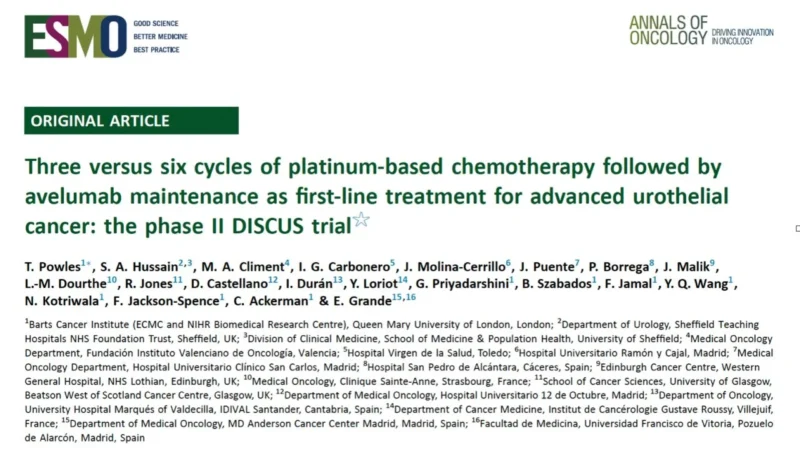
Title: Three versus six cycles of platinum-based chemotherapy followed by avelumab maintenance as first-line treatment for advanced urothelial cancer: the phase II DISCUS trial
Authors: T Powles, S A Hussain, M A Climent, I G Carbonero, J Molina-Cerrillo, J Puente, P Borrega, J Malik, L-M Dourthe, R Jones, D Castellano, I Durán, Y Loriot, G Priyadarshini, B Szabados, F Jamal, Y Q Wang, N Kotriwala, F Jackson-Spence, C Ackerman, E Grande
Read the Full Article.
Other articles featuring Enrique Grande on OncoDaily.