





Cancer Research Institute (CRI) shared a post on LinkedIn:
“New research from CRI Clinical Accelerator Investigator Dr. Dmitriy Zamarin of Icahn School of Medicine at Mount Sinai, and CRI Scientific Advisory Council Associate Directors Dr. Jedd Wolchok of Weill Cornell Medicine and Dr. E. John Wherry of Penn Medicine, University of Pennsylvania Health System describes why some cancer patients don’t respond to immunotherapy.
Researchers found that worn-out T cells in tumors display high levels of CD47, a protein that acts like a receptor for distress signals. A molecule called TSP-1, abundant in tumor environments, binds to CD47 and triggers a chain reaction that essentially tells T cells to give up fighting. This process turns on genes that make T cells dysfunctional, and unable to kill cancer cells.
When investigators blocked this CD47-TSP-1 interaction in experimental models, T cells maintained their cancer-fighting abilities, and tumors shrank more effectively. This discovery offers a new target to help immunotherapy be more effective in more patients.”
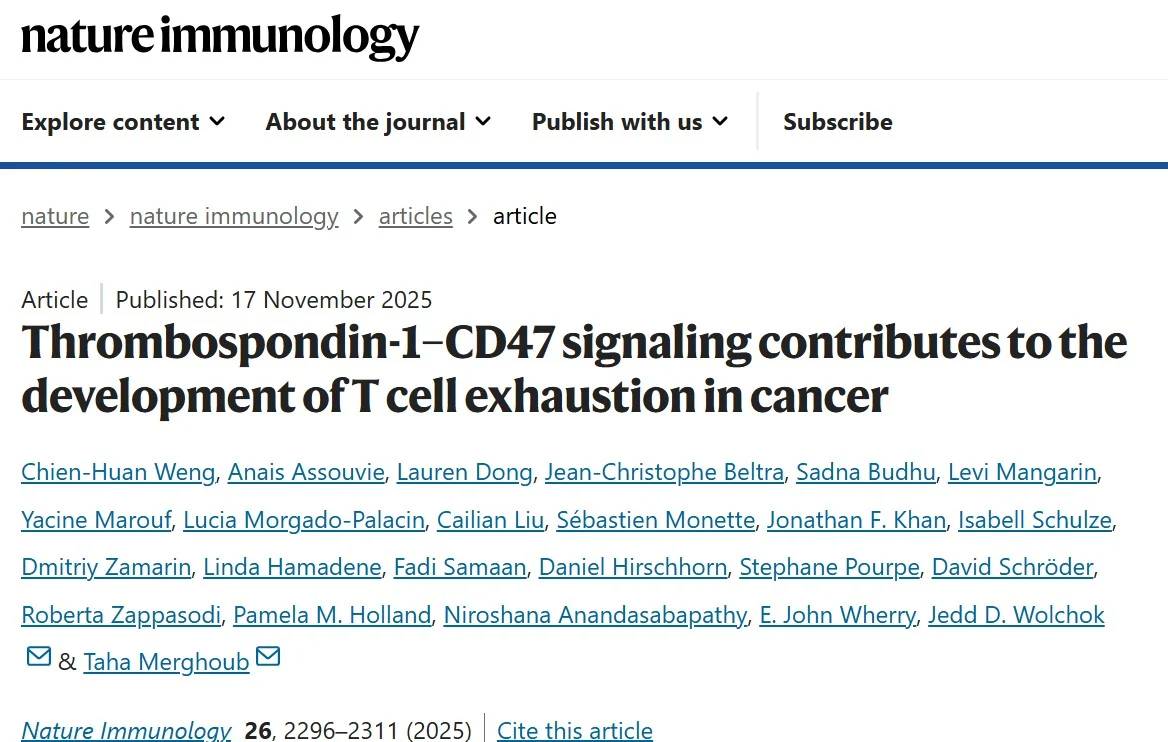
Title: Thrombospondin-1–CD47 signaling contributes to the development of T cell exhaustion in cancer
Authors: Chien-Huan Weng, Anais Assouvie, Lauren Dong, Jean-Christophe Beltra, Sadna Budhu, Levi Mangarin, Yacine Marouf, Lucia Morgado-Palacin, Cailian Liu, Sébastien Monette, Jonathan F. Khan, Isabell Schulze, Dmitriy Zamarin, Linda Hamadene, Fadi Samaan, Daniel Hirschhorn, Stephane Pourpe, David Schröder, Roberta Zappasodi, Pamela M. Holland, Niroshana Anandasabapathy, E. John Wherry, Jedd D. Wolchok and Taha Merghoub
You can read the full article in Nature Immunology.
More posts from Cancer Research Institute.