






Bernardo Rocco, Director of the UOC of Urology at Fondazione Policlinico Universitario Agostino Gemelli IRCCS, shared a post on LinkedIn:
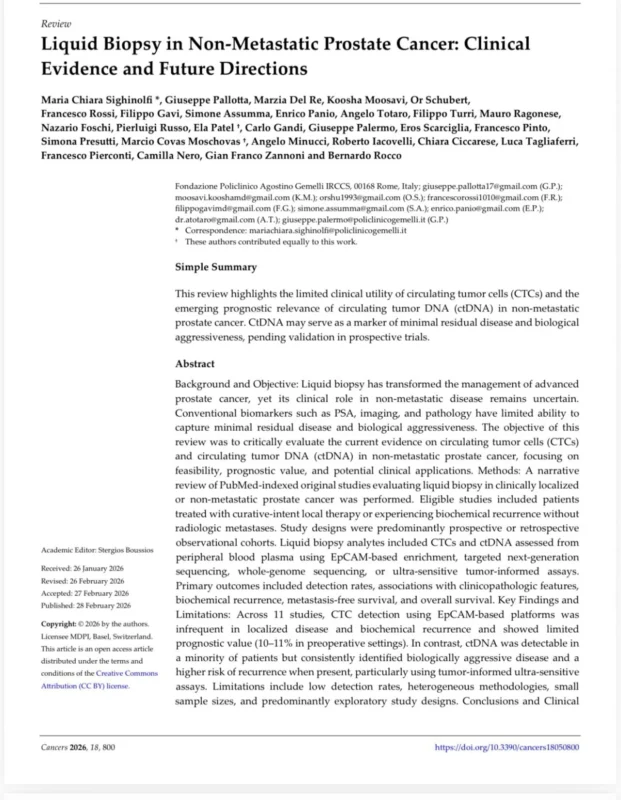
“Liquid biopsy is rapidly reshaping how we think about non‑metastatic prostate cancer, but its real value today lies in a very specific role: acting as a biological risk modifier rather than a universal test for everyone.
Early EpCAM‑based CTC assays taught us a clear lesson: in localized disease, circulating tumor cells are rarely detectable and add little to clinical decision‑making. This “failure” was not only technical, but biological-localized tumors simply shed very little material into the bloodstream.
The advent of highly sensitive next‑generation sequencing has changed the landscape, shifting the focus to circulating tumor DNA (ctDNA). Across multiple studies, ctDNA is detectable only in a minority of non‑metastatic patients, but when present it consistently tracks biologically aggressive disease and a markedly higher risk of early biochemical recurrence and metastasis. In other words, a weak signal-if captured correctly-carries very strong prognostic information.
The most compelling and realistic application is minimal residual disease (MRD) assessment after radical treatment. Tumor‑informed, ultra‑sensitive ctDNA assays can identify patients with molecular persistence of disease well before conventional imaging and often even before PSA rise, opening the door to truly biology‑driven escalation or de‑escalation of adjuvant and salvage strategies. However, this comes with important challenges: assay complexity, cost, need for high‑quality tissue, bioinformatics infrastructure, and evolving regulatory and reimbursement frameworks.
For prostate cancer units and multidisciplinary teams, the takeaway is clear: ctDNA in non‑metastatic prostate cancer should not be seen as a new “super‑PSA”, but as a selective, high‑impact tool reserved for well‑defined scenarios where traditional markers are blind to biology. The next step is to design and complete prospective, biomarker‑driven trials to demonstrate that MRD‑guided management can improve outcomes and reduce overtreatment. Only then will these technologies move from promising research to routine standard of care.”
Other articles on OncoDaily.