






Aung Myo, Founder and Principal at Innovicto Clinical shared a post on LinkedIn:
“Everyone is talking about the daraxonrasib data presented at AACR Annual Meeting 2026-early first-line pancreatic cancer data showed encouraging activity.
But what caught my attention was the development strategy behind it.
Separately, Revolution Medicines recently announced positive Phase 3 results versus chemotherapy in previously treated metastatic pancreatic cancer.
Impressive outcome.
But what really caught my attention was how they got there.
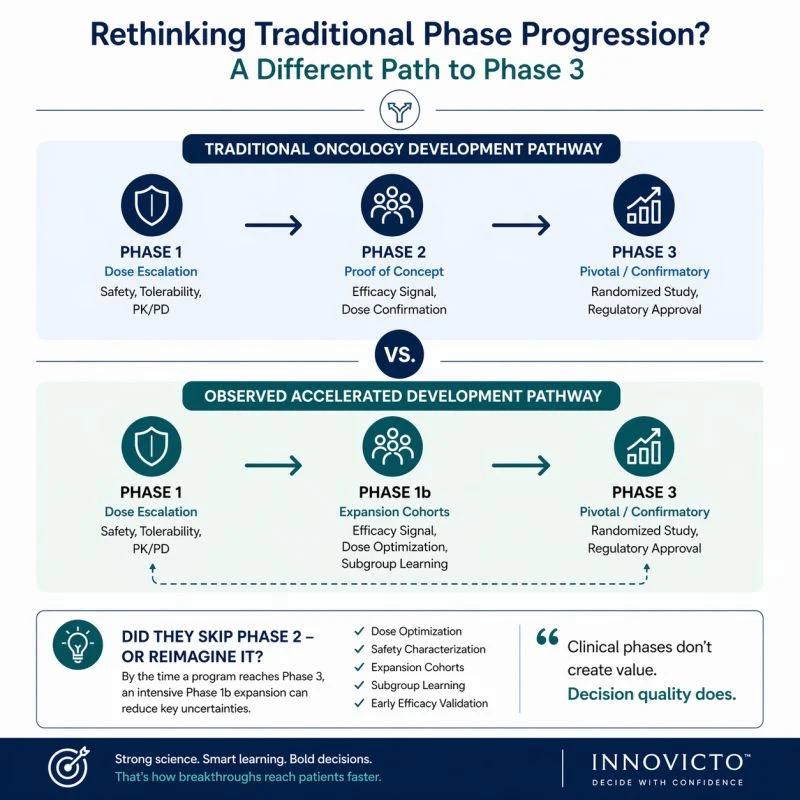
Traditional oncology development often follows:
Phase 1 – Phase 2 – Phase 3.
This program appears to have taken a more compressed path:
Phase 1 dose escalation – expansion cohorts – Phase 3.
That is a bold move. The earlier expansion data appeared strong enough to generate much of the learning a traditional Phase 2 trial often provides:
- Dose confidence.
- Safety learning.
- Subgroup insights.
- Early efficacy validation.
Of course, that strategy carries risk. Single-arm expansion cohorts can overestimate treatment effect. And moving quickly into Phase 3 can become very expensive if the signal does not hold.
So far, the bet appears to be working.
But the takeaway is not:
‘Skip Phase 2.’
It is this: Clinical phases don’t create value. Decision quality does. The real question is whether enough uncertainty has been reduced before committing major capital. That is where many programs succeed-or fail.”
Other articles about Pancreatic Cancer on OncoDaily.