Arif Kamal, Chief Patient Officer of American Cancer Society and President of American Academy of Hospice and Palliative Medicine, shared on LinkedIn:
“Many are familiar with the ‘1 in 8’ statistic for lifetime risk of breast cancer in women.
But did you know there’s another ‘1 in 8’ cancer statistic that might surprise you?
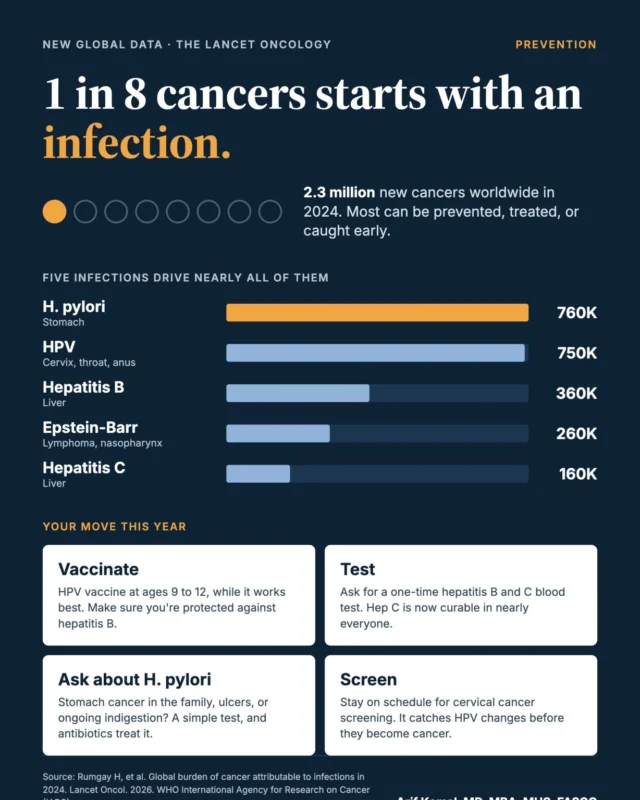
A new WHO study in The Lancet Oncology found that 2.3 million new cancers worldwide in 2024 were caused by infections. That’s 12% of all cancers diagnosed globally, or 1 in 8.
Infections linked to cancer can be causes by viruses, bacteria, and even parasites.
The biggest culprit is H. pylori (short for helicobacter pylori), a common stomach bacterium linked to about 760,000 cancers, mostly stomach cancer. HPV (a virus) is a close second at 750,000, followed by hepatitis B, Epstein-Barr virus and hepatitis C.
As an oncologist, this is the part I want people to hear: most of these cancers can be stopped before they start. We have vaccines for HPV and hepatitis B. Hepatitis C is curable. H. pylori is treated with antibiotics. Cervical screening catches HPV changes years before they become cancer.
Here at home, we’re leaving protection on the table. Only about 63% of U.S. teens were up to date on HPV vaccination in 2024.
So here’s my ask. Pick one this month:
- If you have a child age 9 to 12, ask their pediatrician about the HPV vaccine. And make sure to complete the two doses.
- Ask your doctor for a one-time hepatitis B and C blood test, recommended for all adults at least once in their lifetime by the US Centers for Disease Control
- If stomach cancer runs in your family, or you live with ulcers or ongoing indigestion, ask about H. pylori testing.
- If you have a cervix, as your doctor about the right test and frequency for HPV
Prevention is the most underused cancer treatment we have.”
You can also read: Cervical Cancer Screening’s Global Evolution: From Pap Smears to HPV Testing