Key Takeaways
- The FDA has accepted Immunome’s New Drug Application (NDA) for varegacestat in adults with desmoid tumors, with a PDUFA target action date of April 28, 2027.
- The filing rests on the Phase 3 RINGSIDE trial, where varegacestat cut the risk of progression or death by 84% (HR 0.16) and drove an objective response rate of 56% versus 9% for placebo.
- Varegacestat is an oral, once-daily agent; a marketing application to the EMA is planned by the end of 2026.
- If approved, it would be the second gamma secretase inhibitor cleared for desmoid tumors, after SpringWorks’ Ogsiveo (nirogacestat) in 2023.
A key regulatory milestone
Immunome (Nasdaq: IMNM) announced that the U.S. Food and Drug Administration has accepted its New Drug Application for varegacestat, an investigational oral, once-daily gamma secretase inhibitor (GSI), for the treatment of adults with desmoid tumors. The agency assigned a Prescription Drug User Fee Act (PDUFA) target action date of April 28, 2027.
The Bothell, Washington–based company submitted the NDA at the end of April 2026, so the FDA’s acceptance marks the formal start of the review clock. Clay Siegall, Ph.D., Immunome’s president and chief executive officer, called the acceptance:
an important milestone for Immunome and for patients living with desmoid tumors

Clay Siegall/Immunome
pointing to the strength of the underlying clinical dataset.
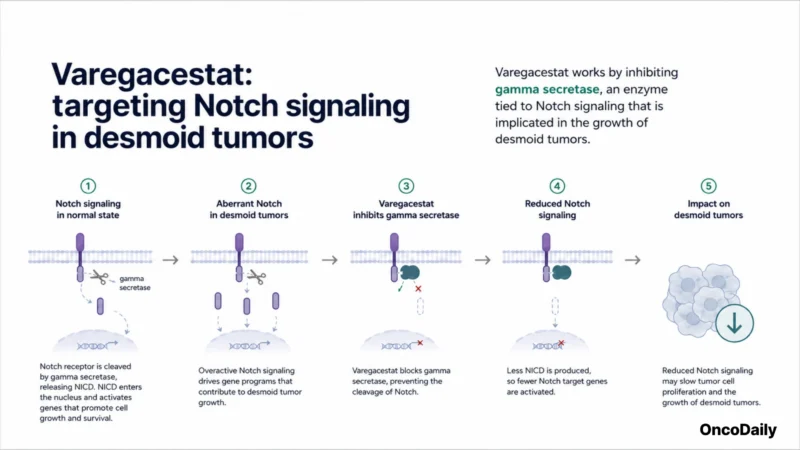
Varegacestat, formerly known as AL102, works by inhibiting gamma secretase, an enzyme tied to Notch signaling that is implicated in the growth of desmoid tumors. The same mechanistic class already has a foothold in the indication, which sets up a closely watched head-to-head narrative discussed below.
Inside the Phase 3 RINGSIDE trial
The NDA is supported by RINGSIDE (NCT04871282), a global, randomized, double-blind, placebo-controlled Phase 3 study, described by the company as the largest randomized trial conducted in this patient population. A total of 156 adults with progressing desmoid tumors were randomized to varegacestat 1.2 mg once daily or placebo, continuing until disease progression or death, with progression-free survival by blinded independent central review (BICR) as the primary endpoint.
The efficacy signal was strong across the board:
- Progression-free survival: an 84% reduction in the risk of disease progression or death versus placebo (HR 0.16; 95% CI, 0.071–0.375; p<0.0001).
- Objective response: a confirmed RECIST 1.1 response rate of 56% with varegacestat versus 9% with placebo by BICR (p<0.0001).
- Tumor volume: an exploratory analysis showed a median best change in tumor volume of –83% with varegacestat, compared with +11% for placebo, underscoring the depth of response.
Immunome also reported that the progression-free survival benefit held consistently across prespecified subgroups, including tumor location, baseline tumor size, patient age, and prior systemic therapy.
Because desmoid tumors are as much a quality-of-life disease as a radiographic one, the pain data matter. Varegacestat produced a statistically significant improvement in worst pain intensity by week 12, with a clinically significant difference emerging as early as the first assessment at week 4.
Topline results first read out in December 2025, and detailed efficacy and safety data were presented in an oral abstract session at the 2026 ASCO Annual Meeting in Chicago.
Tolerability in line with the class
Varegacestat’s safety profile tracked with what is expected of gamma secretase inhibitors. The most common any-grade adverse events were gastrointestinal and dermatologic, including diarrhea (82%), fatigue (44%), rash (43%), nausea (35%), and cough (34%), with events generally low grade and manageable. Tolerability will be one of the practical differentiators clinicians weigh, given that desmoid patients may stay on therapy for extended periods.
Why desmoid tumors need more options
Desmoid tumors, also called aggressive fibromatosis, are rare soft-tissue tumors that arise from connective tissue. They do not metastasize, but they can invade surrounding structures and organs, causing pain, restricted movement, disfigurement, and diminished quality of life. They are most often diagnosed in adults between roughly 20 and 44 years of age and occur more frequently in women, and their behavior can be unpredictable, sometimes growing rapidly and other times stabilizing on their own.
For years, management relied on active surveillance, surgery, radiation, or off-label systemic therapies, with no agent specifically approved for the disease. That changed only recently, and it frames why a second targeted, oral option is being watched so closely.
The competitive landscape: a two-GSI race
The reference point for varegacestat is SpringWorks Therapeutics’ Ogsiveo (nirogacestat), which on November 27, 2023 became the first FDA-approved treatment for adults with progressing desmoid tumors who require systemic treatment. Ogsiveo is also an oral gamma secretase inhibitor, dosed twice daily, and it has since built a commercial foothold as the established standard of care in the indication.
Ogsiveo’s approval was based on the Phase 3 DeFi trial (NCT03785964), which enrolled 142 patients and demonstrated a 71% reduction in the risk of disease progression, with an objective response rate of 41% versus 8% for placebo.
That sets up a genuine class competition. On cross-trial numbers, varegacestat’s reported figures, an 84% risk reduction and a 56% response rate, sit at the higher end, and its once-daily schedule could be positioned as a convenience advantage over twice-daily dosing. The important caveat: these are separate trials with different designs, timeframes, and patient populations, so head-to-head conclusions cannot be drawn from a numerical comparison alone. Still, for a rare disease that had zero approved therapies just a few years ago, the prospect of a second targeted option is a meaningful shift for patients and treating oncologists.
What comes next
The April 28, 2027 PDUFA date is now the key catalyst for Immunome and for the desmoid community. In parallel, the company plans to submit a Marketing Authorization Application to the European Medicines Agency by the end of 2026, and an open-label extension of RINGSIDE remains ongoing, which should add to the longer-term efficacy and safety picture.
For a tumor type that long sat at the margins of drug development, the coming year could bring a second approved therapy, and, with it, real choice in how desmoid tumors are treated.
Read more biotech insights on OncoDaily Biotech.
Written by: Semiramida Nina Markosyan, Editor, OncoDaily Canada