
Johnson & Johnson agreed on June 8 to acquire Firefly Bio for $1 billion in cash. By the standards of big-pharma oncology deals, the headline number is modest. Firefly is four years old, has raised just under $100 million in venture funding, and its pipeline is still preclinical. But the size of the check is less telling than what it’s for. J&J isn’t buying a finished medicine. It’s buying a platform, and a particular idea about where antibody-conjugate technology heads next.
A familiar pattern, with a meaningful twist
The shape of this deal will look familiar to anyone who has followed oncology dealmaking. OncoDaily recently traced the $13 billion land grab in which major drugmakers have repeatedly written large checks for antibody-drug conjugate (ADC) specialists, Gilead’s Tubulis acquisition among the most recent. The throughline of that spree was that buyers weren’t chasing individual drugs so much as the engineering capability to generate a whole pipeline of well-designed conjugates: buying the boat, not the fish.

Read ADCs: Why Pharma’s Booming $13 Billion Land Grab Won’t Slow Down.
Firefly extends that pattern in a genuinely different direction. It isn’t, strictly, an ADC company. Its platform, Firelink, preserves the antibody and the targeted-delivery logic of a conjugate, but replaces the cytotoxic payload with a targeted protein degrader. The field calls the result a degrader-antibody conjugate, or DAC. So the land grab hasn’t simply continued; it has opened a new frontier. The same strategic logic that drove the ADC buying spree is now being applied to a payload that works by an entirely different mechanism.
Why the payload swap is a serious idea
To appreciate the bet, it’s worth being precise about what conjugates do well and where they strain.
A conventional ADC joins a tumor-seeking antibody to a potent cell-killing toxin via a chemical linker. The premise, deliver the payload to cancer cells, spare healthy ones, has produced more than 20 approved drugs and reshaped treatment across several tumor types. It is a real achievement, not a flawed concept. But it carries a well-understood engineering challenge: linkers don’t always hold the payload perfectly stable in circulation, payloads don’t always release cleanly at the target, and that imprecision limits how high a dose can go before toxicity becomes the constraint. Much of the field’s recent progress has come from steadily refining exactly these elements.
Firefly’s platform takes aim at that challenge from a different angle. A targeted protein degrader doesn’t kill a cell by accumulating toxin; it flags a specific disease-driving protein for the cell’s own disposal machinery and can, in principle, act catalytically rather than dose-for-dose. Pairing that mechanism with an antibody’s precision is a coherent scientific rationale for why a DAC might widen the therapeutic window where ADCs hit a ceiling. Firefly also developed its own linker chemistry aimed at improving the stability of the construct in circulation, addressing the other half of the conjugate problem. These are credible technical ideas advanced by a team and investors with real standing in the modality.
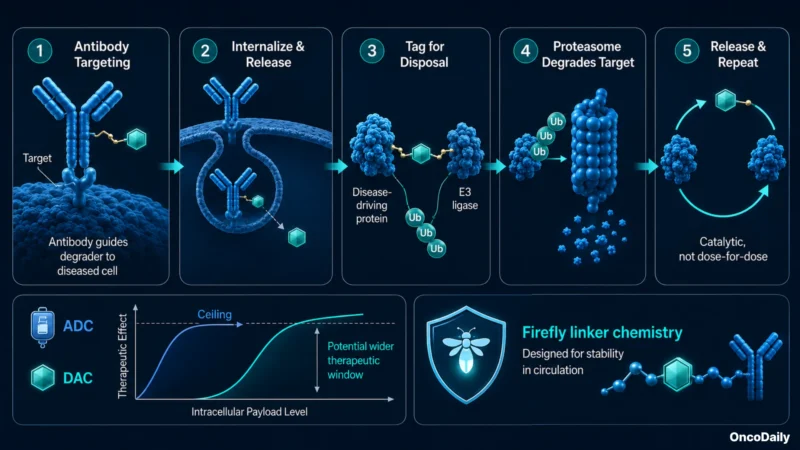
What no one can yet say is how the approach performs in people. Firefly’s candidates remain preclinical, and the conjugate field is full of elegant designs that met their limits only in the clinic. That’s not a knock on Firefly specifically, it’s the honest state of any platform at this stage, and it’s precisely why J&J’s interest reads as a bet on a promising direction rather than a verdict on a proven one.
The KRAS context, fairly weighed
Firefly directed its platform at tumors driven by KRAS, one of the most common and historically intractable oncogenes in cancer, implicated across pancreatic, colorectal, and lung tumors. The choice is well-timed: KRAS was a defining storyline of ASCO 2026, where pan-RAS inhibitor data, daraxonrasib’s RASolute 302 results in pancreatic cancer most prominently, turned a long-“undruggable” target into one of oncology’s most active battlegrounds.
That timing is a genuine strength of the rationale, and also a competitive reality worth naming. A KRAS-directed platform is attractive precisely because the target matters so much; it will also, if its candidates advance, enter a space filling quickly with small-molecule inhibitors and other modalities. A degrader-based conjugate could offer something those approaches don’t, but it will have to demonstrate that against a moving standard of care, not today’s.
What a large company’s early bet does and doesn’t mean
Deals like this are easy to over-read in either direction, as proof a modality “works,” or as a giant overpaying for science fiction. Both readings miss it. When a company this large commits this much this early, it is mainly disclosing where it believes the field is heading and positioning accordingly. That’s the same logic that powered the broader ADC spree, and it deserves the same measured interpretation: real conviction, not yet clinical validation.
There’s also an unglamorous strategic backdrop, true of much of the industry rather than unique to J&J: established franchises facing biosimilar competition and patent expirations, and a corresponding push to build the next generation of oncology assets. Firefly is the second conjugate-adjacent company J&J has acquired since early 2024, after Ambrx. Read generously, that’s a deliberate, sustained thesis about conjugate platforms. The clinical data, still years out, will determine how the thesis ages.
What’s known, and what’s still open
Known: the terms ($1 billion, all cash), the structure (an outright acquisition expected to close later this year, subject to regulatory clearance), the platform’s design intent, and its KRAS focus. Firefly was founded in 2022.
Still open: whether a degrader-antibody conjugate can convert a sound mechanistic rationale into a tolerable, durable therapy; how Firefly’s candidates would compare with the KRAS-directed drugs maturing alongside them; and whether deals like this mark a real generational step in conjugate design or an early, well-placed wager on one.
Read more biotech insights on OncoDaily Biotech.
Written by: Semiramida Nina Markosyan, Editor, OncoDaily Canada