Singapore-headquartered biotech says the designation supports a planned U.S. launch readiness in late 2026.
Gene Solutions has announced that the U.S. Food and Drug Administration has granted Breakthrough Device Designation to SPOT-MAS 10, a multi-omics blood test designed to detect cancer-associated signals across 10 common and aggressive cancers.
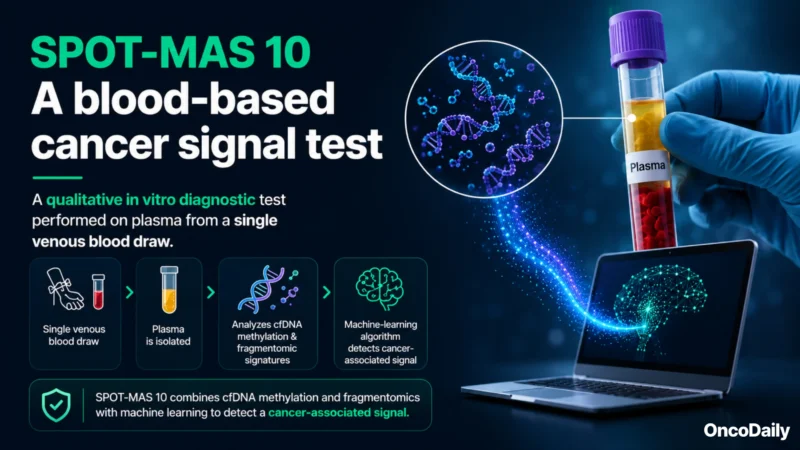
The FDA-designated indication describes SPOT-MAS 10 as a qualitative in vitro diagnostic test performed on plasma from a single venous blood draw. The assay analyzes circulating cell-free DNA (cfDNA) methylation and fragmentomic signatures using a machine-learning algorithm to detect a cancer-associated signal. It is intended for use as an adjunctive screening test in asymptomatic adults aged 40 years and older, to assist in the detection of cancers within the scope of the assay.
The 10 cancers covered fall into two groups:
- Five common cancers with established screening pathways: breast, lung, liver, colorectal and gastric.
- Five aggressive, less common cancers that currently lack standard screening methods: ovarian, pancreatic, esophageal, endometrial and head & neck.
According to the company, SPOT-MAS 10 is designed to complement, not replace, existing guideline-recommended screening programs, with positive results to be followed by physician-directed diagnostic evaluation based on the predicted tissue of origin.
What Breakthrough Device Designation does, and does not, mean
The FDA’s Breakthrough Devices Program is intended to speed development and review of devices that may provide more effective diagnosis or treatment of life-threatening or irreversibly debilitating conditions, including cancer. The designation gives developers a prioritized channel of engagement with the FDA but, importantly, is not FDA approval, clearance or marketing authorization. The device remains subject to applicable regulatory review requirements, and the designation does not guarantee future authorization.
SPOT-MAS 10 joins a small but growing group of multi-cancer early detection (MCED) technologies that have received Breakthrough Device Designation as the field moves toward broader regulatory engagement.
Validation data and real-world use
SPOT-MAS has been evaluated in the K-DETEK prospective cohort study, which enrolled more than 9,000 asymptomatic participants. Results were published in BMC Medicine in 2025 and, according to the company, demonstrated high specificity and the ability to identify cancer-associated signals across multiple cancer types. In March 2025, SPOT-MAS became the first MCED blood test in Asia to complete a large prospective cohort validation.
Beyond the validation cohort, Gene Solutions reports that SPOT-MAS has been used in more than 100,000 individuals in real-world practice. Real-world performance data were presented at ESMO Asia 2025, and additional data are scheduled for presentation at ASCO Breakthrough 2026 in Singapore.
Company perspective and U.S. development plans
“Receiving FDA Breakthrough Device Designation for SPOT-MAS 10 is a defining milestone for Gene Solutions that validates the potential of our multi-omics approach to transform cancer care,” said Dr. Nguyen Hoai Nghia, CEO and Co-founder of Gene Solutions, in a statement.
Dr. Le Son Tran, Principal Investigator of SPOT-MAS, framed the underlying technical rationale: ”
Early cancer detection requires more than identifying a single molecular signal. By integrating multiple layers of cell-free DNA information with machine learning, SPOT-MAS is designed to extract deeper biological signals from blood while maintaining the high specificity required for responsible screening.

Le Son Tran/Gene Solutions
SPOT-MAS is currently available through select hospitals and clinics across Asia, with additional availability in Brazil, Turkey and the Middle East. The company is targeting U.S. launch readiness in late 2026, supported by ongoing U.S. laboratory and validation activities.
Read more biotech insights on OncoDaily Biotech.
Written by: Semiramida Nina Markosyan, Editor, OncoDaily Canada