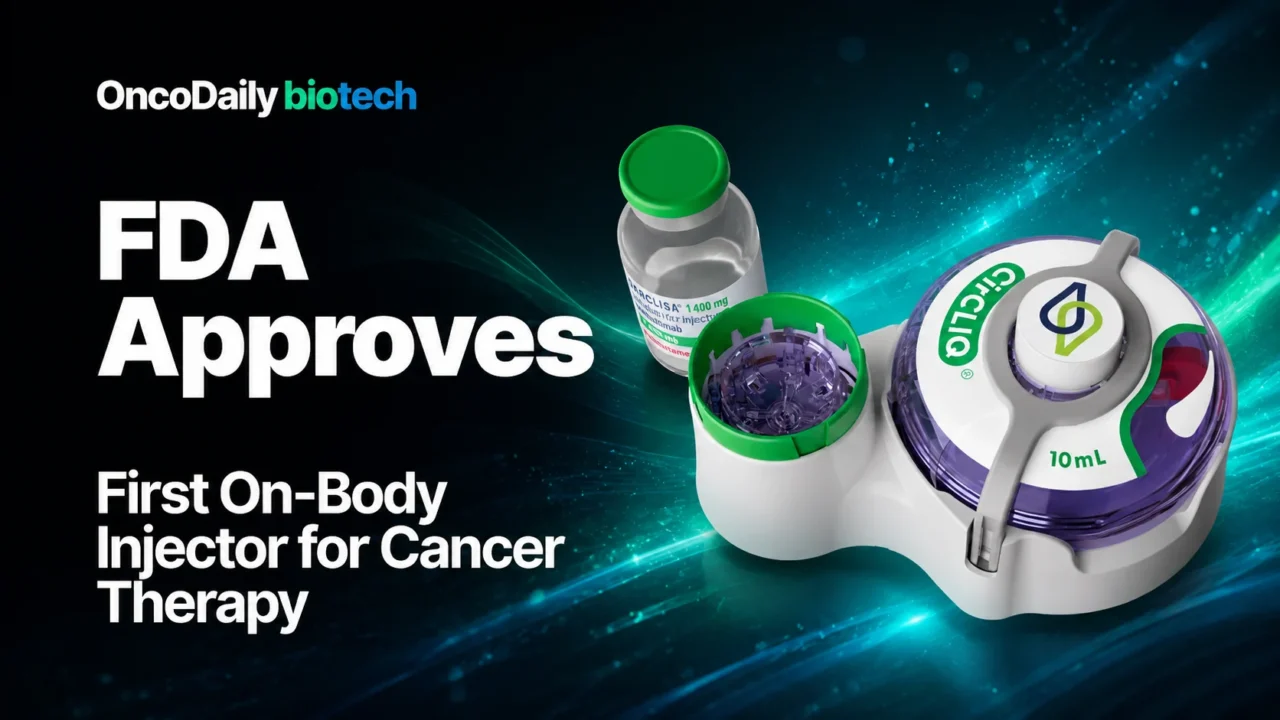
On July 10, 2026, the U.S. Food and Drug Administration approved Sarclisa Escena, a subcutaneous form of the multiple myeloma drug isatuximab that is delivered by a wearable, push-button injector rather than by intravenous infusion. According to the agency, it is the first anticancer treatment cleared for delivery by an on-body injector. The active molecule is unchanged from the intravenous version; the approval concerns the route and method of administration.
Multiple myeloma is a cancer of the plasma cells, a type of white blood cell that turns malignant and accumulates in the bone marrow. It is currently considered incurable, and patients are typically treated with a succession of drug regimens over a period of years, much of it historically administered by intravenous infusion.
The Drug and Its Target
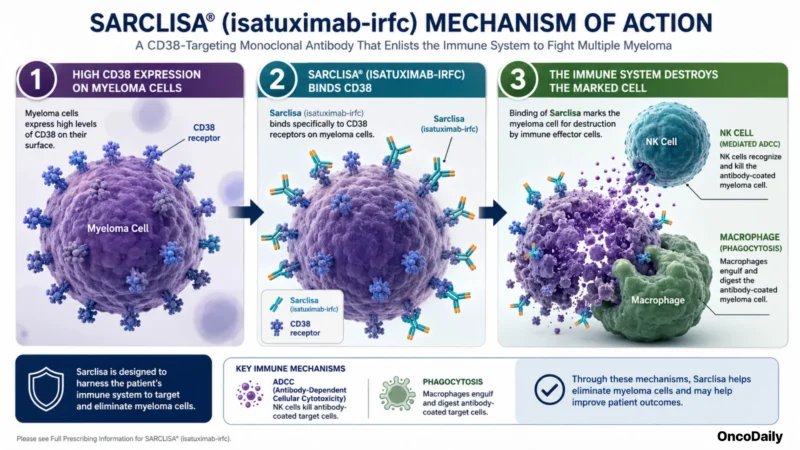
Sarclisa (isatuximab-irfc) is a monoclonal antibody that binds to CD38, a protein expressed at high levels on myeloma cells; binding marks the cells for destruction by the immune system. The drug was first approved as an intravenous infusion in 2020 and is used in combination with other myeloma drugs in both newly diagnosed and relapsed disease. Its maker, Sanofi, says more than 70,000 patients worldwide have received Sarclisa-based regimens.
The New Delivery Method
The intravenous formulation is dosed by body weight and, for a first dose, is infused over roughly three hours, with premedication and monitoring; infusion-related reactions have been common.
The newly approved version delivers a fixed 1,400-milligram dose from the CirCLIQ on-body injector, a device made by Enable Injections of Cincinnati. Attached to the abdomen, it administers the drug through a retractable 30-gauge needle, thinner and shorter than needles typically used for large-volume injections, at the press of a button. In the pivotal trial, the median administration time was about 13 minutes.
Trial Results
The approval was supported by a trial called IRAKLIA, which enrolled more than 500 patients with relapsed or refractory multiple myeloma. The subcutaneous version produced an objective response rate of 71.1 percent, compared with 70.5 percent for the intravenous form, meeting the trial’s threshold for non-inferiority. Systemic administration reactions occurred in 1.5 percent of patients receiving the injector versus 25 percent receiving the intravenous infusion, and injection-site reactions were reported as rare and mostly mild.
Reported Effects for Patients and Providers
Sanofi and the trial investigators cite a shorter administration time and a fixed dose that does not require weight-based calculation. Sikander Ailawadhi of Mayo Clinic Florida, the trial’s principal investigator, said in Sanofi’s announcement that myeloma “often requires frequent IV infusions or manual subcutaneous injections,” and that treatment “can be a cumbersome experience for patients, while also placing a strain on providers by requiring physical effort to push high-resistance syringes for several minutes.”
Because the injector runs without a clinician holding a syringe, staff can attend to other tasks during administration. Donna Catamero, a myeloma nurse practitioner at Mount Sinai, said the system “has the potential to meaningfully reduce administrative burden.” Whether shorter administration times reduce congestion or increase capacity at infusion centers has not been demonstrated at scale in routine practice.
Cost and Limitations
Sanofi has set a U.S. list price of $8,796 per vial for the injector version; list prices do not necessarily reflect the amounts paid by insurers. Whether the method lowers total treatment-related costs, accounting for staff time and device expense, has not been established.
The drug carries the same warnings as the intravenous form, including reduced white-blood-cell counts, infection risk, second cancers, and potential harm to a fetus, and it remains indicated only as part of a combination regimen. Staff require training on the device. At-home administration has been studied and is permitted in some countries, but U.S. use remains in the clinical setting. Real-world data on uptake and long-term outcomes are not yet available.
Industry Context
The approval follows a broader trend of reformulating infused biologics as subcutaneous injections; rituximab, trastuzumab, and, in myeloma, Johnson & Johnson’s daratumumab (Darzalex Faspro) have all been developed in subcutaneous forms. Daratumumab targets the same CD38 protein, leads the class by prescription volume, and already had a subcutaneous option. With the injector, Sarclisa becomes the only anti-CD38 antibody in myeloma available by both wearable injector and manual injection.
The IRAKLIA trial was designed to demonstrate efficacy comparable to the intravenous form rather than improved survival. Further adoption will depend on cost, patient and provider preference, and evidence beyond the single trial.
Read more biotech insights on OncoDaily Biotech.
Written by: Semiramida Nina Markosyan, Editor, OncoDaily Canada