In one midsummer stretch, the field chasing oncology’s most notorious oncogene earned a plenary standing ovation and a confirmatory-trial faceplant. Both tell you where the class is headed.
Two headlines, one week. At the ESMO Gastrointestinal Cancers Congress in Munich (July 1–4), Bristol Myers Squibb‘s Krazati (adagrasib) plus cetuximab, a chemotherapy-free regimen carrying a 2024 FDA accelerated approval in KRAS G12C–mutated colorectal cancer, flunked its confirmatory phase 3 trial against ordinary chemotherapy. The field, meanwhile, was still basking in the afterglow of Revolution Medicines’ daraxonrasib, which weeks earlier had drawn a plenary standing ovation at ASCO for nearly doubling survival in pancreatic cancer. Same oncogene, same season, opposite verdicts. Welcome to KRAS’s awkward adolescence.
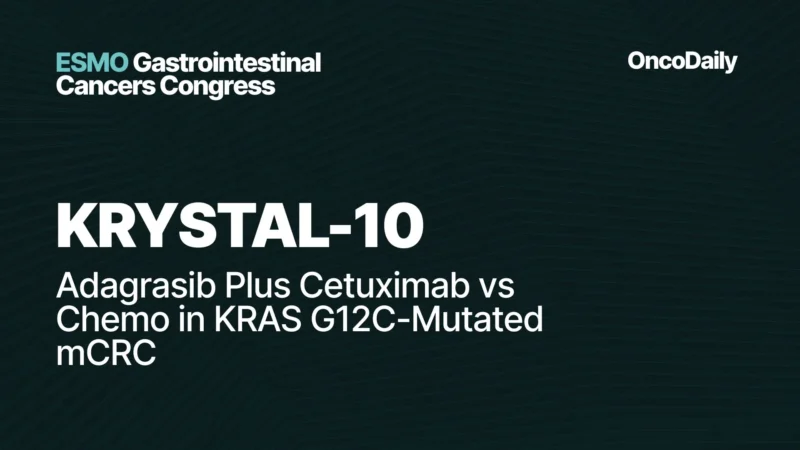
You can read more on KRYSTAL-10 at ESMO GI 2026 on OncoDaily.
Why “undruggable” stuck for four decades
KRAS is the most frequently mutated oncogene in human cancer, the molecular accelerator jammed on in roughly 90% of pancreatic, 40% of colorectal, and a third of lung adenocarcinomas. Yet from its discovery in the early 1980s until 2021, it beat every drug hunter who tried. The protein is a smooth switch with no obvious pocket for a small molecule to grip, and it clings to its activating partner GTP with such ferocious affinity that competing for the site is hopeless.
The breakthrough came sideways: the specific G12C mutation swaps in a cysteine residue that offers a chemical toehold, letting covalent drugs (sotorasib, then adagrasib) lock the protein in its inactive “OFF” state. Suddenly a slice of KRAS was druggable, but only the ~13% of cases (mostly lung) carrying G12C, and even there responses often proved shallow and brief.
The pan-RAS turn, and pancreatic cancer.
The next generation flips the strategy. Rather than trapping the OFF state, Revolution’s “RAS(ON)” inhibitors form a complex with the active, GTP-bound protein, hitting KRAS where it actually signals. Daraxonrasib (RMC-6236) is multi-selective, going after several mutant forms and even wild-type RAS at once.
In the phase 3 RASolute 302 trial, previously treated metastatic pancreatic patients on once-daily oral daraxonrasib lived a median 13.2 months versus 6.7 on investigator’s-choice chemotherapy, a hazard ratio of 0.40, a 60% cut in the risk of death (p<0.0001), with benefit across both RAS-mutant and RAS-wild-type disease. In a cancer where second-line therapy barely moves the needle, that is a number oncologists almost never see. The foundational data landed in the New England Journal of Medicine; the FDA opened expanded access in May and awarded the program a National Priority Voucher, with a filing pending.
Zoldonrasib (RMC-9805) extends the thesis to a mutation no approved drug touches: G12D, the single most common KRAS variant and a workhorse of pancreatic and GI cancer. As monotherapy in pretreated G12D lung cancer it posted response rates in the 50–60% range and won Breakthrough Therapy status in January. More striking, paired with daraxonrasib in a RAS(ON) doublet, it produced a 50% response rate in second-line G12D pancreatic cancer at ESMO GI, with median progression-free survival of 9.6 months. Tumors long filed under “untargetable” now have a mechanistic handle.
The counterpoint: a confirmatory trial calls the bluff.
Which is what makes the colorectal result sting. Adagrasib plus cetuximab won accelerated approval in June 2024 on the strength of KRYSTAL-1, a single-arm study in 94 patients showing a 34% response rate. That is precisely what accelerated approval is built to do: clear a drug for a serious disease on a surrogate signal (here, tumor shrinkage) “reasonably likely” to predict benefit, on the condition that the sponsor run a randomized confirmatory trial to prove it. KRYSTAL-10 was that trial.
In 461 patients randomized against standard chemotherapy, the combination missed both co-primary endpoints: median PFS 7.5 versus 8.1 months (HR 0.89), and overall survival 21.6 versus 21.7 months (HR 0.83, p=0.09). Response rate still favored the targeted arm handily, 47% versus 16%, but response rate was never the question a confirmatory trial exists to answer.
There is a wrinkle worth flagging: the chemotherapy arm survived a median 21.7 months, far above the 12–14 months historically expected for this poor-prognosis subgroup. Investigators openly puzzled over it, roughly 30% crossover and patient selection are the usual suspects, and it muddies any clean read of efficacy. But regulators judge trials as run, not as hoped. A failed confirmatory study puts the accelerated approval squarely in play: under the post-FDORA framework the FDA can move to withdraw the indication, or the parties can negotiate a label change. Nothing formal has been announced, and adagrasib’s separate lung approval is untouched, but the colorectal indication is now living on borrowed time.
What the split verdict means.
Read together, the two results are less contradictory than instructive: they reward mechanism and punish shortcuts. Daraxonrasib works because it attacks the active protein broadly and was tested, early, in a randomized trial powered on survival. The colorectal combination leaned on a G12C-only, OFF-state drug, a partner antibody, and a surrogate endpoint, and the confirmation didn’t hold.
The lesson the field is internalizing is that single-agent RAS inhibition, even the good kind, invites resistance, so the future is combinations: RAS(ON) doublets, RAS-plus-chemo, and RAS-plus-epigenetic pairings already posting eye-popping early pancreatic numbers. And the gating factor for the whole class won’t be response rates in press releases, it will be confirmatory trials with hard endpoints. This summer served up one of each. The next two years will be full of them, and they, not the mechanism, will decide how much of KRAS actually becomes druggable.
Read more biotech insights on OncoDaily Biotech.
Written by: Semiramida Nina Markosyan, Editor, OncoDaily Canada