At the ESMO GI Cancers Congress 2026, Josep Tabernero presented results from KRYSTAL-10, a global phase 3 trial evaluating adagrasib plus cetuximab as second-line treatment for patients with KRAS G12C-mutated metastatic colorectal cancer.
The presentation, titled “Second-line adagrasib plus cetuximab vs chemotherapy in patients with KRASG12C-mutated metastatic colorectal cancer: Results from the KRYSTAL-10 trial,” was presented as late-breaking abstract LBA1.
Background
KRAS G12C mutations define a molecular subgroup of metastatic colorectal cancer with an important need for targeted treatment strategies. In the earlier phase 1/2 KRYSTAL-1 trial, adagrasib, a KRAS G12C inhibitor, combined with cetuximab showed promising activity and manageable safety in heavily pretreated patients.
KRYSTAL-10 was designed to test whether this chemo-free targeted combination could improve outcomes compared with standard second-line chemotherapy-based treatment.

Read more about Adagrasib (Krazati) Updates on OncoDaily.
KRYSTAL-10 Trial Design
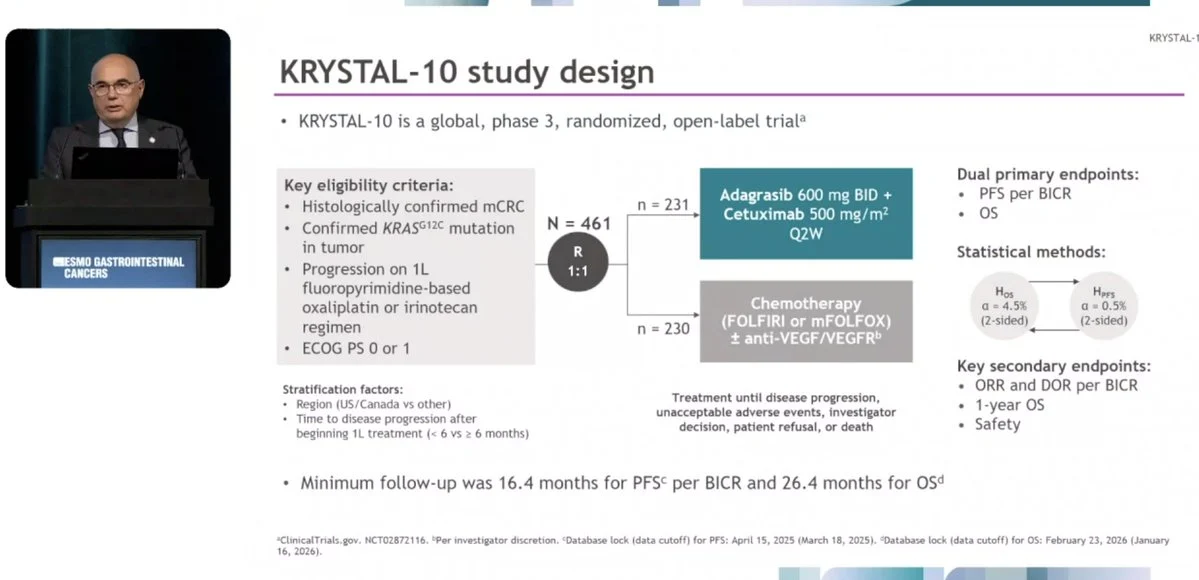
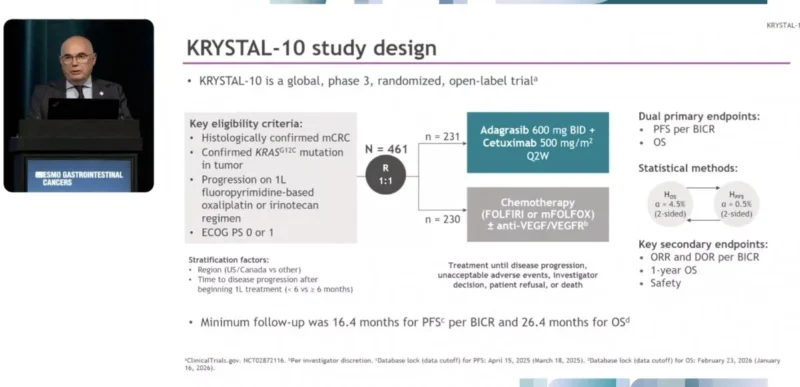
KRYSTAL-10 was a global, open-label, randomized phase 3 trial in patients with KRAS G12C-mutated metastatic colorectal cancer who had progressed after first-line fluoropyrimidine-based doublet chemotherapy with oxaliplatin or irinotecan.
Patients were randomized 1:1 to receive adagrasib 600 mg twice daily plus cetuximab 500 mg/m² every 2 weeks, or chemotherapy with FOLFIRI or mFOLFOX6, with or without VEGF/VEGFR inhibitors.
The dual primary endpoints were progression-free survival by blinded independent central review and overall survival. Key secondary endpoints included objective response rate, DOR per BICR, 1-year OS and safety.
The trial is registered as NCT04793958.
Results
A total of 461 patients were enrolled, including 231 patients in the adagrasib plus cetuximab arm and 230 patients in the chemotherapy arm.
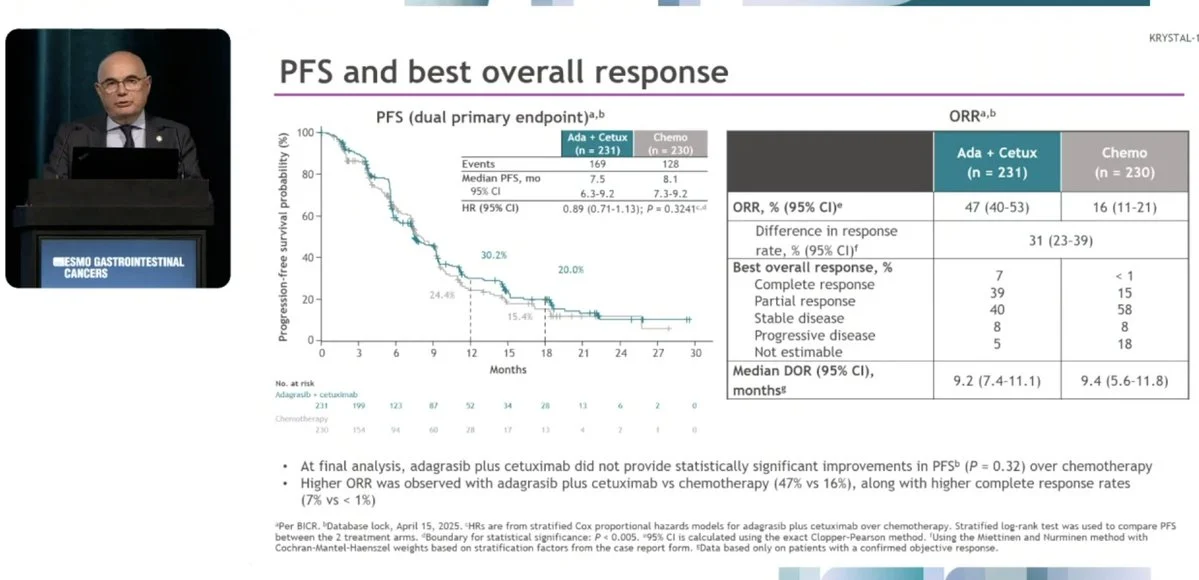
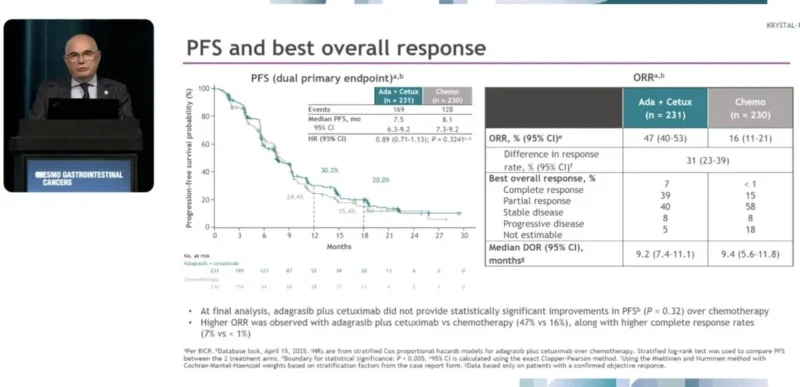
Median progression-free survival by blinded independent central review was 7.5 months with adagrasib plus cetuximab and 8.1 months with chemotherapy (HR 0.89; 95% CI: 0.71–1.13; p=0.32).
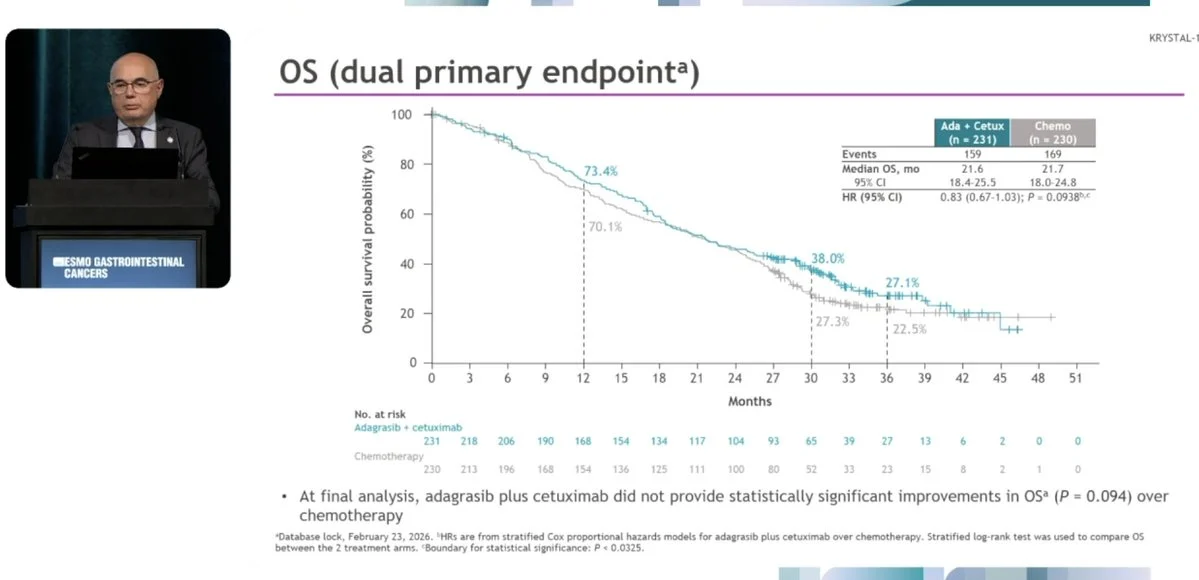
At a minimum follow-up of 26.4 months for overall survival, median OS was 21.6 months with adagrasib plus cetuximab and 21.7 months with chemotherapy (HR 0.83; 95% CI: 0.67–1.03; p=0.09).
The study did not achieve statistical significance for either of its dual primary endpoints.
However, objective response rate was higher with adagrasib plus cetuximab: 47% compared with 16% in the chemotherapy arm. Complete responses were also more frequent with adagrasib plus cetuximab, occurring in 7% of patients versus less than 1% with chemotherapy.
Safety was manageable, and no new safety signals were reported. Among treated patients, any-grade treatment-related treatment-emergent adverse events occurred in 98% of patients receiving adagrasib plus cetuximab and 96% receiving chemotherapy. Grade 3–5 treatment-related events occurred in 46% and 55%, respectively.
Serious treatment-related events occurred in 9% of patients in the adagrasib plus cetuximab arm and 12% in the chemotherapy arm. Treatment-related adverse events leading to discontinuation of the regimen occurred in 3% and 2%, respectively.
Conclusion
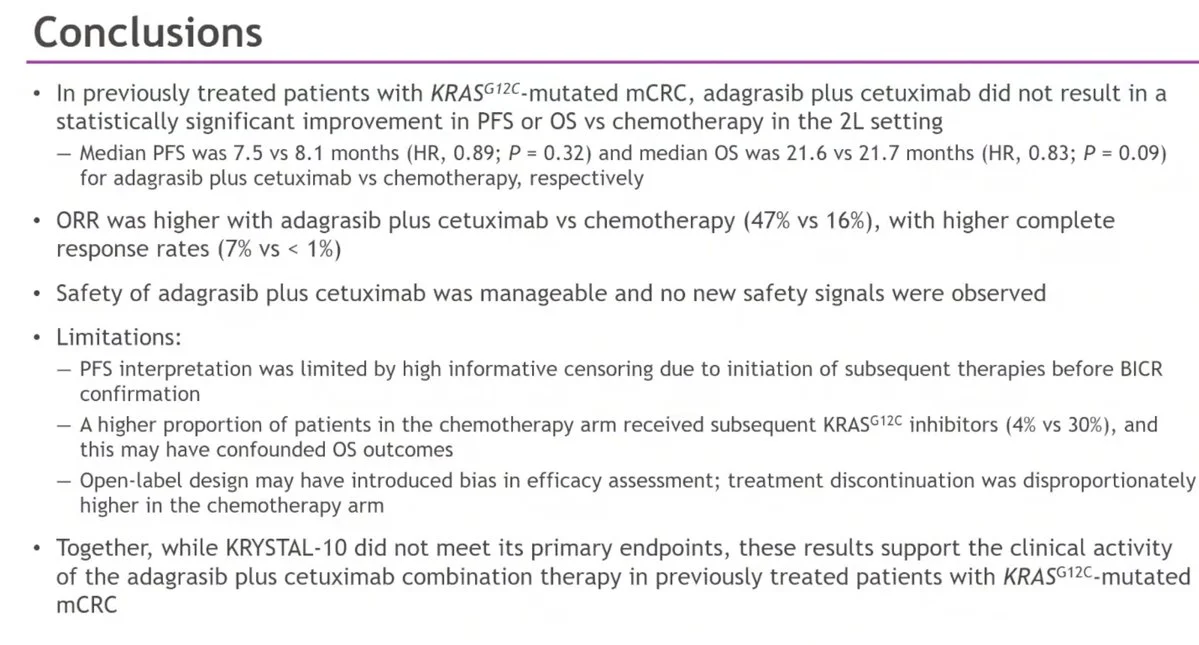
KRYSTAL-10 did not meet its dual primary endpoints of progression-free survival and overall survival in patients with previously treated KRAS G12C-mutated metastatic colorectal cancer.
Median PFS was 7.5 months with adagrasib plus cetuximab versus 8.1 months with chemotherapy, and median OS was 21.6 versus 21.7 months, respectively.
However, adagrasib plus cetuximab showed antitumor activity, with a higher objective response rate than chemotherapy, 47% versus 16%, and a higher complete response rate, 7% versus less than 1%. Safety was manageable, and no new safety signals were observed.
The interpretation of PFS was limited by informative censoring related to subsequent therapies before BICR confirmation. OS interpretation may also have been affected by a higher proportion of patients in the chemotherapy arm receiving subsequent KRAS G12C inhibitors. The open-label design was another limitation noted in the presentation.
Together, while KRYSTAL-10 did not meet its primary endpoints, the results support the clinical activity of adagrasib plus cetuximab as a chemo-free targeted regimen in previously treated KRAS G12C-mutated metastatic colorectal cancer.
Expert Highlights
Paolo Ciracì shared the KRYSTAL-10 results on X, highlighting that adagrasib plus cetuximab did not meet the dual primary endpoints, while response rates were numerically higher with the targeted combination.
“Results from the phase 3 KRYSTAL-10 trial (2L KRAS G12C-mut mCRC):
adagrasib + cetuximab did not meet its dual primary endpoints of PFS and OS vs chemo ± anti-VEGF/R
ORR was numerically higher (47% vs 16%)”
Arndt Vogel also commented on the KRYSTAL-10 data on X, noting the higher response rate but lack of progression-free survival and overall survival benefit compared with chemotherapy.
“Second-line adagrasib + cetuximab vs CTx in KRASG12C-mutated mCRC: Results from the KRYSTAL-10 trial
ORR with 40% higher, but no PFS & OS benefit for combination over CTx
30% crossover
a bit disappointing after the PDAC data”
More details are available in the official ESMO Gastrointestinal Cancers Congress 2026 programme.
Read more about CAPRI-2 GOIM at ESMO GI 2026 on OncoDaily.