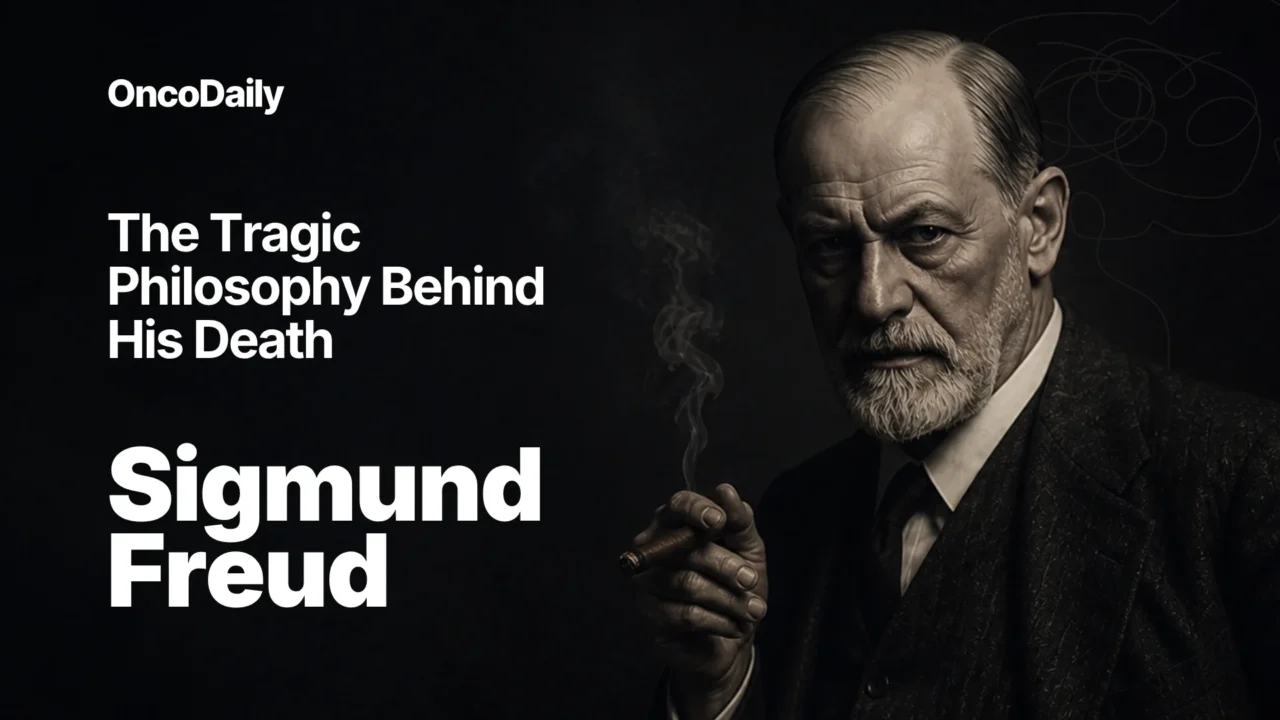
“The life drive and the death drive Eros and Thanatos struggle within us.”
(Paraphrased from Beyond the Pleasure Principle)
On September 23, 1939, Sigmund Freud exiled in London, ravaged by 16 years of oral cancer whispered to his physician, Max Schur, “It is enough,” and received a final, lethal dose of morphine. This wasn’t sudden tragedy but a deliberate end to unbearable pain from a jaw malignancy that demanded over 30 surgeries, a prosthetic palate, and daily agony. Eerily, Freud’s death seemed to embody the very theories he spent decades developing: the human psyche torn between Eros, the life drive, and Thanatos, the death drive; a fierce commitment to facing unvarnished reality over consoling illusions; and an atheist’s insistence on personal autonomy against religious promises of afterlife comfort.

Photo: Depositphotos
Did Freud’s final act requesting euthanasia to escape suffering represent the ultimate expression of his philosophy, or merely a practical response to terminal illness? This article explores how his prolonged dying, rational choice of death, and rejection of metaphysical solace mirrored Beyond the Pleasure Principle’s tension between survival instinct and self-annihilation, his critiques of religion as “illusion,” and his ethic of unflinching truth even at life’s close.
The Long Dying: Freud’s Oral Cancer and Final Months
Sigmund Freud’s confrontation with mortality began not in 1939 but in 1923, when a persistent leukoplakia lesion likely triggered by his lifelong habit of smoking over 20 cigars daily appeared on the roof of his mouth. Diagnosed as squamous cell carcinoma of the hard palate, it marked the start of a grueling 16-year ordeal: over 30 excruciating surgeries under local anesthesia (to preserve his speech), repeated removal of necrotic tissue, fitting of an ever-shifting prosthetic jaw, chronic osteomyelitis infections, and unrelenting pain radiating to his cheek and eye socket.
By 1938, exiled from Nazi-occupied Vienna to London, Freud’s condition had worsened dramatically radiation treatments failed, the tumor infiltrated surrounding tissues, and morphine doses escalated to manage constant agony that impaired eating, speaking, and sleep. Early in their doctor-patient relationship, Freud had forged a pact with his physician, Max Schur: “Schur, you promise you will not let me suffer unnecessarily.” This agreement, rooted in mutual trust, guided Schur’s care through Freud’s final days in September 1939.
On September 21, Schur administered three successive 20mg morphine injections far exceeding standard palliative doses—to induce a coma, following Freud’s explicit request: “It is enough.” Freud slipped away peacefully the next evening. While widely viewed as physician-assisted suicide (euthanasia), some medical historians debate this: the cumulative doses might represent heavy palliative sedation hastening an inevitable natural death from cachexia and sepsis, not direct intent to kill. Regardless, Freud’s end tested the boundaries of suffering’s tolerability, echoing his own question in Civilization and Its Discontents: how much pain can the psyche endure before collapse?
Freud’s Philosophy of Death: Eros, Thanatos, and the End
In his 1920 work Beyond the Pleasure Principle, Freud introduced two fundamental psychic forces locked in eternal opposition: Eros, the life drive, which propels attachment, survival, sexuality, and self-preservation through binding energies that create unity and complexity; and Thanatos, the death drive, an innate compulsion toward tension reduction, fragmentation, and ultimate return to the inorganic stillness of pre-birth a biological urge to dissolve all bonds and restore equilibrium through aggression, self-destruction, or outward violence.
Freud observed this duality in human behavior beyond mere pleasure-seeking: patients in analysis unconsciously repeat traumatic experiences (the “repetition compulsion”), replaying unresolved pain not for catharsis but to master it or, paradoxically, reenact annihilation suggesting an underlying pull toward zero tension, even if it means self-undoing. War neuroses, children’s games (fort-da), and dreams all hinted at this deathly inertia, where the organism seeks inorganic peace over life’s exhausting excitations.
Aging and chronic illness like Freud’s cancer embodied this convergence: Eros sustains through adaptation and care, yet Thanatos whispers in unrelieved pain, fatigue, and decay, where avoidance of suffering (morphine, surgery) blurs into acceleration toward non-being. Freud recognized this in himself his pact with Schur to end “unnecessary” suffering acknowledged that extreme Eros (prolonging tortured life) might serve Thanatos more than vitality, transforming endurance into quietus.
The Ethics of Truth and Suffering
Freud’s relationship with his physician Max Schur was defined by a stark pact: “Schur, despite all my pride, promise you won’t let me suffer unnecessarily.” This wasn’t mere contingency planning but a deliberate ethic insisting Schur always tell him the unvarnished truth about his cancer’s progression, no matter how grim, while intervening only when pain transcended tolerable limits. Freud rejected euphemisms or false hopes, even as his jaw prosthesis shifted, infections raged, and morphine clouded his final clarity; Schur honored this by detailing each surgical outcome and decline with clinical precision.
This mirrored Freud’s lifelong philosophical crusade: unmasking illusions to confront psychic reality head-on. In The Future of an Illusion (1927), he branded religion a collective “fiction” shielding humanity from life’s cruelties death chief among them arguing that consoling narratives (afterlife, divine purpose) infantilize adults, preferring the painful maturity of facing meaninglessness without “protective dams.” Suffering, for Freud, was non-negotiable biology, not divine test; truth, however brutal, preserved autonomy over delusion.
Freud’s stance resonates in today’s bioethics: his demand for radical physician honesty prefigures “truth-telling” mandates in modern palliative care, challenging paternalistic withholding. His calibrated threshold “unnecessary” suffering fuels assisted dying debates, framing euthanasia not as moral defeat but rational self-mastery, akin to Oregon’s Death with Dignity Act or Dignitas protocols where patients invoke autonomy against prolonged agony. Yet it provokes tension: does unsparing truth empower, or hasten despair? Freud embodied the gamble living (and dying) as if reality’s sting forged the strongest psyche.
Did Freud Live (and Die) His Own Theory?
Freud’s morphine request invites scrutiny: was it Thanatos triumphant the death drive’s insidious pull toward tensionless inertia, manifesting consciously as a “rational” escape from pain? Or primarily Eros asserting dignity, a life drive preserving psychic integrity by rejecting prolonged degradation, much like his therapeutic aim to master trauma rather than repeat it endlessly? The ambiguity fits his dual-drive model: morphine dissolved the exhausting excitations of cancer (Thanatos’ reductionism), yet the premeditated pact with Schur affirmed self-determination, binding doctor-patient in a life-sustaining alliance against unchecked suffering (Eros’ cohesion).
The deeper paradox lies here: Freud, who posited Thanatos as unconscious compulsion repetition compulsion replaying destruction beyond ego control—consciously negotiated his demise. He analyzed his own endgame, invoking prior agreement and Balzac’s fatalistic novella La Peau de chagrin on his deathbed, turning potential surrender into deliberate agency. This self-awareness suggests Eros modulating Thanatos, transforming blind urge into chosen cessation—psychoanalysis applied to the self.
Critics caution against over-psychologizing. Historian Peter Gay argues Freud’s choice was pragmatic medicine: cumulative morphine from September 21-22 simply hastened a “natural” coma from cachexia/sepsis, not theatrical enactment of theory. Biographer Ernst Jones concurs focus on excruciating pain and 1930s palliative limits, not symbolic performance; Freud sought relief, not philosophical flourish. Thus, his death tests his ideas without proving them, leaving us to wonder: conscious control or Thanatos’ sly victory?
Legacy: Freud’s Death in Today’s Bioethics Debates
Freud’s morphine-assisted end reverberates in contemporary bioethics, frequently cited as a foundational case for euthanasia and patient autonomy. In debates over laws like the Netherlands’ Termination of Life on Request Act or U.S. Death with Dignity statutes, ethicists invoke his pact with Schur as exemplary “rational suicide” a competent patient’s right to define “unnecessary suffering” and enlist physicians without coercion. Palliative care discussions contrast his era’s crude interventions (local anesthesia surgeries, escalating morphine) with modern opioids and hospice, yet uphold his insistence on truth-telling as a benchmark against paternalistic withholding, influencing guidelines like the AMA’s emphasis on honest prognoses.
Beyond medicine, Freud’s death drive and illusion critiques endure in psychoanalytic and existential thought. Thanatos informs trauma therapy’s repetition compulsion models, while his atheism rejecting religion’s “consoling fictions” resonates in Sartre and Camus, who champion absurd authenticity over metaphysical denial. His end prefigures secular dignity-in-dying movements, framing mortality as biological inevitability demanding mastery, not transcendence.
Freud teaches that facing death without denial stripped of afterlife myths forces confrontation with raw autonomy. His choice whispers a stoic truth: true maturity lies not in endless endurance, but knowing when suffering serves no further growth, choosing cessation with eyes wide open.
Modern Oral Cancer: From Freud’s Era to 2026
While Freud endured crude 1920s-1930s treatments local anesthesia surgeries and no effective chemotherapy today’s oral cancer landscape reflects vast progress amid persistent challenges. Globally, incidence rose ~1-fold from 1990-2017 (ASR 4.84/100,000), with ~378,000 new cases annually; by 2026 projections, U.S. sees ~60,480 cases and 13,150 deaths, while India anticipates 131,414 male cases rising to 163,224 by 2036.
Tobacco (20+ cigars daily) drives 75% of cases, plus alcohol, HPV (oropharyngeal surge), and betel nut in Asia (Pakistan’s ASR peaks at 27/100,000). Survival leaps with early detection—Stage 1: 70-90% 5-year rate (surgery/radiation curative); Stage 2: 60-75%; late-stage plummets to 20-50%.
His 16-year battle (no targeted therapies) contrasts modern immunotherapies (pembrolizumab for PD-L1+), ADCs, and HPV vaccines slashing oropharyngeal rates 50% in vaccinated cohorts. Yet global ASRs vary wildly (Pakistan 27 vs. Iraq 1/100,000), underscoring inequities prevention via quit-smoking campaigns and screening could avert 40% cases, echoing Freud’s unheeded personal risks.
The Tragic Coherence of Freud’s End
Freud’s death was tragic in its raw physicality a slow erosion by cancer that stripped speech, appetite, and comfort, mirroring the inexorable decay he theorized as Thanatos’ quiet work. Yet it achieved philosophical coherence, a deliberate alignment of life and thought: facing mortality without religious illusion, negotiating pain through rational pact, embodying the tension between survival’s tenacity and annihilation’s pull his final morphine dose dissolving the very tensions his life’s work illuminated.
In whispering “It is enough,” Freud fulfilled his singular project: peering into the psyche’s darkest truths suffering, death, illusion without ever turning away.
You Can Also Read A Man From the Roman Empire Diagnosed With Metastatic Cancer 1,700 Years After His Death Masterpiece by OncoDaily
Written by Aharon Tsaturyan, MD, Editor at OncoDaily Intelligence Unit
FAQ
What was Freud's pact with Max Schur?
Early on, Freud told Schur: "Schur... promise you won't let me suffer unnecessarily," ensuring full truth about his prognosis (no euphemisms) and intervention at pain's intolerable threshold. In final days, reading Balzac's La Peau de chagrin, he invoked it: "Now it is nothing but torture... Talk it over with Anna." Schur convinced daughter Anna; injections induced coma. This embodied Freud's ethic: autonomy via honesty, not paternalism.
What are Eros and Thanatos in Freud's death theory?
From Beyond the Pleasure Principle (1920), Eros (life drive) binds energies for survival, sex, unity; Thanatos (death drive) seeks tension zero via aggression/self-destruction, returning to inorganic state. Explains repetition compulsion (replaying trauma), contrasting pleasure principle seen in war dreams, children's fort-da. Freud linked to biology: organism conserves/restores equilibrium.
Did Freud's morphine request prove Thanatos?
Ambiguous: Thanatos as unconscious tension-end (morphine dissolved pain/excitations); yet Eros preserved dignity via rational pact, avoiding degradation. Paradox: he consciously analyzed his end, modulating "blind" drive psychoanalysis on self.
Was Freud's death euthanasia or sedation?
Explicit request ("It is enough") suggests euthanasia; doses exceeded palliative norms. Critics (Gay, Jones): 1930s limits made it hasten natural decline (cachexia/sepsis), not intent to kill pragmatic relief.
How did Freud reject religion in facing death?
Called it "universal obsessional neurosis" (Future of an Illusion), shielding from death via "consoling fictions" like afterlife. Atheist to end, chose autonomy over divine purpose—maturity in meaninglessness.
What book did Freud read before dying?
Honoré de Balzac's La Peau de chagrin (shrinking skin as life metaphor); prompted frailty reflections, invoking Schur's pact.
Freud's death impact on euthanasia laws?
Archetype for "rational suicide": autonomy defining suffering, truth-telling. Influences Netherlands' Euthanasia Act, U.S. Death with Dignity vs. 1930s crude care.
Did Freud embody his philosophy dying?
Yes unmasked illusions, balanced drives rationally, faced reality sans denial; morphine dissolved tensions his work illuminated, fulfilling psyche-truth quest.