
SALUS POPULI SUPREMA LEX ESTO
“The health of the people shall be the highest law.”
Cancer is often seen as a distinctly modern condition, shaped by industrial pollutants, lifestyle changes, and increased lifespan. Yet archaeological research increasingly shows that malignant disease stretches far deeper into human history. A newly examined skeleton from Late Roman Milan, within the Roman Empire, provides one of the clearest examples of metastatic cancer in antiquity, demonstrating that aggressive tumors existed long before the evolution of today’s risk factors.

Photo: Depositphotos
A Glimpse Into a Roman-Era Burial in Milan
The remains belonged to a 40–65-year-old man buried in the “Necropolis of the Cattolica,” a major cemetery beneath what is now the Università Cattolica del Sacro Cuore. Dating to the 3rd–4th century CE, the burial ground contained nearly 600 graves from across the city’s population. The skeleton was heavily fragmented, but enough was preserved over 75% of the bones to allow for a detailed medical and archaeological assessment.
Metastatic cancer in antiquity: Case study from 3rd-4th century Milan, Italy, Lucie Biehler Gomez a 1, Carlotta Sala a b 1, Mirko Mattia a, Marco Sannazaro c, Cristina Cattaneo. Sep 2025 International Journal of Paleopathology
What the Bones Revealed About His Illness
Macroscopic inspection revealed striking abnormalities. Thick and spiculated new bone covered both scapulae, spread across the iliac surfaces of the pelvis, and appeared on several vertebrae. These lesions differed sharply from age-related degeneration or postmortem damage. Radiography and CT imaging confirmed dense, cloud-like areas of radiopacity with irregular margins,patterns strongly associated with osteoblastic processes rather than destructive lesions.
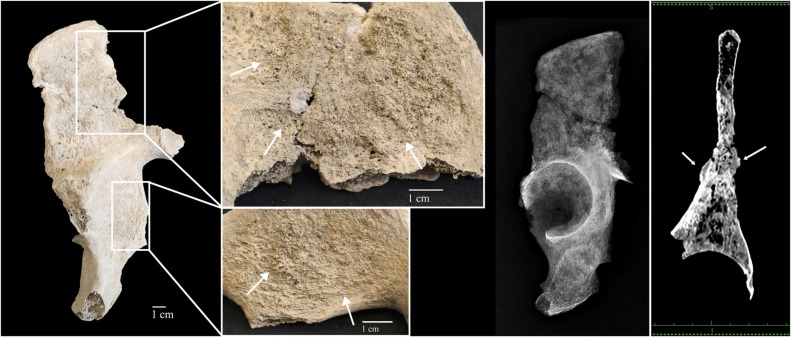
Photo:Biehler-Gomez et al. (2025), International Journal of Paleopathology.
How Researchers Narrowed Down the Diagnosis
The team evaluated multiple possible conditions. To distinguish between infectious, metabolic, benign, and malignant disorders, they compared each one with the lesion patterns observed.
Conditions ruled out included:
- Osteomyelitis: No sequestra, cloacae, or involucrum present
- Paget disease: Absence of bone enlargement, cortical thickening, or mixed lytic–sclerotic changes
- Ewing sarcoma and osteosarcoma: Inconsistent with the man’s age and the distribution of lesions
- Fibrous dysplasia: Lesions lacked ground-glass appearance and typical bone deformities
- Hematologic malignancies (leukemia, multiple myeloma): These cause osteolytic—not osteoblastic lesions
- None of these disorders matched the lesion pattern, distribution, or radiological character.
Why Metastatic Cancer Fits the Evidence Best
After excluding other conditions, metastatic carcinoma emerged as the most plausible diagnosis.
The diagnosis is supported by several key observations: the thick, spiculated osteoblastic reaction characteristic of metastatic spread from certain carcinomas; the involvement of the spine, pelvis, and scapulae, which are common metastatic sites in adults; and the individual’s sex and age, which align with cancers known to produce predominantly osteoblastic metastases, particularly prostate cancer. Radiological findings showing cloud-like densities with ill-defined margins further reinforce this interpretation, as they closely match clinical descriptions of metastatic bone disease. Although the primary tumor cannot be definitively identified, the overall lesion pattern is strikingly similar to that observed in modern metastatic prostate cancer.
Living With Advanced Cancer 1,700 Years Ago
Metastatic bone disease is painful and debilitating, often causing persistent and severe bone pain, reduced mobility, neurological symptoms when the spine is involved, and a gradual decline in overall function. Although no fractures or vertebral collapse were identified in this case, the widespread nature of the lesions indicates a long-standing illness. Without access to pain relief or supportive care, the final months of this man’s life would likely have been marked by increasing physical limitation and significant, ongoing discomfort.
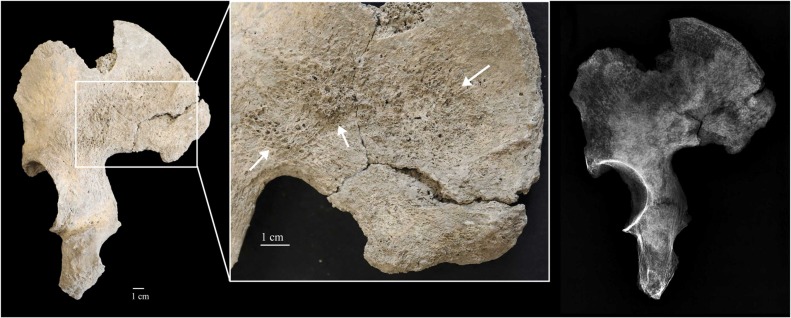
Photo: Biehler-Gomez et al. (2025), International Journal of Paleopathology.
Why This Case Matters for Understanding Ancient Health
Documented cases of ancient cancer remain rare, largely because many tumors do not affect bone, and even when they do, bone preservation can be incomplete. This case is particularly valuable because it shows a clear pattern of metastatic disease supported by modern imaging methods.
The significance of this case lies in its ability to expand the still-limited dataset of confirmed ancient cancer cases while demonstrating that aggressive malignancies existed long before the industrial era. It offers valuable insight into the disease burden carried by Roman-era populations and highlights the usefulness of CT imaging for identifying pathology in archaeological remains. Beyond its diagnostic contribution, the case strengthens the growing field of paleo-oncology by showing how modern medical tools can illuminate ancient disease. Notably, another neoplastic condition—multiple myeloma—has also been documented in the same necropolis, suggesting that cancers were indeed present, although likely underrecognized, in Late Antiquity.
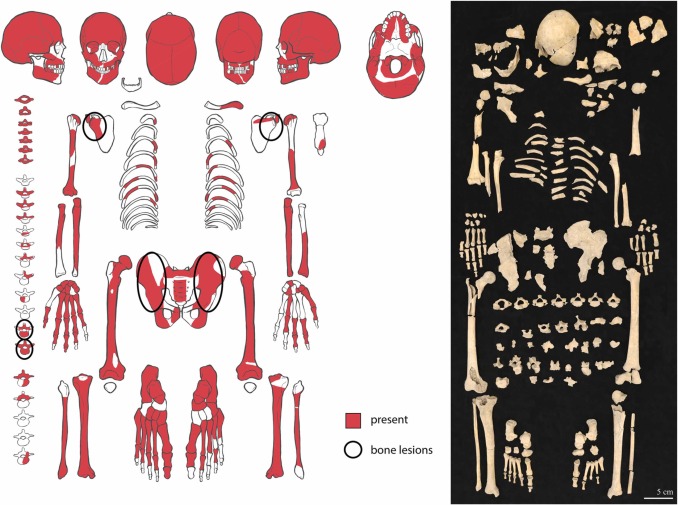
Photo: Biehler-Gomez et al. (2025), International Journal of Paleopathology.
Looking Back to Better Understand Cancer Today
This discovery challenges the assumption that cancer is primarily a modern disease. Instead, it highlights the long evolutionary history of malignancy and the roles of genetic susceptibility, environmental factors, and infectious agents across centuries. As more ancient remains are studied with modern medical techniques, our understanding of cancer’s origins and progression will continue to deepen.
By examining cases like this one, researchers are not only reconstructing the lived experiences of past populations but also enriching the broader scientific narrative of cancer across human history.
VITA BREVIS, ARS LONGA
“Life is short, art (or craft/knowledge) is long.”Hippocrates
Written by Aharon Tsaturyan, MD, Editor at OncoDaily Intelligence Unit
FAQ
Did cancer exist in the Roman Empire?
Yes. Growing archaeological and paleopathological evidence shows that cancer existed in the Roman Empire. The 1,700-year-old skeleton from Milan described in this article is one of the clearest examples of metastatic cancer in antiquity.
How do researchers diagnose cancer in ancient skeletons?
Experts use macroscopic examination, radiography, and CT imaging to identify characteristic bone lesions that match known patterns of metastatic disease.
What does metastatic cancer look like in ancient bones?
Metastatic cancer often leaves thick, irregular, or spiculated new bone deposits (osteoblastic lesions) or areas of bone destruction (osteolytic lesions). In this case, only osteoblastic lesions were present.
What type of cancer did the man likely have?
The pattern of osteoblastic metastases most closely resembles metastatic prostate cancer, although the exact primary tumor cannot be confirmed after 1,700 years.
How old is the earliest known case of cancer?
Cancer cases have been identified in remains dating thousands of years, including Egyptian mummies and prehistoric skeletons. This Roman case is one of the best-documented metastatic examples in Europe.
Were cancers rare in ancient times?
Probably less rare than the archaeological record suggests. Many cancers do not spread to bone, and soft tissues rarely preserve. This means only a small percentage of cases leave physical evidence.
What symptoms would someone with metastatic cancer have experienced in antiquity?
Severe bone pain, limited mobility, and neurological symptoms if the spine was involved. Without treatment or pain relief, the illness would have been extremely debilitating.
Why is CT imaging important for studying ancient diseases.
CT scans allow researchers to see inside bones without damaging them, revealing internal structures and lesion patterns that are invisible during visual examination.
How does this discovery change our understanding of cancer?
It shows that aggressive cancers existed long before industrial pollutants or modern lifestyle factors, emphasizing that cancer has deep evolutionary origins.
Why is paleo-oncology important today?
Studying ancient cancers helps researchers understand how malignancies evolved, how common they were historically, and how environmental and genetic factors contributed to disease across time.