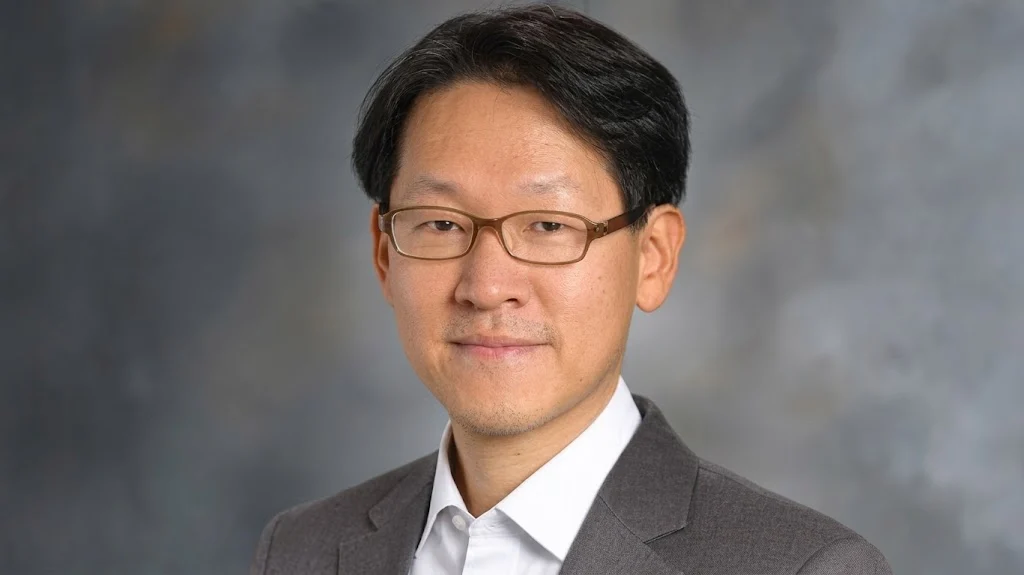
Young Kwang Chae, Medical Oncologist and Professor of Medicine at Northwestern University Feinberg School of Medicine and Member of the Robert H. Lurie Comprehensive Cancer Center, shared on X:
“One of 2026’s Most Paradigm-Shifting Cancer Papers: The Tumor Microenvironment Has a Neural Connection (Published in Nature).
What if part of cancer’s immune escape mechanism takes a detour through the brain?
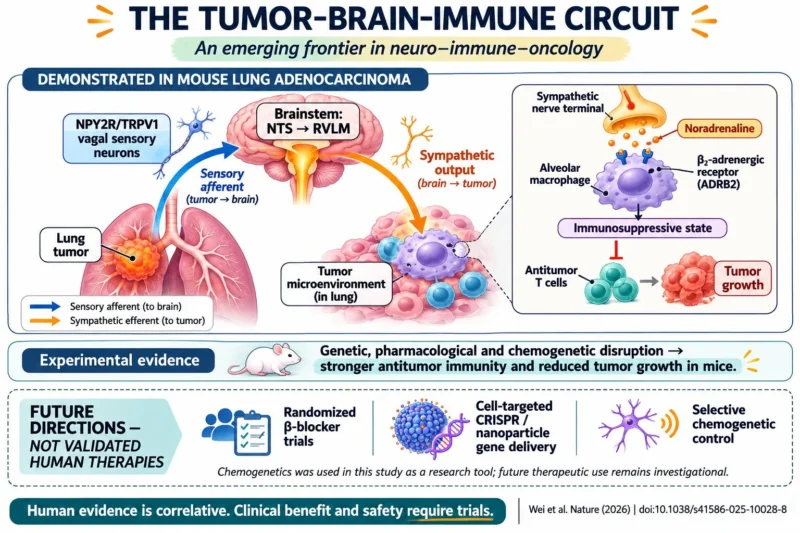
In mouse lung adenocarcinoma models, this Nature study maps a remarkable circuit: Tumor – ‘vagal sensory neurons’ – ‘brainstem’ – ‘sympathetic output’ – noradrenaline – β₂-adrenergic signaling in alveolar macrophages – immune suppression.
Interrupting this pathway reduced tumor growth. But what is the evidence in actual patients? Two complementary analyses support human relevance:
In 2,166 patients with NSCLC, higher expression of the neuronal-associated genes TRPV1, UCHL1 and TUBB3 was associated with worse overall survival.
In 518 TCGA lung adenocarcinomas, a higher combined vagal sensory–sympathetic gene-signature score was associated with poorer survival (P=0.00237) and a lower CD8-associated transcriptional signal. When sensory and sympathetic signatures were scored separately, patients high for both had worse survival than those low for both (130 patients per group; P=0.00607) and lower CD8-signature scores (P=0.036).
These are retrospective gene-expression associations – not recordings of neural activity or proof of the complete circuit in humans.
Bulk tumor RNA also cannot reliably tell us which cells produced each transcript. The causal experiments remain in mice. That distinction matters.
My interpretation: this paper helps pioneer neuro–immune–oncology, but the next breakthrough must be human validation—not simply a more exciting mouse experiment.
Propranolol trials?
Yes. Premature adoption? No. I look forward to randomized, biomarker-rich trials. This paper does not establish clinical benefit from propranolol (many trials in progress), and patients should not start it for cancer on this basis. Beyond β-blockade, I see a precision-engineering opportunity.
- Could CRISPR-based approaches identify – and eventually selectively modify – the critical cellular programs?
- Could nanoparticle-mediated gene delivery reach the right cells?
- Could chemogenetics provide controllable switches?
Chemogenetics already serves as a research tool here. These proposed human therapies remain investigational, greater technological complexity does not guarantee a better therapeutic window.
The ambition is not to silence the nervous system. It is to interrupt the tumor-supporting signal while preserving normal physiology. A major mechanistic advance and a compelling roadmap, not yet a clinical treatment.”
Title: Tumour–brain crosstalk restrains cancer immunity via a sensory–sympathetic axis
Authors: Haohan K. Wei, Chuyue D. Yu, Bo Hu, Xing Zeng, Hiroshi Ichise, Liang Li, Yu Wang, Ruiqi L. Wang, Ronald N. Germain, Rui B. Chang, Chengcheng Jin.
You can also read: Cancer and the Brain: How Tumors Hijack Neural Signals to Fuel Tumor Growth