
David Aggen, Assistant Attending at Memorial Sloan Kettering Cancer Center, shared on X:
“Adjuvant therapy initiation and completion rates differ amongst phase III trials.
If you start EV/P neoadjuvant then compelled to offer EV/P adjuvant.
If you start EV/D neoadjuvant then offer adjuvant durvalumab.”
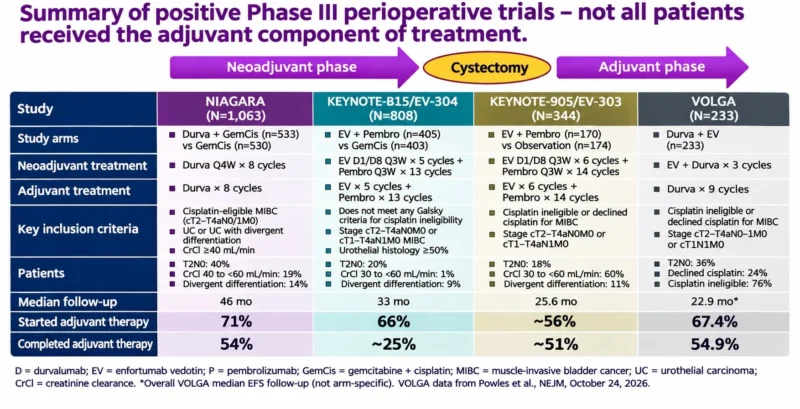
The VOLGA trial (NCT04960709) is a global, randomized Phase III clinical trial evaluating perioperative immunotherapy and antibody-drug conjugate therapy in patients with muscle-invasive bladder cancer (MIBC) who are ineligible for or decline cisplatin-based chemotherapy.
The study enrolled 695 adult patients with resectable MIBC (clinical stage T2 – T4aN0/1M0 or T1N1M0) planned for radical cystectomy (bladder removal). Patients were randomly assigned (1:1:1) to three arms:
- Doublet Arm (n = 233). Three 21-day cycles of neoadjuvant durvalumab plus enfortumab vedotin before surgery, followed by radical cystectomy and up to nine 28-day cycles of adjuvant durvalumab monotherapy.
- Triplet Arm (n = 233). The same regimen as the doublet arm, with the addition of two cycles of tremelimumab (Imjudo) before surgery and one cycle after surgery.
- Control Arm (n = 229). Radical cystectomy alone without neoadjuvant systemic therapy, followed by observation or locally approved adjuvant treatment.
The dual primary endpoints were event-free survival (EFS) for each experimental arm compared against the control arm, with overall survival (OS) as a key secondary endpoint.
You can also read: