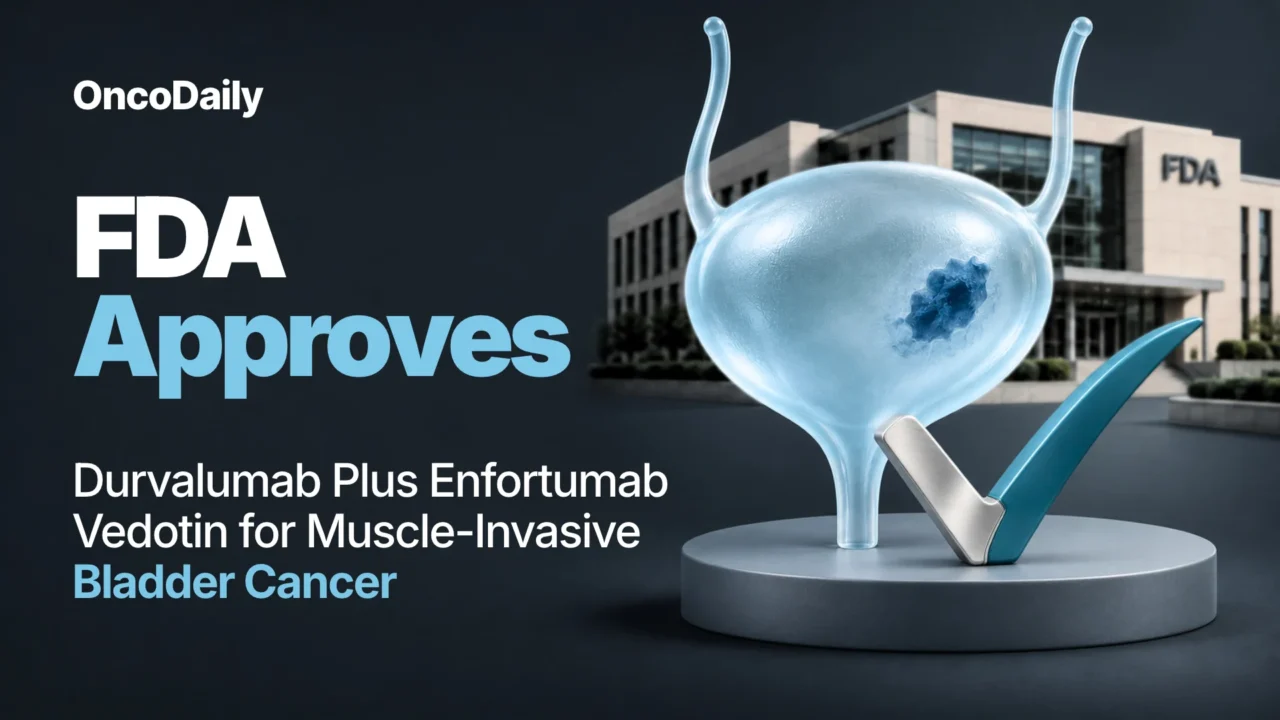
A new treatment option has emerged for patients with muscle-invasive bladder cancer who cannot receive cisplatin-based chemotherapy. The FDA has approved a perioperative regimen combining durvalumab and enfortumab vedotin, following Phase III results showing a 49% reduction in the risk of an event or death and a 42% reduction in the risk of death.
On November 13, 2026, AstraZeneca announced that the US Food and Drug Administration (FDA) approved durvalumab in combination with enfortumab vedotin before surgery, followed by durvalumab alone after surgery, for adults with muscle-invasive bladder cancer (MIBC) who are ineligible for or have declined cisplatin-based chemotherapy.
The approval is based on the Phase III VOLGA trial, which demonstrated significant improvements in event-free survival (EFS) and overall survival (OS) compared with radical cystectomy with or without approved adjuvant treatment.
The results were presented at the ESMO Congress 2026 and simultaneously published in The New England Journal of Medicine.
The decision represents another step toward expanding curative-intent treatment options for patients historically limited to surgery alone.
Addressing a Major Treatment Gap in Bladder Cancer
Muscle-invasive bladder cancer presents a considerable therapeutic challenge, particularly for patients who cannot tolerate cisplatin-based chemotherapy.
Approximately one-quarter of patients with bladder cancer develop muscle-invasive disease, and as many as half of patients with MIBC are ineligible for cisplatin because of impaired kidney function or other medical conditions.
For many of these patients, radical cystectomy has historically been the primary treatment option. However, surgery alone does not eliminate the risk of recurrence, and approximately half of patients may experience their cancer returning.
The newly approved regimen aims to improve outcomes by treating the cancer before surgery and continuing immunotherapy afterward.
VOLGA Phase III Trial: 42% Reduction in Risk of Death
The VOLGA trial (NCT04960709) enrolled 695 patients across 182 centers in 25 countries.
Patients were randomized to three treatment groups, including two experimental regimens and a comparator group receiving radical cystectomy with or without approved adjuvant treatment.
The newly approved regimen consisted of:
- Three cycles of durvalumab plus enfortumab vedotin before surgery.
- Radical cystectomy.
- Nine cycles of adjuvant durvalumab monotherapy following surgery.
The approved two-drug strategy was evaluated in 233 patients, compared with 229 patients in the control group.
Event-Free Survival Improved Significantly
At the planned interim analysis, the durvalumab–enfortumab vedotin regimen reduced the risk of an event or death by 49% compared with the control group.
The event-free survival hazard ratio was 0.51 (95% CI, 0.38–0.67; p<0.0001).
At two years:
- 64% of patients receiving the combination were alive and event-free.
- 45% of patients in the comparator group were alive and event-free.
Median event-free survival had not yet been reached in the combination group, compared with 12.1 months in the comparator group.
Overall Survival: 78% of Patients Alive at Two Years
The survival findings were equally important.
The combination reduced the relative risk of death by 42%, with an overall survival hazard ratio of 0.58 (95% CI, 0.40–0.83; p=0.0027).
At 24 months, estimated overall survival was:
- 78% with durvalumab plus neoadjuvant enfortumab vedotin.
- 69% with the comparator treatment.
Median overall survival had not been reached in either group at the time of analysis.
Together, these findings provide evidence that treatment before and after surgery can improve outcomes in patients who are unable or unwilling to receive cisplatin-based chemotherapy.
In an exclusive interview with OncoDaily TV at ESMO 2026, Thomas Powles, international coordinating investigator of the VOLGA trial, discussed the study and its potential impact on treatment strategies for muscle-invasive bladder cancer.
Watch the Interview: ESMO 2026: VOLGA Trial – Improving Survival in Muscle-Invasive Bladder Cancer? | Thomas Powles
Could Durvalumab Plus Enfortumab Vedotin Become a New Standard of Care?
Jonathan E. Rosenberg, Chief of the Genitourinary Oncology Service at Memorial Sloan Kettering Cancer Center and a member of the VOLGA Steering Committee, welcomed the approval.
Rosenberg emphasized that:
“The VOLGA regimen has the potential to become a new standard of care”
He highlighted the statistically significant improvements in event-free and overall survival, along with the manageable safety profile demonstrated in the trial.
One distinguishing feature of the approved regimen is the timing of enfortumab vedotin administration.
Unlike perioperative approaches that continue enfortumab vedotin after surgery, VOLGA administers the antibody-drug conjugate only before radical cystectomy, while postoperative treatment consists of durvalumab monotherapy.
This approach provides another therapeutic option in an increasingly complex treatment landscape, where perioperative immunotherapy and antibody-drug conjugates are becoming important components of bladder cancer care.
Safety and Quality of Life: What Did VOLGA Show?
The combination demonstrated a safety profile consistent with the known adverse effects of durvalumab and enfortumab vedotin, with no new safety signals identified.
According to AstraZeneca’s reported analysis, Grade 3 or 4 adverse events from any cause occurred in:
- 64% of patients receiving the durvalumab combination.
- 44% of patients in the comparator group.
These findings highlight the importance of careful patient selection and toxicity monitoring, particularly among patients who may already have substantial comorbidities.
Despite the additional systemic treatment, patient-reported quality of life was maintained after surgery in the combination group.
The survival benefits must therefore be considered alongside treatment-related toxicity and the individual patient’s ability to tolerate perioperative therapy.
AstraZeneca Expands the Role of Durvalumab in Bladder Cancer
The latest approval further expands the role of durvalumab across different stages of bladder cancer.
Durvalumab is already approved in more than 50 countries for cisplatin-eligible MIBC based on the Phase III NIAGARA trial, which established the benefits of adding perioperative immunotherapy to neoadjuvant chemotherapy and surgery.
Durvalumab in combination with Bacillus Calmette-Guérin (BCG) induction and maintenance therapy is also approved in the United States, Japan, and other countries for patients with BCG-naïve, high-risk non-muscle-invasive bladder cancer, based on the Phase III POTOMAC trial.
The VOLGA approval now extends its use to patients with muscle-invasive disease who cannot receive or decline cisplatin.
Dave Fredrickson, Executive Vice President of AstraZeneca’s Oncology Haematology Business Unit, described the new regimen as one that “almost halved the risk of disease recurrence.”
Fredrickson also emphasized the 42% reduction in the risk of death observed in VOLGA and the significance of expanding treatment options for patients receiving curative-intent therapy.
Regulatory applications based on VOLGA are currently under review in the European Union, Japan, and several other countries.
What Does This FDA Approval Mean for Bladder Cancer Treatment?
For patients with muscle-invasive bladder cancer who cannot receive cisplatin, the therapeutic landscape has historically offered fewer systemic treatment options.
The VOLGA findings demonstrate that adding durvalumab and enfortumab vedotin before surgery, followed by durvalumab monotherapy afterward, can significantly improve both event-free and overall survival compared with surgery-based management alone.
Importantly, the benefit was observed in a population with a substantial unmet need for effective curative-intent treatment.
The approval also adds to a broader shift in bladder cancer management, with immunotherapy and antibody-drug conjugates increasingly moving from advanced disease into earlier treatment settings.
As clinicians navigate multiple perioperative regimens, questions remain about optimal patient selection, treatment sequencing, toxicity, and which patients benefit most from each approach.
For now, the VOLGA approval provides another evidence-based treatment option for patients facing muscle-invasive bladder cancer without access to cisplatin-based chemotherapy.
Read further on OncoDaily: VOLGA at ESMO 2026: Perioperative Durvalumab With or Without Tremelimumab Plus Enfortumab Vedotin in MIBC