Andrea Boutros, Assistant Professor at University of Genoa, shared on LinkedIn:
“Which results from ESMO 2026 could change how we treat melanoma and skin cancers?
Madrid opens on Friday.
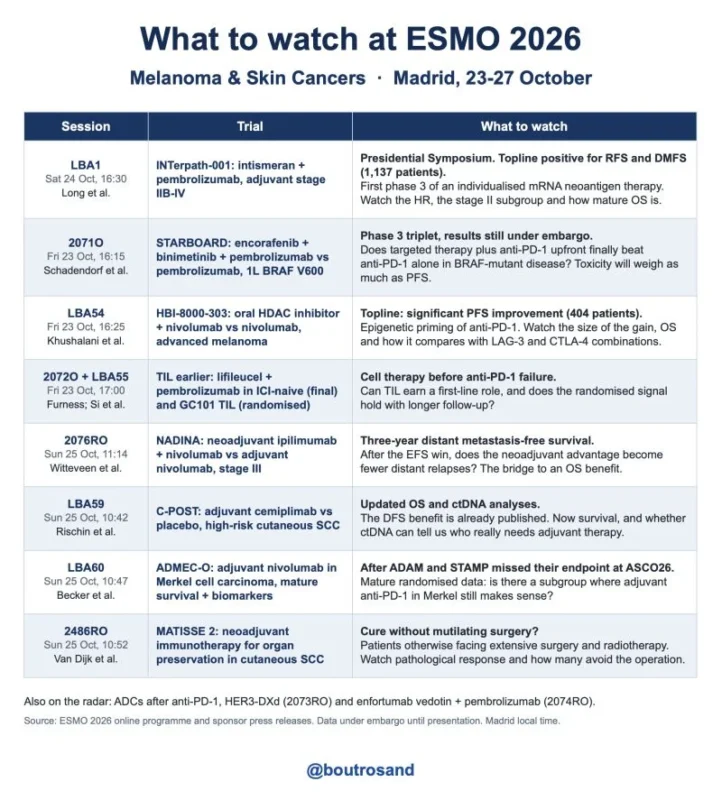
These are the eight presentations I will be following, plus one class of drugs I am watching closely.
- INTerpath-001 (LBA1, Presidential Symposium): the first phase 3 of an individualised mRNA neoantigen therapy, adjuvant with pembrolizumab. Topline positive for RFS and DMFS in 1,137 patients
- STARBOARD: encorafenib + binimetinib + pembrolizumab vs pembrolizumab in first-line BRAF V600 melanoma
- HBI-8000-303: an oral HDAC inhibitor added to nivolumab, with a significant PFS improvement announced in 404 patients
- TIL earlier: lifileucel + pembrolizumab in ICI-naive patients and a randomised TIL trial
- NADINA: three-year distant metastasis-free survival with neoadjuvant ipilimumab + nivolumab
- C-POST: updated OS and ctDNA with adjuvant cemiplimab in high-risk cutaneous SCC
- ADMEC-O: mature data with adjuvant nivolumab in Merkel cell carcinoma
- MATISSE 2: neoadjuvant immunotherapy for organ preservation in cutaneous SCC
And then ADCs.
Melanoma still has no approved antibody-drug conjugate, and two rapid orals test them after anti-PD-1: HER3-DXd (2073RO) and enfortumab vedotin + pembrolizumab (2074RO).
How I read it. Most of the program pushes treatment earlier: neoadjuvant, adjuvant, first-line triplets, cell therapy before progression.
The open problem is still the patient whose disease progresses on anti-PD-1, and that is where ADCs could add something new.
I will be looking at response rates, durability and toxicity before calling it a trend.
A ‘Best of ESMO26‘with the data will follow after Madrid.
Which trial are you waiting for?”
You can also read: Amelanotic Melanoma: The Skin Cancer That Can Be Easy to Miss