ASCO 2026 brought together oncology professionals, researchers, advocates, and industry leaders from around the world to discuss the latest advances shaping cancer care. This year, OncoDaily Ambassadors played an active role in amplifying the congress experience by sharing key moments, scientific updates, session highlights, and personal reflections across social media.
Through their posts, the ambassadors helped make ASCO 2026 more accessible to a broader global audience, extending important conversations beyond the conference halls. From breakthrough clinical trial results and expert discussions to networking moments and behind-the-scenes perspectives, their coverage reflected the energy, diversity, and collaborative spirit of the oncology community.
As part of OncoDaily’s mission to connect and inform the global cancer care ecosystem, the ambassador program highlights the power of digital engagement in oncology. Their voices helped translate the ASCO experience into real-time insights for clinicians, researchers, trainees, patients, and oncology professionals following the meeting from different parts of the world.
” I wrapped up Day 2 at ASCO 2026 with one of the most thought-provoking sessions of the meeting: “Value, Access, and Quality Care: Can We Have It All?”
A huge congratulations to Ian Tannock, Brooke Wilson, Haydee Cristina Verduzco-Aguirre and Ajay Aggarwal for an outstanding discussion on some of the most complex challenges facing oncology today.
The session explored the difficult balance between innovation, affordability, access, and quality of care. As cancer treatments become increasingly sophisticated, healthcare systems around the world continue to face tough decisions about how to ensure patients receive the greatest possible benefit while maintaining sustainability.
Several concepts particularly resonated with me.
One was the discussion around why oncology markets often exhibit “inelastic pricing,” driven by factors such as life-threatening disease, limited treatment alternatives, and the role of payers and insurance systems in shielding the true cost of care.
Another was the review of different approaches used globally to manage cancer drug costs, including health technology assessments, value-based pricing models, external reference pricing, competitive procurement strategies, and innovative reimbursement mechanisms. These tools are increasingly important as healthcare systems seek to balance access with long-term sustainability.
I was also struck by the discussion around low-value care and how it can inadvertently displace higher-value interventions. Examples included routine imaging without proven clinical benefit and treatments used in settings where evidence remains limited. Beyond costs, these practices can consume valuable healthcare resources, including hospital capacity, nursing support, and diagnostic services.
As Medical Manager at Further, I see daily how access to quality cancer care involves much more than the availability of a treatment. Patients need timely access to expertise, evidence-based guidance, appropriate treatment pathways, and support navigating increasingly complex healthcare systems.
Scientific innovation remains essential, but its true value is only realized when patients can access the right care, at the right time, in the right setting.
Thank you again to Ian Tannock, Brooke Wilson, Haydee Cristina Verduzco-Aguirre, and Ajay Aggarwal for an excellent session and for fostering an important conversation that extends far beyond ASCO ” OncoDaily Ambassadors
“I will be presenting my second poster at the American Society of Clinical Oncology (ASCO) 2026 Annual Meeting today.
Poster Board 587
June 1, 2026 | 1:30–4:30 PM CT
The Impact of High Body-Mass Index on Cancer Mortality in the United States: An Emerging Public Health Challenge
If you are interested in obesity, cancer epidemiology, prevention, and public health, I would be glad to discuss our findings. Hope to see you there.”
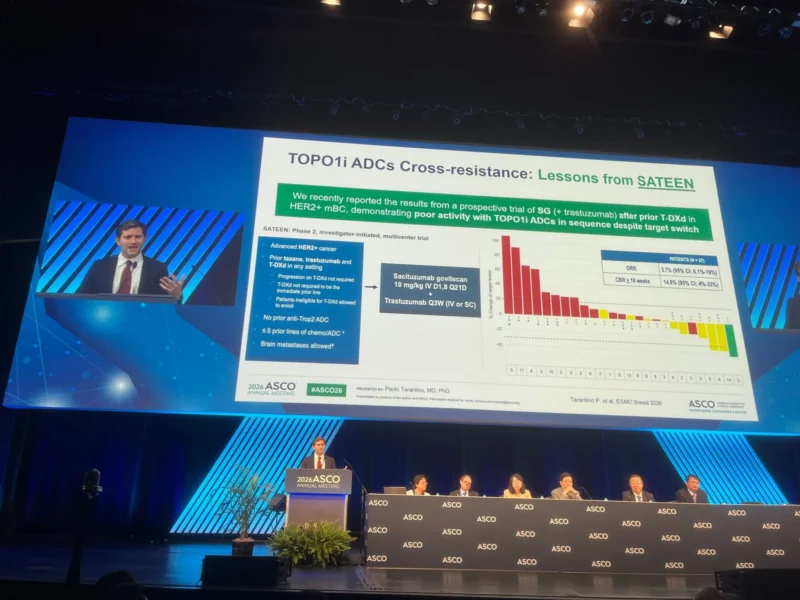
“ADCs from Paolo Tarantino, a leading expert in the field, at ASCO26 who stressed that to optimally use ADCs new biomarkers are required!
pathology is here to assist with optimising IHC, implementing multiplex-IHC and -IF, and also with AI and spatial-omics!
The next part of the session confirmed exactly this!
Immediate next 2 lectures by Drs Italiano Antoine and Gil Shamai offered an insight for the new tools that are getting into use: multiplex IHC/IF and AI!
Special comment for Dr Shamai who demonstrated that the AI analysis of a histopathology image may be more accurate than molecular analysis as the presence of a gene alteration does not always correlate with protein expression and thus patient benefit from a targeted treatment like ADCs!
We have the tools to make the big leap forward for cancer care!
My thanks to all involved in these panels and to American Society of Clinical Oncology (ASCO) for enabling this session!”
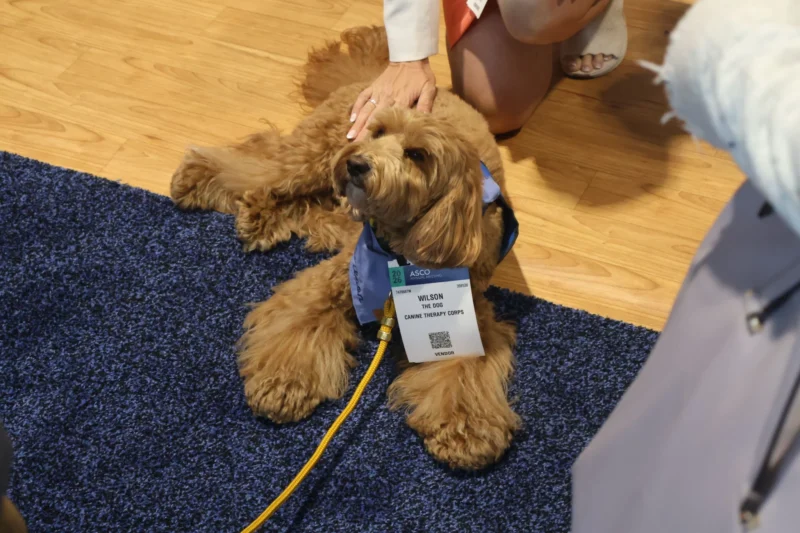
“The best ASCO26 crew!
Meet the canine support team!
The good boys and girls are ready to melt your hearts and relieve the stress from the busy ASCO26!
Reward their hard word with pets, gentle scratches and rubs!”OncoDaily Ambassadors
“Deploying AI without investing in communication training is not equity. It is a different kind of exclusion, one that has not yet been named.
Here is what the evidence already tells us. Only 30.4% of cancer patients report clear communication with their healthcare provider about their risk of recurrence. Even after an oncology consultation, only 35% of patients accurately understand the risk figures they were just given. Nearly 7 in 10 walk out of that room still carrying a number they cannot fully interpret.
Now imagine that number did not come from the oncologist sitting across from them. Imagine it came from an algorithm – something a close family member of mine recently experienced firsthand when diagnosed with breast cancer.
AI prognostic tools are already embedded in routine oncology workflows, generating recurrence risk scores and survival estimates that clinicians must present to patients who did not ask to receive them from a machine. When communication is already this fragile, what happens when the source of the information is a system neither party fully understands and that cannot be questioned, reassured or asked to try again?
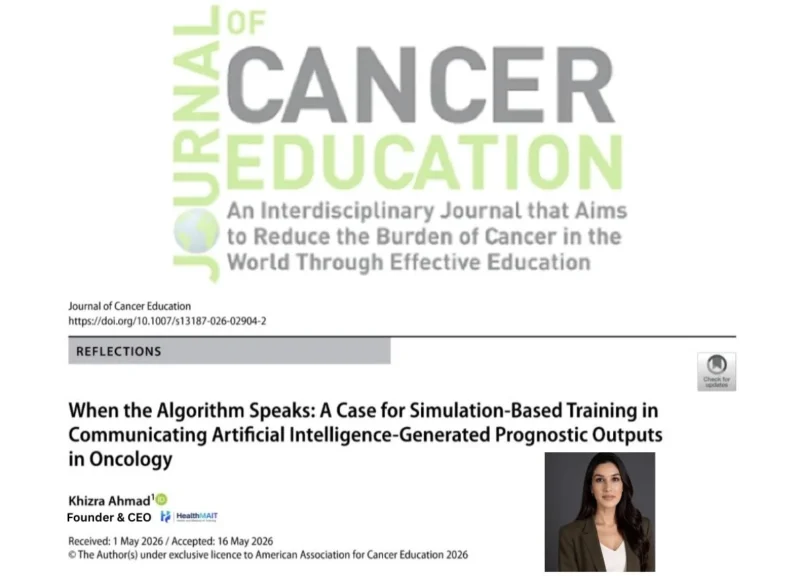
In my latest research published with Springer Nature in American Association for Cancer Education (AACE) – Journal for Cancer Education, I introduce the concept of the algorithmic consultation and propose TRACE, a standardised patient-based simulation framework built around the five communicative demands that arise when an AI output mediates the conversation between clinician and patient. No existing framework trains clinicians for this encounter.
TRACE is a first step toward changing that.
The algorithm is already speaking. The question is whether the clinicians interpreting its outputs have been equipped to do so.
Read the full Reflection here and let me know your thoughts https://rdcu.be/fkglu
I would also like to extend my sincere gratitude to Dr. Amr S Soliman, Editor-in-Chief of the Journal of Cancer Education for the honour of an invitation to join the journal as a Peer Reviewer. I very much look forward to contributing to the rigour and reach of cancer education research.”
“The ADC revolution continues. Moving ADCs into the first-line setting is no longer a question.
DESTINY-Ovarian01
This is a Phase III trial evaluating trastuzumab deruxtecan (T-DXd, Enhertu) plus bevacizumab versus bevacizumab alone as first-line maintenance therapy for patients with HER2-expressing advanced high-grade epithelial ovarian cancer after platinum-based chemotherapy plus bevacizumab. HER2 expression includes IHC 1+, 2+, and 3+.”
“ASCO 2026 ADC Insights from Dr. Paolo Tarantino
Oncology is experiencing an “explosion of ADCs”
Key takeaways:
Topoisomerase I inhibitors continue to dominate
However, switching the antigen target while using the same payload may not always translate into meaningful clinical advances. Cross-resistance and overlapping toxicity remain important considerations.
A striking reminder: despite advances in linker technology, a substantial proportion of ADC payload exposure still occurs through **systemic circulation**, raising ongoing questions about the balance between targeted delivery and off-target toxicity.”
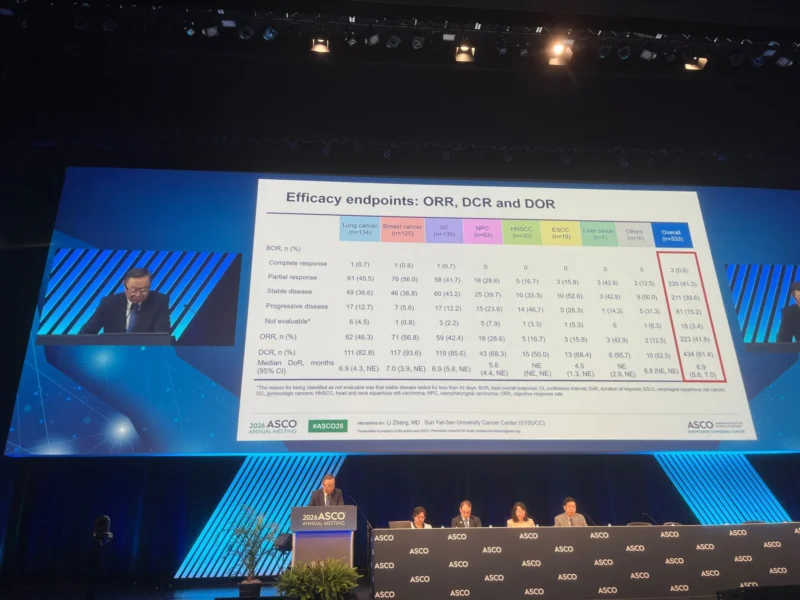
“Another exciting HER2 ADC signal in ovarian cancer presented by Professor Zhang at ASCO 2026.
Preliminary efficacy approaching 60% ORR in ovarian cancer
Eye-catching 100% ORR in the platinum-sensitive subgroup
Of course, these results remain very early (n=9), and caution is warranted before drawing conclusions.
Activity observed across HER2-low and even HER2-ultralow (1+) populations.
The key questions now are:
Will these responses translate into meaningful PFS and OS benefit?”
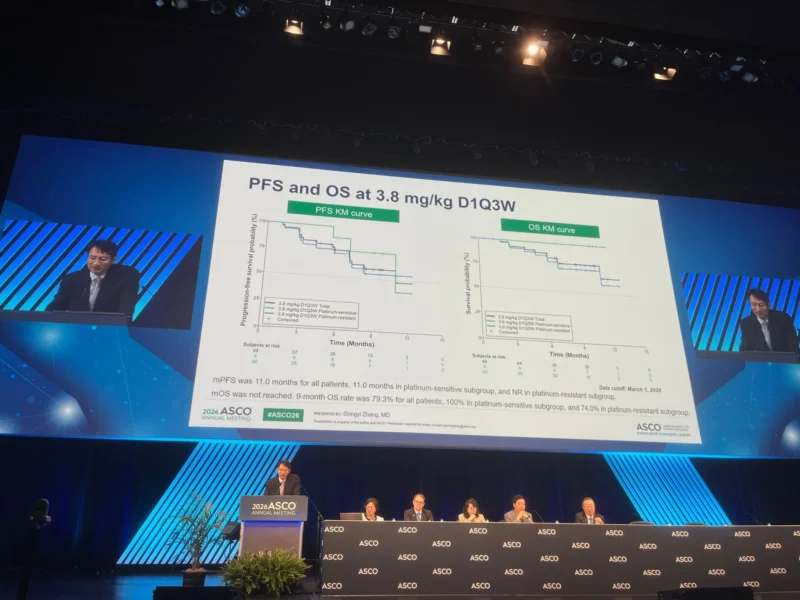
“ASCO2026 continues to showcase the next generation of ADCs in gynecologic cancers.
Professor Zhang presented exciting early data targeting **B7-H3**, an emerging therapeutic target across multiple solid tumors. The novel ADC **SYS6043** demonstrated promising activity, with an objective response rate (ORR) approaching **50% in ovarian cancer** patients.
While these results are encouraging, validation in larger global studies and populations beyond China will be essential to better understand efficacy, safety, and the potential role of B7-H3-directed therapy in clinical practice.
Definitely one to watch as the ADC landscape in gynecologic oncology continues to expand beyond established targets.”
“Day 1 ASCO 2026 Highlights – Last but Not Least: Cervical Cancer
Cervical cancer deserves equal attention in the ADC revolution.
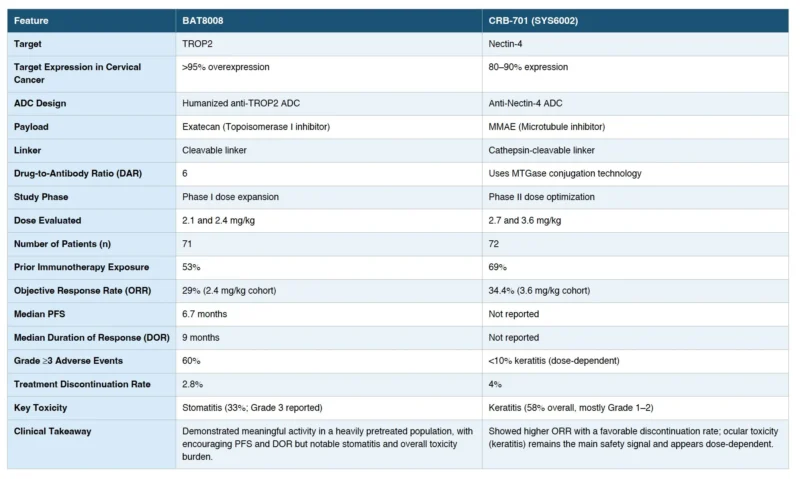
While tissue factor-targeted therapy has paved the way, we are now seeing the emergence of new targets beyond tissue factor, including TROP2 and Nectin-4, with encouraging activity in early-phase clinical trials.
I am sharing a comparative table highlighting the key characteristics and early efficacy signals of BAT8008 (anti-TROP2 ADC) and CRB-701/SYS6002 (anti-Nectin-4 ADC). As always, caution is warranted—these are separate studies, and cross-trial comparisons should not be made.
Some questions that came to mind while reviewing these data:
Will TROP2-directed ADCs offer a meaningful alternative in patients progressing after immunotherapy?
For MMAE-based ADCs such as CRB-701, what will be the long-term impact of peripheral neuropathy as treatment duration increases?
Can advances in linker and conjugation technologies improve the therapeutic window and reduce the classic toxicities associated with ADC payloads?
Will novel linker platforms help mitigate myelosuppression, one of the major challenges observed across several ADC classes?
The next generation of ADCs is not only about identifying new targets—it is also about optimizing payload delivery, minimizing off-target toxicity, and improving patient quality of life.
The cervical cancer ADC landscape is becoming increasingly competitive and innovative. Exciting times ahead for patients and clinicians alike.” OncoDaily Ambassadors
“Congratulations, Professor Stephanie Lheureux. Thank you for digesting the ovarian cancer highlights for us.
We are still trying to better understand the TME -> Rosella, MIRASOL, and B96, the OS gains appear encouraging, although the PFS benefit is modest. Immune modulation?
As you mentioned:
“We have new hope; ADCs are moving from the resistant to the sensitive setting.”
“ADCs are definitely here to stay.”
“Prior exposure to bevacizumab, PARP inhibitors, and now weekly paclitaxel and mirvetuximab will matter for future trial selection.”
Thank you again for sharing these valuable insights.”OncoDaily Ambassadors
“The energy in Chicago for ASCO26 has been incredible, particularly with the sheer volume of practice-changing data being presented this year. Three trials stand out that are poised to redefine how we approach solid tumors:
1. RASolute 302: A New Standard in Pancreatic Cancer
We finally have a clear shift for previously treated KRAS-mutant metastatic pancreatic cancer. Daraxonrasib, an oral RAS(ON) multiselective inhibitor, effectively doubled median overall survival (13.2 vs. 6.6 months) and progression-free survival compared to standard chemotherapy. Just as importantly, the tolerability profile is highly favorable, with only a 1% discontinuation rate due to adverse events versus 11% for chemotherapy.
2. HARMONi-6: Bispecifics Advancing in Squamous NSCLC
Bringing bispecific programs into the clinical workflow is a major operational and clinical focus right now, and this data underscores why. In first-line advanced squamous NSCLC, ivonescimab (a PD-1/VEGF-A bispecific) plus chemotherapy significantly improved overall survival (27.9 vs. 23.7 months) compared to tislelizumab plus chemo. Notably, this benefit was seen even in the challenging PD-L1 <1% population, and it successfully brings a VEGF-targeted agent to squamous patients. If the global HARMONi-3 trial confirms these findings, this is a true paradigm shift.
3. PROTEUS: Intensification and Nuance in Prostate Cancer
For patients with high-risk localized prostate cancer undergoing radical prostatectomy, adding perioperative apalutamide to ADT improved 5-year metastasis-free survival (78% vs. 74%) and yielded higher pCR/MRD rates (9% vs. 1%). However, the data carries a critical caveat: mortality was higher in the experimental arm for patients over 75 (15% vs. 13%). It is a potent reminder that as we intensify perioperative therapies, rigorous geriatric assessment and careful patient selection remain absolutely paramount.
What data from this year’s plenary sessions has you rethinking your current clinical pathways?”OncoDaily Ambassadors
” The LIBRETTO-432 data is officially out, and it is a major win for precision medicine in early-stage lung cancer. This Phase 3 trial evaluated adjuvant selpercatinib (Retevmo) versus placebo in patients with resected, early-stage (IB-IIIA) RET fusion-positive NSCLC, and the results are immediately practice-changing.
Key takeaways from the presentation:
Event-Free Survival (EFS): A massive 83% reduction in the risk of disease recurrence or death (HR 0.17) in the primary analysis population (Stage II-IIIA).
24-Month EFS Rate: 92% for selpercatinib vs. 61% for placebo.
Safety Profile: Consistent with what we see in the advanced setting. The primary grade ≥3 events were elevated ALT/AST, which were manageable with dose modifications.
Historically, we’ve relied heavily on standard-of-care surgery and adjuvant chemo, but patients with these rare RET fusions remain at high risk for recurrence. This data proves that targeting micrometastatic disease with a specific kinase inhibitor significantly extends event-free survival.
Most importantly, it heavily reinforces the need for comprehensive molecular biomarker testing right at the time of diagnosis, rather than waiting until a patient reaches the metastatic setting!”
Written by Nare Hovhannisyan,MD
Explore more oncology news and features on OncoDaily