
Lung cancer is not always the same disease at diagnosis and during treatment. As cancer cells are exposed to targeted therapies, they may develop genetic changes that allow them to survive and continue growing. In some cases, however, the changes go beyond treatment resistance: the tumor can acquire the characteristics of an entirely different type of lung cancer.
This phenomenon, known as histologic transformation, is particularly important in patients with EGFR-mutant non-small cell lung cancer (NSCLC). Research has shown that some lung adenocarcinomas can transform into small cell lung cancer (SCLC), a more aggressive subtype with distinct biological features and treatment requirements.
Although relatively uncommon, this transformation presents a significant clinical challenge. A treatment that initially controlled the disease may become ineffective, while the transformed tumor may require a different therapeutic approach. Studies have also identified molecular alterations, particularly involving the TP53 and RB1 genes, that may increase the likelihood of transformation (Offin et al., 2019).
Understanding how and why lung cancer changes its identity is essential for recognizing treatment resistance, determining when repeat biopsies are necessary, and selecting appropriate therapies as the disease evolves.
Can Lung Cancer Change From One Type to Another?
Yes. In certain circumstances, lung cancer can undergo histologic transformation, meaning that the cancer develops the microscopic and biological characteristics of a different tumor subtype.
Lung cancers are broadly divided into two main categories:
Non-small cell lung cancer (NSCLC): Accounts for approximately 85% of lung cancers and includes adenocarcinoma, squamous cell carcinoma, and large cell carcinoma.
Small cell lung cancer (SCLC): A less common but generally aggressive form of lung cancer characterized by rapid growth, neuroendocrine features, and a tendency to spread early.
Under usual circumstances, these classifications remain important throughout a patient’s disease. However, treatment can expose differences between cancer cell populations that were not apparent when the tumor was first diagnosed.
For example, a patient may initially be diagnosed with EGFR-mutant lung adenocarcinoma and respond well to an EGFR inhibitor. After months or years of treatment, the cancer may begin growing again. A new biopsy might reveal that some or all of the sampled tumor now has the characteristics of SCLC.
This does not necessarily mean that a completely new cancer has developed. In many cases, molecular testing shows that the transformed tumor retains the original EGFR mutation, suggesting that the two tumor types share a common origin.
It is also important to distinguish histologic transformation from molecular resistance. A cancer that acquires a new resistance mutation has changed genetically, but it has not necessarily become a different histologic type. (Kobayashi et al., 2005; Marcoux et al., 2019)
Why Does Lung Cancer Change During Treatment?
Lung cancer often contains different populations of malignant cells, even within the same tumor. These populations may share important genetic characteristics while differing in their ability to survive treatment.
When a targeted therapy is introduced, sensitive cancer cells may shrink or disappear. Other cells with resistance mechanisms may survive and eventually become more prominent.
This process is known as clonal selection.
In some tumors, cancer cells may also change their differentiation state or adopt a different cellular program. Researchers describe this ability as lineage plasticity.
What Is Lineage Plasticity in Lung Cancer?
Lineage plasticity refers to the ability of cancer cells to change features associated with their original cellular identity.
In EGFR-mutant lung adenocarcinoma, certain cancer cells may develop a neuroendocrine phenotype resembling SCLC. This change may allow them to grow despite treatment that continues to inhibit the EGFR pathway.
Two biological explanations are being investigated:
- Selection of pre-existing cells: A small population of cells with different characteristics may already exist within the tumor before treatment and become dominant over time.
- Cellular reprogramming: Cancer cells may acquire changes that alter their differentiation and gene-expression patterns during disease evolution.
These mechanisms are not mutually exclusive, and their relative contribution may differ between tumors.
What Role Do EGFR, TP53, and RB1 Play?
EGFR mutations can drive the growth of certain lung adenocarcinomas, making these tumors sensitive to EGFR tyrosine kinase inhibitors (TKIs).
However, additional genetic alterations can influence how tumors evolve.
Two particularly important genes are TP53 and RB1, both of which normally help regulate cell growth and prevent uncontrolled proliferation.
Alterations affecting these genes have been associated with a higher risk of small-cell transformation in EGFR-mutant lung cancer.
In a study by Offin et al. (2019), EGFR-mutant lung cancers with concurrent TP53 and RB1 alterations represented a subgroup at increased risk of histologic transformation.
However, these alterations do not mean that transformation will inevitably occur. Many tumors with additional molecular abnormalities never develop SCLC characteristics.
Can Non-Small Cell Lung Cancer Turn Into Small Cell Lung Cancer?
Yes. Transformation from NSCLC to SCLC is one of the best-recognized examples of a lung tumor changing its histologic identity during treatment.
The phenomenon has been most extensively studied in patients with EGFR-mutant lung adenocarcinoma who develop resistance to EGFR-targeted treatment.
In a multicenter study published in the Journal of Clinical Oncology, Marcoux et al. (2019) examined 67 patients with EGFR-mutant lung cancers that had developed SCLC or other high-grade neuroendocrine characteristics.
The researchers found that transformed tumors frequently retained their original EGFR mutations, despite displaying different microscopic features and clinical behavior.
This finding provides important evidence that the cancer may evolve from its original form rather than representing an unrelated second primary tumor.
The study also reported a median overall survival of 10.9 months following transformation. This is a historical estimate from a selected patient population, not an individual prediction of survival.
How Common Is Small Cell Transformation?
Small-cell transformation is relatively uncommon but clinically significant.
Published studies estimate that approximately 3–10% of EGFR-mutant NSCLCs undergo SCLC transformation, particularly in populations evaluated after acquired resistance to EGFR inhibitors.
The true frequency remains difficult to establish because not every patient undergoes repeat tissue biopsy at progression.
In addition, a single tumor may contain both adenocarcinoma and small-cell components, meaning that one biopsy may not capture its full biological diversity.
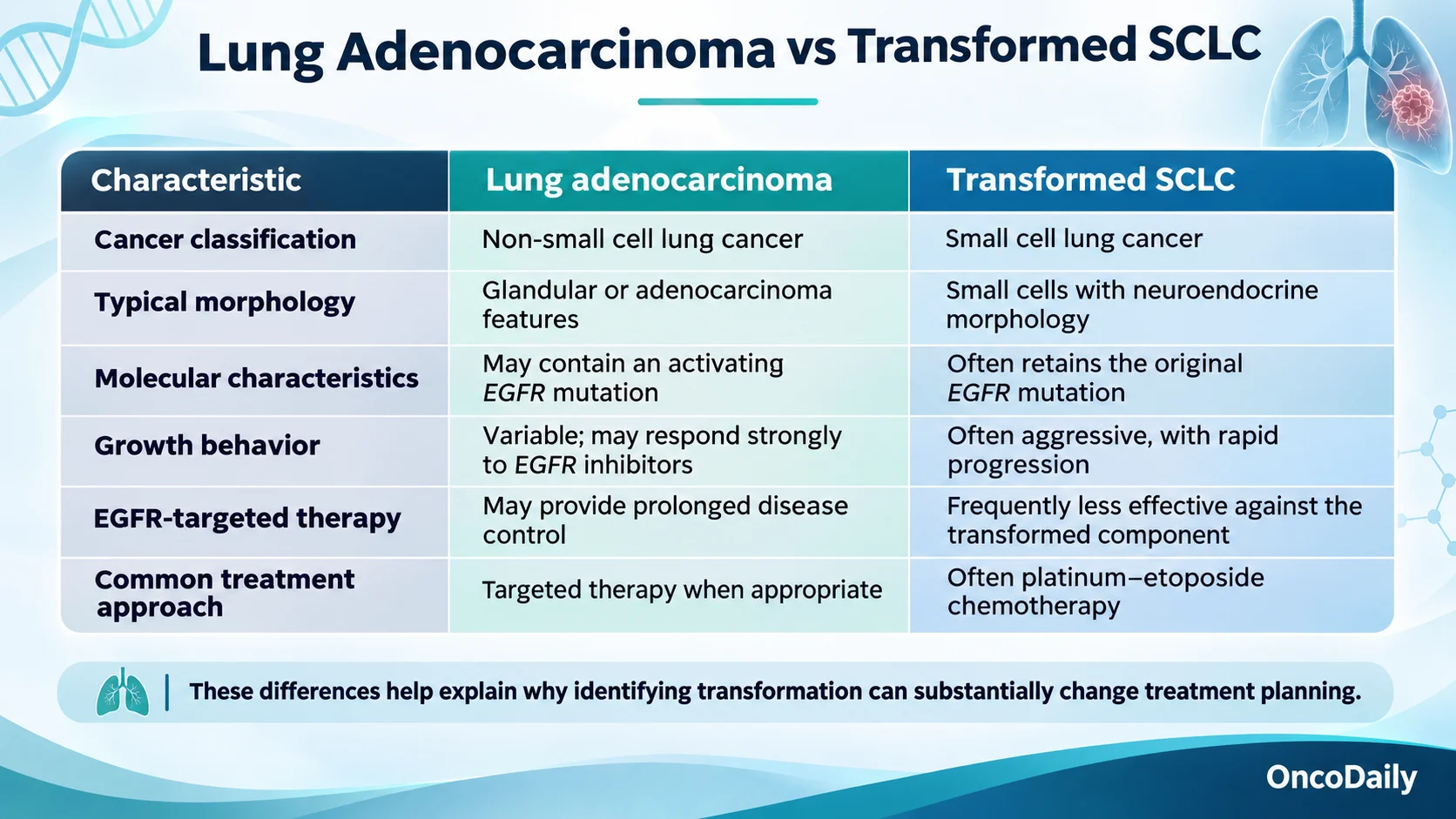
The following table highlights several differences between conventional lung adenocarcinoma and transformed SCLC.
Which Lung Cancer Treatments Are Associated With Histologic Transformation?
Histologic transformation has been documented most clearly during treatment with EGFR-targeted therapies, although lineage changes and histologic evolution have also been described in other treatment settings.
EGFR-Targeted Therapies
EGFR inhibitors have substantially improved outcomes for patients with advanced EGFR-mutant NSCLC.
A landmark NEJM study by Kobayashi et al. (2005) described the emergence of an EGFR T790M resistance mutation in a patient whose lung cancer initially responded to gefitinib.
The study demonstrated that a tumor can develop a molecular alteration that reduces its sensitivity to treatment.
Importantly, the T790M mutation itself does not mean that NSCLC has transformed into SCLC. Instead, it illustrates how cancer can evolve genetically under treatment pressure.
Later, the phase III FLAURA trial demonstrated improved progression-free survival with first-line osimertinib compared with earlier-generation EGFR inhibitors in patients with advanced EGFR-mutant NSCLC (Soria et al., 2018).
Although osimertinib provides effective disease control for many patients, acquired resistance remains a challenge. Subsequent research has identified different resistance pathways, including additional EGFR alterations, activation of alternative signaling pathways, and histologic transformation.
Can Immunotherapy Cause Lung Cancer to Change Its Type?
Histologic changes have been reported in lung cancers treated with immune checkpoint inhibitors, but the evidence is much more limited than for EGFR-targeted therapy.
Most available reports involve individual cases or small patient series.
It remains uncertain whether immunotherapy directly induces these changes or whether treatment selects tumor populations with previously existing biological differences.
Therefore, histologic transformation should not be considered an established or common consequence of immunotherapy.
What Are the Signs That Lung Cancer Has Changed Its Type?
Histologic transformation usually does not produce a unique set of symptoms.
In many patients, the first indication is that a previously effective treatment is no longer controlling the disease.
For example, a patient receiving an EGFR inhibitor may initially experience substantial tumor shrinkage. Follow-up imaging may then reveal new lesions or rapid growth of existing tumors despite continued treatment.
Features that may raise suspicion include:
- Rapid disease progression: Tumors begin growing more quickly than expected after a period of treatment response.
- New metastatic lesions: Cancer appears in additional organs or develops a different pattern of spread.
- Unexpected treatment resistance: A previously effective targeted therapy loses its ability to control the disease.
- Changes in tumor appearance: A repeat biopsy reveals microscopic features that differ from the original diagnosis.
However, these findings are not specific to histologic transformation.
Ordinary acquired resistance, changes in tumor burden, and other clinical factors can produce similar findings.
A change in symptoms or imaging alone cannot confirm that lung cancer has transformed. Tissue examination is generally required to establish the diagnosis.
How Do Doctors Diagnose Lung Cancer Transformation?
Diagnosing histologic transformation involves comparing the characteristics of the original tumor with those found when the disease progresses.
A repeat biopsy is particularly important when the cancer begins behaving differently or when the mechanism of treatment resistance is unclear.
Why Is Repeat Biopsy Important?
A tissue biopsy allows pathologists to examine the structure and appearance of malignant cells directly.
If the original tumor was adenocarcinoma but the new sample shows small-cell morphology, doctors can investigate whether histologic transformation has occurred.
Immunohistochemical staining may help identify neuroendocrine differentiation. Markers commonly evaluated include synaptophysin, chromogranin A, CD56, and INSM1.
These findings must be interpreted alongside tumor morphology and the patient’s clinical history.
Molecular testing can provide additional information by identifying mutations shared between the original and transformed tumors.
For instance, detection of the same EGFR mutation in both samples supports a common tumor origin.
Can a Blood Test Detect Lung Cancer Transformation?
Liquid biopsy has become an important tool for identifying molecular alterations associated with treatment resistance.
In a 2008 NEJM study, Maheswaran et al. demonstrated that EGFR mutations could be detected in circulating tumor cells from patients with lung cancer and that resistance-associated genetic changes could be identified during treatment.
These findings supported the use of blood-based approaches to study how lung cancer evolves over time.
However, standard circulating tumor DNA testing generally cannot determine whether a tumor has changed from adenocarcinoma to SCLC because it does not provide the microscopic architecture needed for histologic classification.
Emerging molecular approaches may help identify transformation-associated signatures, but repeat tissue biopsy remains the preferred method when histologic transformation is suspected and biopsy is feasible. (Maheswaran et al., 2008; Marcoux et al., 2019)
How Is Lung Cancer Treated After Small Cell Transformation?
Treatment following histologic transformation depends on the new tumor characteristics, prior treatments, extent of disease, and the patient’s overall condition.
When EGFR-mutant adenocarcinoma transforms into SCLC, treatment often shifts toward chemotherapy regimens used for small cell lung cancer.
Platinum-Based Chemotherapy
The most commonly used approach is a combination of a platinum agent, such as carboplatin or cisplatin, and etoposide.
These drugs target rapidly dividing cancer cells and may produce meaningful tumor responses in transformed SCLC.
In the study by Marcoux et al. (2019), platinum–etoposide chemotherapy produced responses in a substantial proportion of patients.
However, disease control was often temporary, emphasizing the need for better treatment strategies.
Can EGFR-Targeted Therapy Be Continued?
Whether EGFR-targeted therapy should be continued after SCLC transformation remains an area of clinical investigation.
Some transformed tumors retain the original EGFR mutation but become less dependent on EGFR signaling for survival.
In certain patients, an EGFR inhibitor may still be considered alongside other treatments, particularly when a remaining adenocarcinoma component is thought to be contributing to the disease.
However, there is no universally established approach for continuing EGFR inhibitors after transformation.
Treatment decisions require individualized assessment, ideally through a multidisciplinary oncology team.
What About Immunotherapy?
Immune checkpoint inhibitors have an established role in several settings of conventional SCLC treatment. Their role in EGFR-mutant NSCLC that has transformed into SCLC is less clear.
In the Marcoux et al. study, none of the 17 patients who received immunotherapy after transformation experienced an objective response.
Although this was a relatively small retrospective group, the findings suggest that transformed SCLC may behave differently from conventional SCLC in its response to immunotherapy.
Clinical trials remain important for evaluating more effective treatment approaches.
Can Histologic Transformation Be Prevented or Reversed?
At present, there is no established treatment that reliably prevents EGFR-mutant lung cancer from undergoing small-cell transformation.
Researchers are investigating whether molecular characteristics present at diagnosis can identify tumors more likely to change their histologic identity.
The association between TP53 and RB1 alterations and transformation risk is particularly important because it suggests that some tumors may already possess biological features that make transformation more likely.
However, molecular risk factors are not sufficiently reliable to predict transformation in every patient.
Research is also exploring whether targeting pathways involved in neuroendocrine differentiation, tumor-cell plasticity, and treatment resistance could delay or potentially reverse these changes.
For now, these approaches remain investigational.
The most practical clinical strategy is to recognize unexpected progression, reassess the tumor when appropriate, and adapt treatment to its current biological characteristics.
What Does Lung Cancer Transformation Mean for Patients?
A diagnosis of histologic transformation can be difficult because it may require a significant change in treatment after a period of successful disease control.
However, it is important to distinguish transformation from ordinary progression.
Some lung cancers become resistant because of additional genetic mutations, while others undergo more extensive changes in their cellular characteristics. These mechanisms may require different treatment strategies.
A repeat biopsy can therefore provide information that was not available at the original diagnosis.
As molecular testing, pathology, and treatment options continue to advance, understanding how lung cancer evolves may help clinicians make more informed decisions when resistance develops.
The central message is that lung cancer is not always biologically static. Its genetic characteristics, treatment sensitivity, and, in rare cases, histologic identity can change over time.
Recognizing these changes is essential to selecting the most appropriate treatment as the disease evolves.
Sources
- EGFR Mutation and Resistance of Non–Small-Cell Lung Cancer to Gefitinib. New England Journal of Medicine. DOI: 10.1056/NEJMoa044238
- Osimertinib in Untreated EGFR-Mutated Advanced Non–Small-Cell Lung Cancer. New England Journal of Medicine. DOI: 10.1056/NEJMoa1713137
- Detection of Mutations in EGFR in Circulating Lung-Cancer Cells. New England Journal of Medicine. DOI: 10.1056/NEJMoa0800668
- Targeting EGFR in Non–Small-Cell Lung Cancer. New England Journal of Medicine. DOI: 10.1056/NEJMe058113
- EGFR-Mutant Adenocarcinomas That Transform to Small-Cell Lung Cancer and Other Neuroendocrine Carcinomas: Clinical Outcomes. Journal of Clinical Oncology. DOI: 10.1200/JCO.18.01585
FAQ
Can Lung Cancer Change From Non-Small Cell to Small Cell?
Yes. In a small proportion of patients, particularly those with EGFR-mutant lung adenocarcinoma receiving targeted therapy, the cancer can undergo histologic transformation into small cell lung cancer. The transformed tumor often retains the original EGFR mutation but develops different cellular features and treatment sensitivity.
How Common Is Small Cell Transformation in Lung Cancer?
Research suggests that approximately 3–10% of EGFR-mutant NSCLCs may undergo small-cell transformation. The reported frequency varies according to the study population, treatments received, and availability of repeat tissue biopsies. Transformation is much less well characterized in other molecular subtypes.
Does Lung Cancer Transformation Mean Treatment Has Failed?
Histologic transformation is generally associated with acquired resistance to a previous treatment, but it does not mean that no further treatments are available. Chemotherapy, selected targeted treatment strategies, and clinical trials may still provide disease control. Treatment depends on the characteristics of the transformed tumor.
Can a Blood Test Show Whether Lung Cancer Has Changed Its Type?
Blood-based testing can detect genetic alterations associated with treatment resistance, including certain EGFR mutations. However, routine liquid biopsy cannot reliably confirm that adenocarcinoma has transformed into SCLC. A tissue biopsy is generally needed to examine the tumor's microscopic characteristics.
Can Lung Cancer Change Back to Its Original Type?
There is currently no established treatment that reliably reverses histologic transformation. Some tumors contain mixed populations of cancer cells, and their relative proportions may change over time or with treatment. Researchers continue to investigate whether cellular plasticity can be targeted therapeutically.