
Cancer is not always biologically fixed. As tumors evolve, some cancer cells can change their identity, adopt new cellular states, and become less dependent on the pathways that originally defined them.
This process, known as lineage plasticity in cancer, is emerging as an important explanation for why some tumors behave differently over time and why treatment resistance can develop even without a new dominant mutation. Instead of simply becoming stronger versions of the same cancer, some tumor cells can reprogram themselves and take on a different biological state.
Understanding how cancer cells change identity is opening a new way of thinking about tumor evolution, treatment resistance, and the limits of therapies that target a single pathway. It also raises an important question: how much of cancer resistance is driven not by new mutations, but by the ability of tumor cells to become something different?
What Is Lineage Plasticity in Cancer?
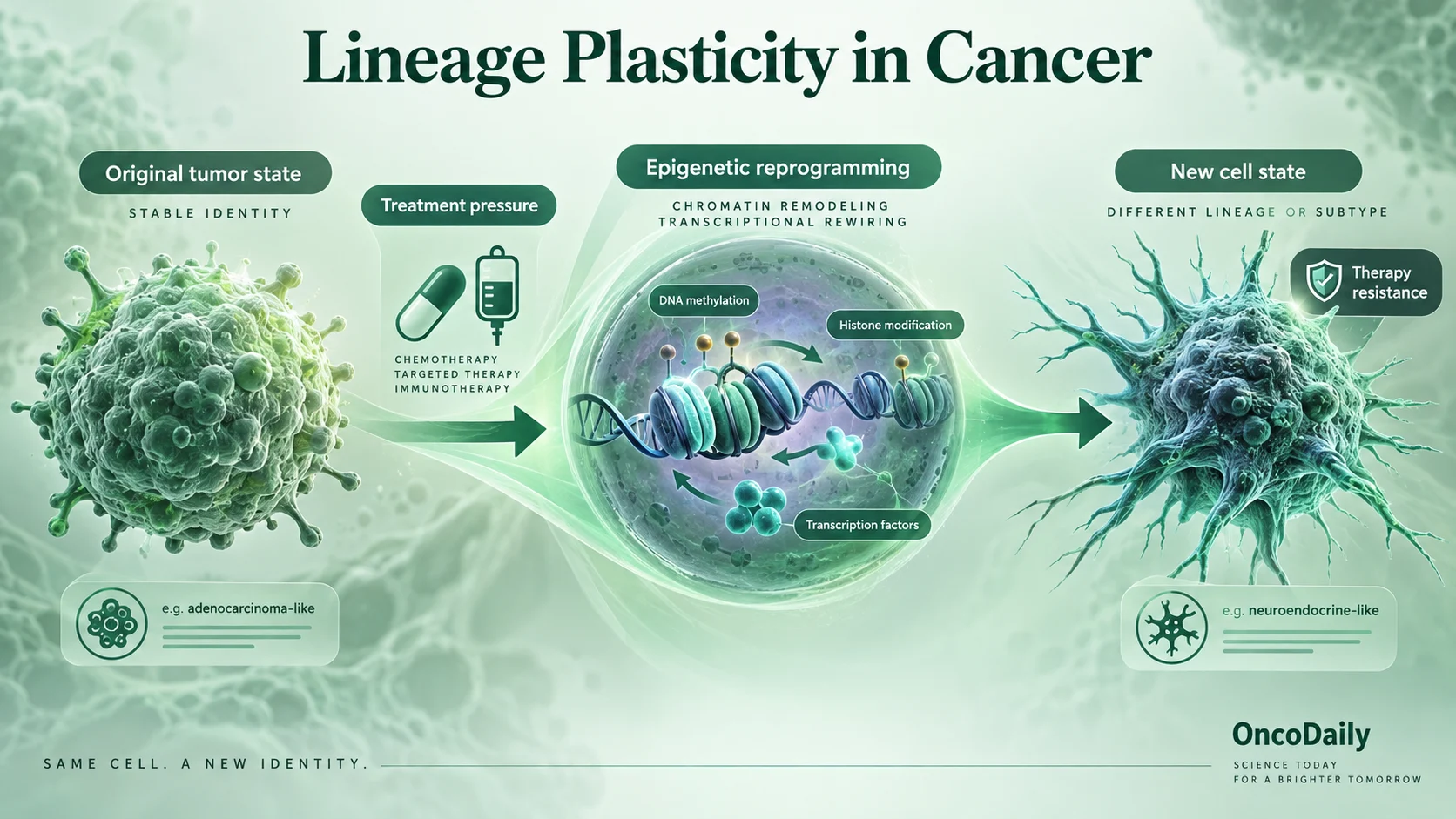
Lineage plasticity is the ability of a cancer cell to change its identity and adopt a different cellular state. Instead of remaining fixed to the differentiation program of the tumor it originated from, the cell can reprogram itself in response to changes in its environment or treatment pressure. (Davies et al., 2023; Li et al., 2025).
A cell’s lineage is defined by the molecular and developmental programs that determine its identity. In cancer, these include transcription factors, signaling pathways, and structural features that characterize a particular tumor type or subtype.
Lineage plasticity is driven largely by transcriptional and epigenetic reprogramming. Changes in chromatin accessibility, enhancer activity, DNA methylation, and lineage-defining transcription factors can activate new gene-expression programs without necessarily requiring a new driver mutation. (Davies et al., 2023).
The degree of change can vary considerably. Some tumors undergo relatively subtle shifts in cellular state, while others undergo histologic transformation, developing the microscopic and molecular features of a different tumor subtype. (Li et al., 2025).
This flexibility gives cancer cells another way to adapt during tumor evolution and treatment, making lineage plasticity an increasingly important part of understanding therapy resistance.
Why Do Cancer Cells Change Their Identity?
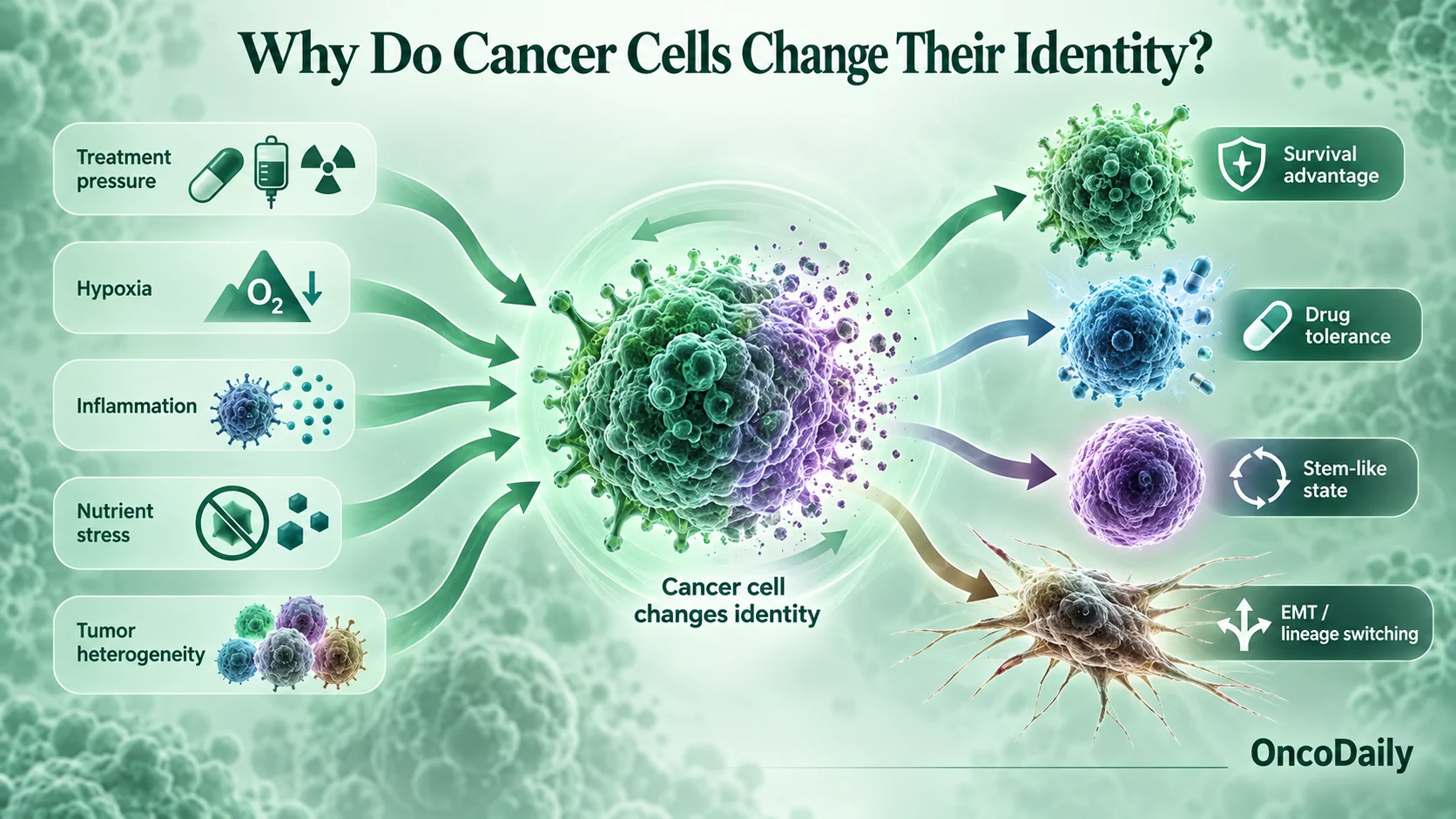
Cancer cells change their identity because plasticity can provide a survival advantage when conditions become unfavorable. Some tumor cells can alter their differentiation program and adopt a state that is better suited to survive treatment or environmental stress. (Davies et al., 2023; Hu et al., 2026).
Treatment is one of the strongest pressures driving these changes. Targeted therapy, hormone therapy, chemotherapy, and radiation can eliminate cells that remain dependent on the original tumor program while selecting for populations that can adapt. (Davies et al., 2023).
The tumor microenvironment also plays a role. Hypoxia, nutrient limitation, inflammation, immune pressure, and signals from surrounding stromal cells can influence gene expression and chromatin organization and promote more adaptable cell states. (Sun et al., 2025; Hu et al., 2026).
Tumor heterogeneity provides the background for this process. Different cells within the same tumor vary in their ability to adapt, and treatment can favor the populations best able to survive changing conditions.
Lineage switching also overlaps with broader forms of cancer-cell plasticity, including dedifferentiation, stem-like states, and epithelial–mesenchymal transitions, although these processes are not identical. (Sun et al., 2025; Hu et al., 2026).
How Does Lineage Plasticity Drive Treatment Resistance?
Lineage plasticity allows cancer cells to escape treatment by changing the program that originally made them sensitive to therapy. Instead of relying only on new resistance mutations, tumor cells can become less dependent on the pathway being targeted. (Davies et al., 2023; Li et al., 2025).
This is especially important with targeted and hormone therapies, where treatment places strong selective pressure on a specific tumor dependency. More plastic populations may survive by adopting a different lineage or a less differentiated state.
Changes in chromatin structure, transcription factors, and signaling pathways can stabilize this new identity. The resulting tumor may behave very differently from the original cancer and may no longer respond to the same treatment. (Qi and Dehm, 2026).
Because this type of resistance can develop through cell-state reprogramming rather than a new dominant mutation, genomic testing alone may not capture the full biological change.
Which Cancers Commonly Develop Lineage Plasticity?
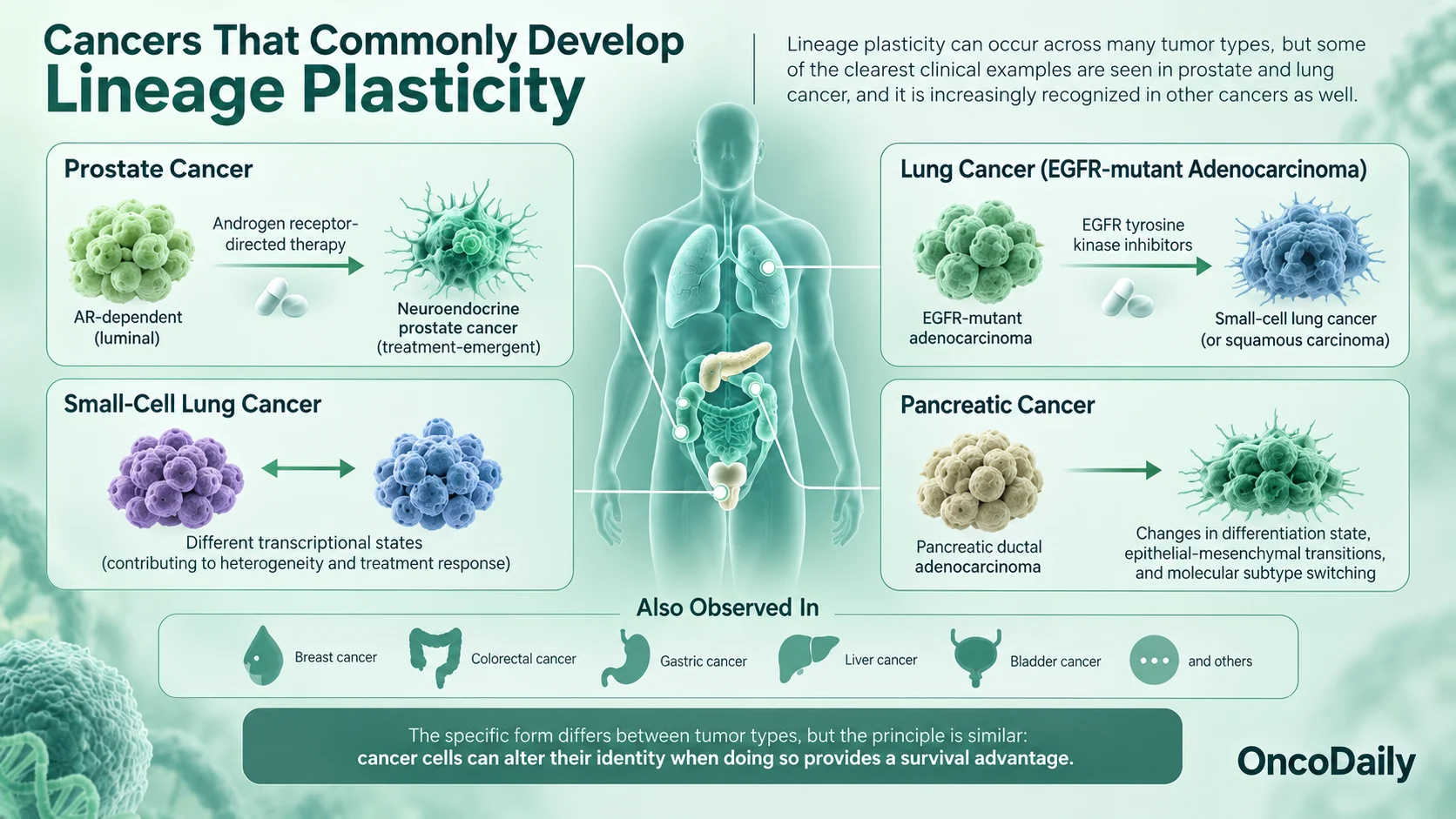
Lineage plasticity can occur across many tumor types, but some of the clearest clinical examples are seen in prostate and lung cancer.
In prostate cancer, prolonged androgen receptor–directed therapy can select for tumors that lose their luminal, AR-dependent identity and acquire neuroendocrine features. Treatment-emergent neuroendocrine prostate cancer is an aggressive manifestation of this process. (Li et al., 2025; Haffner et al., 2025).
A similar process occurs in EGFR-mutant lung adenocarcinoma. During treatment with EGFR tyrosine kinase inhibitors, some tumors undergo transformation to small-cell lung cancer or, less commonly, squamous carcinoma. These tumors generally retain the original EGFR mutation but become less dependent on EGFR signaling. (Li et al., 2025; Lau et al., 2026).
Small-cell lung cancer itself also shows considerable plasticity between transcriptional states, contributing to intratumoral heterogeneity and differences in treatment response.
Lineage reprogramming is increasingly recognized in other cancers as well. In pancreatic ductal adenocarcinoma, plasticity contributes to changes in differentiation state, epithelial–mesenchymal transitions, and molecular subtype switching during progression and treatment. (Zhang et al., 2025).
The specific form differs between tumor types, but the principle is similar: cancer cells can alter their identity when doing so provides a survival advantage.
What Molecular Pathways Control Lineage Plasticity?
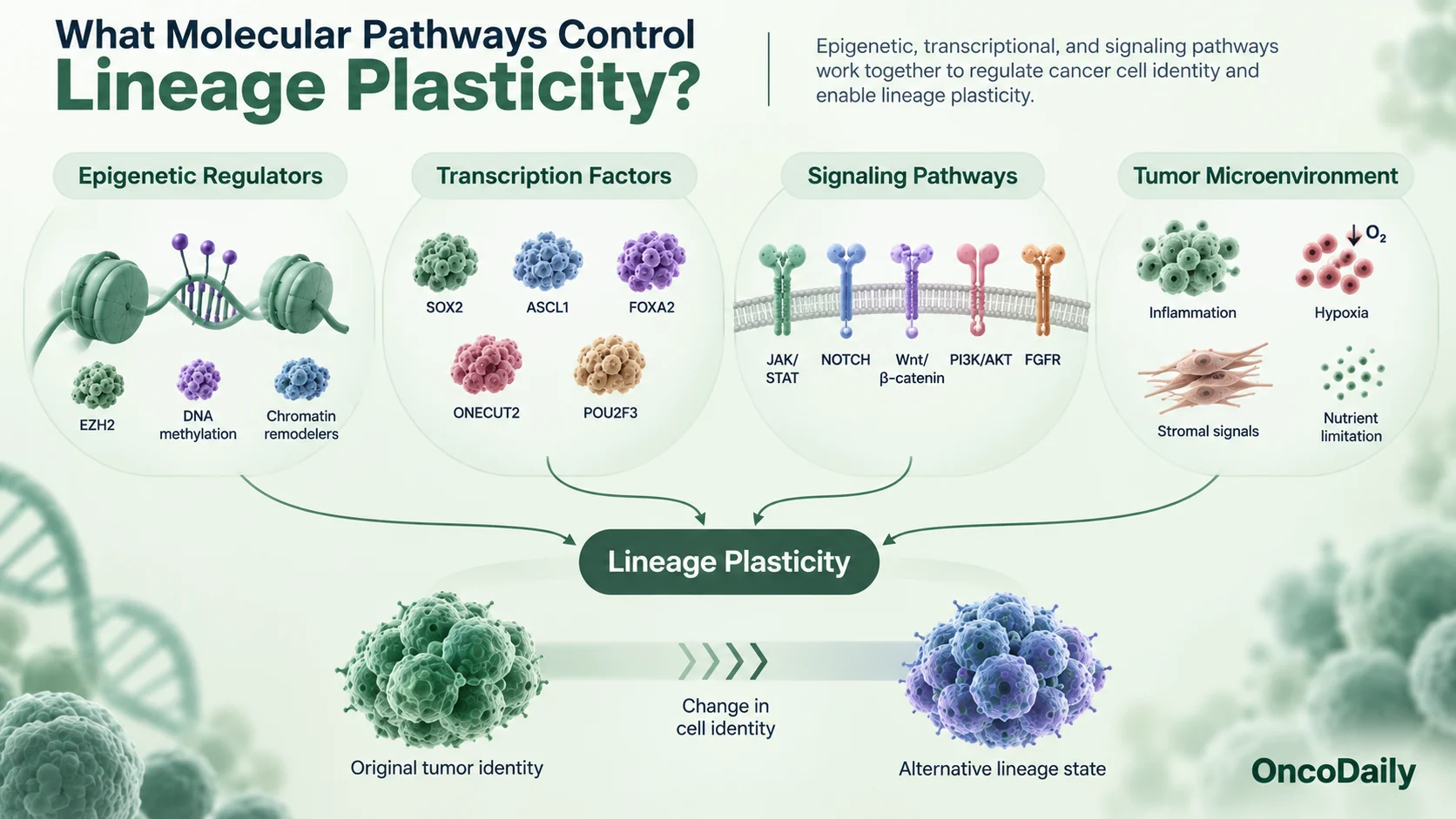
Lineage plasticity is controlled by interacting epigenetic, transcriptional, and signaling pathways that determine which cell-identity programs are active. (Davies et al., 2023; Hu et al., 2026).
Epigenetic regulators play a central role. Proteins such as EZH2, DNA methylation enzymes, chromatin remodelers, and histone modifiers can alter regulatory regions and make it easier for tumor cells to suppress one lineage program and activate another. Changes in 3D chromatin organization can reinforce these transitions. (Qi and Dehm, 2026).
Lineage-defining transcription factors then help establish the new state. Depending on the tumor type, factors such as SOX2, ASCL1, FOXA2, ONECUT2, and POU2F3 can support stem-like, neuroendocrine, or alternative differentiation programs. (Davies et al., 2023).
Signaling pathways including JAK/STAT, NOTCH, Wnt/β-catenin, PI3K/AKT, and FGFR can further influence these transitions, often in response to inflammatory or stromal signals from the tumor microenvironment. (Hu et al., 2026).
These mechanisms rarely act independently. Lineage plasticity usually reflects the interaction between chromatin remodeling, transcription-factor changes, and signaling pathways that together establish a new tumor identity.
Can Lineage Plasticity Be Detected, Prevented, or Targeted?
When histologic transformation is suspected, repeat tissue biopsy with histology and immunohistochemistry remains the most direct way to establish that the tumor has changed phenotype. This is particularly important in settings such as treatment-emergent neuroendocrine prostate cancer. (Haffner et al., 2025; Li et al., 2025).
Molecular profiling can provide additional clues. Alterations involving TP53 and RB1, for example, are associated with an increased tendency toward neuroendocrine transformation in some cancers, but they do not by themselves confirm lineage plasticity. Transcriptional and epigenetic profiling may eventually allow these changes to be recognized earlier. (Li et al., 2025).
Directly preventing lineage plasticity remains experimental. Epigenetic regulators such as EZH2, BET proteins, and DNA methylation pathways are being investigated, but their effects can be highly context-dependent. Recent studies of EZH2, for example, suggest that altering an epigenetic regulator may reshape lineage states rather than simply reverse plasticity. (Jacobi et al., 2026; Thienger et al., 2026).
Another strategy is to redirect tumor cells toward a treatment-sensitive state. In prostate cancer models, targeting the eIF4E cap-binding domain shifted resistant basal-like tumors toward a more luminal phenotype and restored sensitivity to androgen receptor pathway inhibition. (Mishra et al., 2026).
There is currently no approved treatment specifically designed to prevent or reverse lineage plasticity. For now, the clinical priority is recognizing transformation when it occurs and adapting treatment to the tumor’s new phenotype, while therapies that directly target plasticity continue to be investigated. (Li et al., 2025).

FAQ
What is lineage plasticity in cancer?
Lineage plasticity is the ability of cancer cells to change their cellular identity and adopt a different biological state.
How does lineage plasticity cause treatment resistance?
It can make tumor cells less dependent on the pathway a treatment is targeting, allowing them to survive and continue growing.
Which cancers commonly show lineage plasticity?
It is especially well described in prostate cancer and lung cancer, but it is also increasingly recognized in pancreatic, breast, and other cancers.
Is lineage plasticity caused by new mutations?
Not always. It can develop through transcriptional and epigenetic reprogramming without a new dominant resistance mutation.
Can lineage plasticity be targeted with treatment?
Potentially, but this is still an emerging area. Epigenetic and lineage-directed strategies are being studied, while repeat biopsy remains important when transformation is suspected.