For metastatic EGFR-mutant non small-cell lung cancer, histologic transformation to small-cell lung cancer represents one of the most difficult forms of acquired resistance.
The problem is not simply progression on an EGFR tyrosine kinase inhibitor. The tumor changes phenotype.
It adopts the aggressive clinical behavior of SCLC, becomes substantially less dependent on EGFR signaling, and enters a therapeutic space in which evidence is limited and outcomes remain poor. For years, one assumption has been particularly difficult to challenge: immunotherapy is unlikely to help much in EGFR-driven disease, even after transformation.
A new multicenter real-world study published in Lung Cancer now raises a reason to revisit that assumption.
In 59 patients with histologically confirmed SCLC transformation of EGFR-mutant NSCLC, the addition of an immune checkpoint inhibitor to platinum-etoposide was associated with substantially longer survival after transformation than chemotherapy alone.
Median post-transformation overall survival was 17 months with chemotherapy plus immunotherapy versus 9 months with chemotherapy alone, with a hazard ratio for death of 0.327.
This is not randomized evidence, and it is not sufficient to establish a new standard of care. But in one of the least well-defined clinical scenarios in thoracic oncology, it is a signal that deserves attention.
SCLC Transformation Is More Than Another Resistance Mechanism
Resistance to EGFR-targeted therapy can emerge through secondary genomic alterations, bypass signaling pathways and changes in cellular state. SCLC transformation is fundamentally different because it represents lineage plasticity.
The cancer retains its ancestral relationship to the original EGFR-mutant tumor but acquires a neuroendocrine phenotype and clinical behavior resembling SCLC.
Transformation has been reported in approximately 3%–10% of EGFR-mutant NSCLC, although its true incidence is difficult to establish because diagnosis requires repeat tissue sampling and therefore depends on clinicians suspecting the transformation in the first place. The molecular findings in the current cohort illustrate this biological continuity.
Among the 11 patients in whom the transformation specimen could be evaluated for the founder EGFR mutation, 10 retained the original EGFR alteration. TP53 was the most frequently identified co-alteration among patients with available sequencing, with RB1 and PIK3CA alterations also observed.
This is clinically important. The transformed cancer has not necessarily been replaced by an entirely unrelated SCLC clone. Instead, the same cancer appears capable of moving into a different cellular state.
And that raises an important therapeutic possibility:
If lineage transformation changes the phenotype profoundly enough to change sensitivity to chemotherapy, could it also change sensitivity to immunotherapy?
A Rare Population Studied Across 26 Oncology Centers
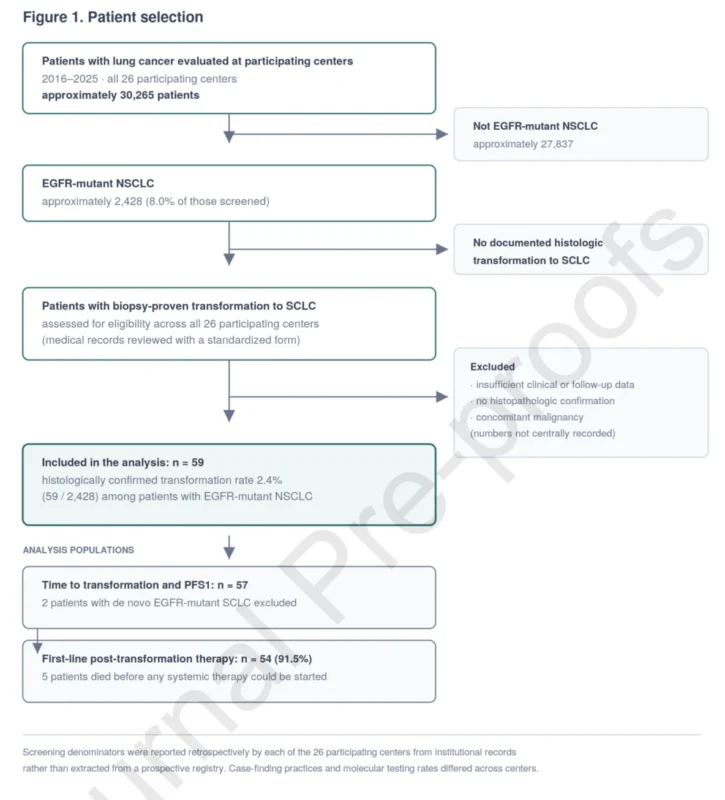
Demir and colleagues conducted a retrospective study across 26 oncology centers in Türkiye between 2016 and 2025.
All included patients had histologically confirmed EGFR-mutant lung cancer followed by biopsy-proven SCLC transformation. Fifty-nine patients were identified, making this one of the larger multicenter real-world datasets examining this specific resistance phenotype.
The median age was 57.8 years, and 76.3% of patients carried an EGFR exon 19 deletion.
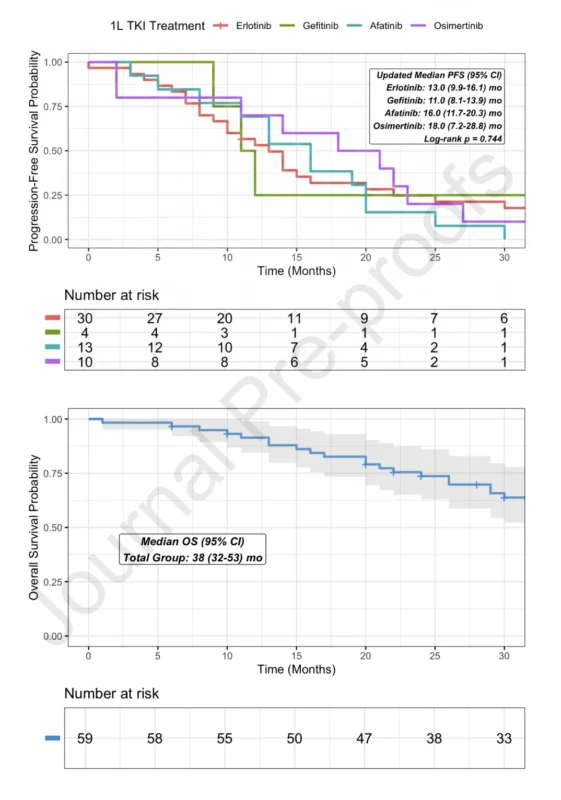
Most patients had initially presented with metastatic disease, and 57 of 59 had received first-line EGFR-TKI therapy. Median progression-free survival on initial EGFR-targeted therapy was 14 months, while the median interval from metastatic diagnosis to histologic SCLC transformation was 22 months.
Importantly, transformation was confirmed by tissue re-biopsy in every patient. The lung was the most common biopsy site, followed by lymph nodes and liver.
That detail is more than methodological. It reinforces one of the most actionable messages from the study: progression on EGFR therapy cannot always be understood from the original molecular diagnosis alone.
When clinical behavior changes, the tumor may need to be redefined.
What Happened After Transformation?
Once SCLC transformation occurred, the prognosis deteriorated rapidly. Fifty-four of 59 patients were able to receive post-transformation systemic treatment. Five patients deteriorated so quickly that treatment could not be initiated.
Among treated patients, 37 received platinum-etoposide alone, 14 received platinum-etoposide plus atezolizumab or durvalumab, two received platinum-etoposide plus osimertinib and durvalumab, and one received platinum-etoposide plus osimertinib.
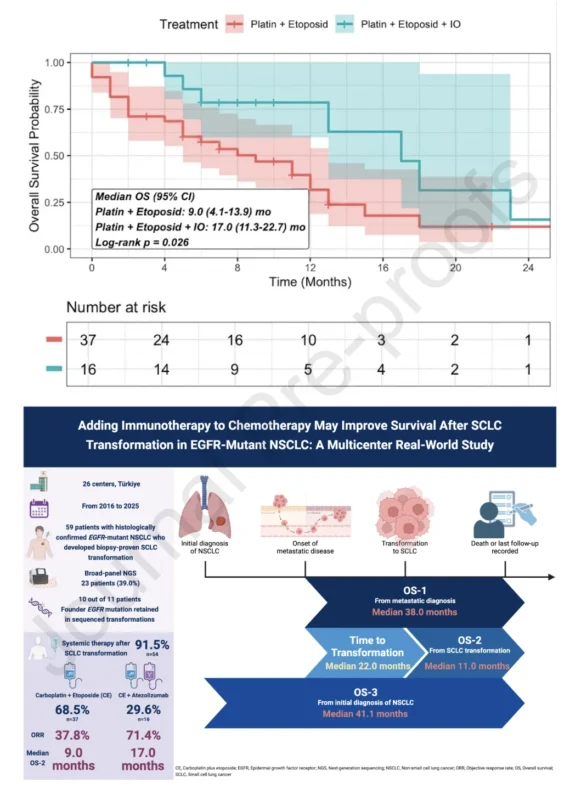
The response signal favored the addition of immunotherapy. Objective response was 37.8% with chemotherapy alone compared with 71.4% among patients treated with chemotherapy plus a checkpoint inhibitor.
But the progression-free survival results were less dramatic. Median post-transformation PFS was 5 months overall. It was approximately 3 months with chemotherapy alone and 5 months with chemotherapy plus immunotherapy, a difference that did not reach statistical significance.
The more provocative finding emerged in overall survival. Among the 53 patients included in the CE-based comparative analysis, median survival from SCLC transformation was:
17.0 months with chemotherapy plus immunotherapy versus 9.0 months with chemotherapy alone. The difference was statistically significant, with a log-rank p=0.026 and HR 0.327 (95% CI 0.139–0.767).
The Kaplan–Meier plot on page 22 makes the survival separation visually clear, although the confidence intervals also reflect the small sample size.
The PFS–OS Disconnect Is Worth Watching
An intriguing aspect of the study is that the apparent overall survival benefit was not accompanied by a statistically significant improvement in PFS.
That should temper interpretation, but it does not necessarily make the finding biologically implausible.
In extensive-stage de novo SCLC, checkpoint inhibitors added to platinum-etoposide have historically produced relatively modest changes in median PFS while improving overall survival, partly through a subset of patients experiencing more durable benefit.
The authors propose that a similar “survival-tail” phenomenon might contribute to the pattern observed here.
That is an interesting hypothesis. But it remains a hypothesis.
The current dataset cannot establish whether the OS difference reflects durable immune benefit, treatment-selection effects, subsequent therapy, or other unmeasured factors. There is another reason for caution.
Overall survival calculated from the original metastatic diagnosis was numerically longer with chemo-immunotherapy, 45 versus 37 months, but was not statistically significant. Similarly, overall survival measured from the original NSCLC diagnosis was 45.4 versus 42.5 months and was also not significantly different.
So the strongest finding is specifically survival after histologically confirmed transformation, rather than a consistent survival advantage across every possible time anchor.
That distinction matters.
Why Is This Signal So Provocative in EGFR-Mutant Disease?
In conventional EGFR-mutant NSCLC, checkpoint inhibition has repeatedly shown limited activity.
EGFR-driven tumors frequently have biological characteristics associated with poorer response to immunotherapy, and checkpoint blockade has generally played a much smaller role than targeted therapy and chemotherapy in this population.
Historical experience after SCLC transformation has also been discouraging. Earlier series reported little activity from immune checkpoint inhibition, and a more recent international retrospective study cited by the authors did not demonstrate a clear benefit from adding immunotherapy to chemotherapy in a smaller cohort of transformed tumors.
The current study therefore challenges an important assumption: The immunotherapy resistance of the original EGFR-mutant adenocarcinoma may not necessarily define the immunotherapy biology of the tumor after SCLC transformation.
Transformation is accompanied by profound transcriptional, phenotypic and potentially immunologic remodeling. The tumor still carries its oncogenic ancestry. But clinically, it may no longer behave like the disease in which that ancestry originated.
This raises a broader precision-oncology question. Should treatment after lineage transformation continue to be dictated primarily by the original driver mutation? Or should the new phenotype increasingly determine the therapeutic strategy?
The answer is unlikely to be binary.
But this study suggests that genotype and phenotype may need to be reconsidered separately after transformation.
Does the Transformed Tumor Become Immunologically “SCLC-Like”?
That is perhaps the most interesting biological question generated by these data. Immunotherapy combined with platinum-etoposide is established in de novo extensive-stage SCLC through studies such as IMpower133 and CASPIAN.
If an EGFR-mutant adenocarcinoma transforms into SCLC, it is reasonable to ask whether some of the immune biology may also move toward the SCLC state.
The current study cannot answer that mechanistically. PD-L1 was available in only 30 patients, and genomic testing at transformation was not systematic. Neither PD-L1 nor DLL3 has been established as a predictive biomarker for checkpoint inhibition in this context.
This is precisely where future studies should go.
Rather than simply comparing chemotherapy with chemo-immunotherapy, prospective investigations should collect transformation tissue systematically and characterize the evolving tumor microenvironment.
Does tumor mutational burden change?
Does antigen presentation change?
Does T-cell infiltration change?
Do TP53/RB1-defined tumors behave differently?
Can immune-sensitive transformed disease be distinguished from immune-resistant transformed disease? The important endpoint may ultimately not be whether all SCLC-transformed EGFR-mutant cancers should receive immunotherapy.
It may be identifying which transformed cancers have undergone enough biological remodeling to become immunotherapy-responsive.
Re-Biopsy May Be the Most Practice-Relevant Message Today
The immunotherapy result is the most attention-grabbing part of the paper. But the recommendation most immediately applicable to clinical practice is probably more fundamental:
- re-biopsy at progression matters.
All 59 patients entered this cohort because transformation was confirmed histologically. Median time to transformation was 22 months, but there was wide variation, with cases occurring from 3 to 110 months after metastatic diagnosis.
The clinical trajectory alone therefore cannot reliably identify transformation. A rapidly progressing lesion, new bulky disease, unexpectedly aggressive behavior, changing metastatic pattern or rising neuroendocrine markers may create suspicion, but tissue is needed to establish that the biology has changed.
The study found that the median interval between documented radiologic progression and transformation biopsy was only 14 days, with approximately 71% of patients biopsied within 30 days, showing that timely re-biopsy is feasible in real-world practice.
This has immediate therapeutic consequences. Continuing to treat a transformed SCLC as conventional EGFR-mutant adenocarcinoma risks treating yesterday’s biology rather than today’s disease.
What About Continuing the EGFR TKI?
Another unresolved issue is whether EGFR inhibition should continue after transformation. Because the founder EGFR alteration frequently persists, there is an intuitive argument for maintaining EGFR blockade, particularly if mixed histologies or persistent adenocarcinoma clones coexist.
In this cohort, however, post-transformation TKI use was heterogeneous. Eleven patients received or reintroduced an EGFR TKI after transformation, and only very small numbers received TKI-containing first-line post-transformation combinations.
The study therefore cannot establish whether continuing osimertinib adds benefit to platinum-etoposide, immunotherapy, or both. That remains an important prospective question.
The persistence of the EGFR mutation should not automatically be interpreted as proof of continued EGFR dependence. Genomic continuity and therapeutic dependence are not the same thing.
Why These Findings Should Not Yet Change the Standard of Care
The magnitude of the observed OS difference is difficult to ignore. But the study has substantial limitations. It was retrospective. Treatment was not randomized. The chemo-immunotherapy population was small.
Molecular testing was incomplete and non-standardized. PD-L1 and DLL3 were not consistently available. TP53 and RB1 status could not be evaluated uniformly across the cohort.
Treatment decisions, pathology assessment and imaging schedules differed between centers. There is also a statistical limitation that deserves particular emphasis.
Although chemo-immunotherapy was associated with lower mortality on univariable Cox analysis, no multivariable model was constructed because treatment regimen was the only variable reaching statistical significance in the univariable analysis.
Therefore, the HR of 0.327 should not be interpreted as an adjusted treatment effect equivalent to what would be expected from a randomized trial. The data show an association. They do not establish causality.
This distinction is especially important in real-world treatment comparisons, where clinicians may select patients for immunotherapy based on factors that are incompletely captured in retrospective databases.
For now, the study should therefore be considered hypothesis-generating rather than practice-defining.
A Different Way to Think About Resistance
There may be a broader lesson here. Precision oncology often approaches resistance by searching for a new molecular target.
SCLC transformation reminds us that cancer can escape targeted therapy in another way: by changing cellular identity. When that happens, the treatment paradigm may need to change with it.
An EGFR-mutant cancer can retain its EGFR mutation while becoming biologically less like EGFR-mutant adenocarcinoma and more like SCLC. This means that precision treatment after progression may require more than another sequencing panel.
It may require reassessing what the tumor has become. And if the current survival signal is confirmed prospectively, the consequences could be clinically meaningful.
Immunotherapy, largely ineffective in conventional EGFR-mutant NSCLC, could potentially regain relevance after a sufficiently profound lineage transformation.
That would be a striking example of therapy being determined not only by the mutation a cancer carries, but by the biological state in which that mutation now exists.
The Bottom Line
SCLC transformation remains one of the most aggressive and poorly defined resistance mechanisms in EGFR-mutant NSCLC. In this 26-center real-world study, median survival after transformation was only 11 months overall, confirming the poor prognosis of this population.
The addition of immunotherapy to platinum-etoposide was associated with a notable survival signal: 17 months versus 9 months with chemotherapy alone, with HR 0.327.
The response rate was also higher with chemo-immunotherapy, although PFS did not improve significantly. These findings challenge the assumption that immunotherapy resistance in the original EGFR-mutant NSCLC necessarily persists after SCLC transformation.
But they do not yet prove that checkpoint inhibition should routinely be added. The study is retrospective, treatment allocation was non-randomized, biomarker characterization was incomplete, and the comparative immunotherapy population was small.
The most actionable message today remains clear:
When EGFR-mutant NSCLC behaves differently at progression, re-biopsy is not simply diagnostic housekeeping, it can redefine the disease and change the treatment strategy.
The next question is whether that transformation also creates a new immunologic vulnerability. This study suggests that it might. Now it needs to be tested prospectively.
Reference
- Demir N, Kıkılı CI, Kemik F, et al. Adding Immunotherapy to Chemotherapy May Improve Survival After SCLC Transformation in EGFR-Mutant NSCLC: A Multicenter Real-World Study. Lung Cancer. 2026. doi:10.1016/j.lungcan.2026.109590. The manuscript was accepted on August 21, 2026.