
The development of targeted therapy has fundamentally changed advanced non–small cell lung cancer from a disease classified primarily by histology into a collection of molecularly distinct malignancies. EGFR mutations, ALK and ROS1 fusions, KRAS alterations, BRAF V600E, RET fusions, HER2 mutations, MET alterations, and NTRK fusions now define therapeutic pathways with markedly different drugs, patterns of resistance, central nervous system behavior, and long-term outcomes.
A new 2026 Series article in The Lancet Respiratory Medicine, “Targeted therapies in advanced non-small-cell lung cancer: new biomarkers and treatment strategies,” provides a broad contemporary assessment of this increasingly complex landscape. The authors emphasize that the progress of precision oncology is no longer measured simply by the number of actionable drivers. New generations of TKIs, bispecific antibodies, antibody–drug conjugates, RAS inhibitors, and emerging synthetic-lethal strategies are changing both the depth and duration of disease control. At the same time, resistance, CNS progression, tumor heterogeneity, long-term toxicity, and unequal access to molecular testing are becoming the next major challenges.
The clinical question has therefore evolved. It is no longer simply whether a genomic alteration is actionable, but how the biology of an individual tumor should determine the choice, intensity, sequence, and adaptation of targeted treatment over time.
Comprehensive Molecular Profiling Is Now the Entry Point to Treatment
The therapeutic diversity of advanced NSCLC makes broad molecular characterization essential at diagnosis. Actionable alterations extend well beyond EGFR and ALK and include ROS1, KRAS, BRAF, RET, HER2, MET, and NTRK, while emerging biomarkers such as NRG1 fusions, MTAP loss, and SMARCA4 deficiency are extending the boundaries of precision medicine further.
Importantly, molecular testing is becoming a longitudinal rather than a one-time diagnostic process. The authors identify comprehensive profiling at both diagnosis and progression as a central principle of contemporary care. Tissue rebiopsy and plasma ctDNA can reveal on-target resistance mutations, bypass-pathway activation, lineage transformation, and other mechanisms that may determine the next therapeutic strategy.
This represents a conceptual change in precision oncology. The first molecular profile identifies the dominant driver and determines initial therapy, but subsequent profiles increasingly describe how that tumor has evolved under treatment pressure. In this model, resistance itself becomes a new biomarker.
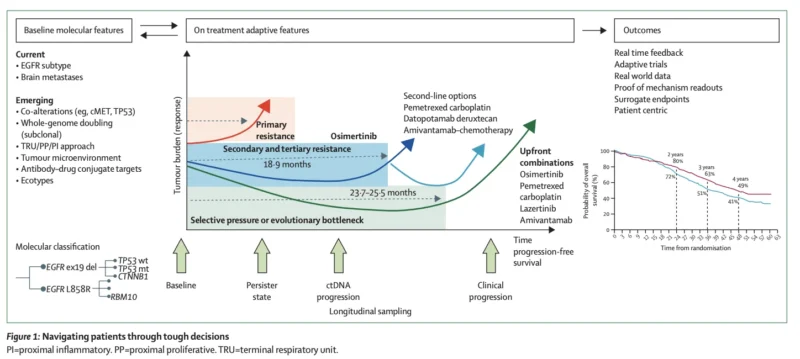
EGFR Treatment Is Moving From Monotherapy Toward Risk-Adapted Intensification
Osimertinib established the modern first-line standard for common EGFR-mutated NSCLC, with FLAURA demonstrating a median PFS of 18.9 months and median OS of 38.6 months. The contemporary question is whether selected patients should receive osimertinib alone or intensified therapy from the outset.
FLAURA2 demonstrated that adding platinum–pemetrexed chemotherapy increased median PFS to 25.5 months and produced an overall survival advantage of approximately 10 months in the overall population, although at the cost of additional predominantly hematologic toxicity. The combination also showed particularly strong intracranial activity in patients with measurable CNS disease.
A second intensification strategy emerged from MARIPOSA, where the EGFR–MET bispecific antibody amivantamab was combined with lazertinib. Median PFS reached 23.7 months, and updated survival data favored the combination over osimertinib, although toxicities including infusion-related reactions, dermatologic events, paronychia, and venous thromboembolism add complexity to treatment selection.
These developments make first-line EGFR treatment increasingly individualized. The appropriate choice may depend on CNS involvement, disease burden, anticipated resistance biology, toxicity tolerance, treatment burden, financial considerations, and patient preference rather than on the EGFR mutation alone.
The larger question is whether treatment should remain sequential, beginning with a highly active TKI and adding therapies as resistance emerges, or whether high-risk disease should receive combination therapy immediately to delay resistance before it becomes clinically established.
Resistance Is Becoming a Therapeutic Target in Its Own Right
Despite increasingly effective first-line EGFR therapy, resistance remains inevitable for most patients. Post-osimertinib disease is biologically heterogeneous, with mechanisms including MET amplification, EGFR C797S, HER2 or RAS–MAPK bypass signaling, and transformation to small-cell or squamous histology.
MET-directed combinations represent one of the most advanced examples of resistance-matched treatment. In INSIGHT-2, tepotinib plus osimertinib produced an ORR of 50% in MET-amplified disease, while savolitinib-based therapy in SAVANNAH achieved an ORR of approximately 55% in tumors with high-level MET alterations.
However, the review also highlights why resistance is difficult to solve with a single additional targeted drug. Resistant tumors may contain several competing subclones, and lineage plasticity can fundamentally alter tumor dependence on the original oncogenic pathway. The failure of some biomarker-agnostic approaches—including the negative phase III HERTHENA-Lung02 trial—illustrates that plausible biology does not always translate into improved outcomes.
Future treatment may therefore require real-time molecular surveillance and adaptive combination therapy, rather than waiting for one dominant resistance mechanism to become clinically obvious.
ALK Demonstrates What Long-Term Targeted Disease Control Can Look Like
ALK-positive NSCLC provides perhaps the clearest example of how successive generations of targeted therapy can transform metastatic disease.
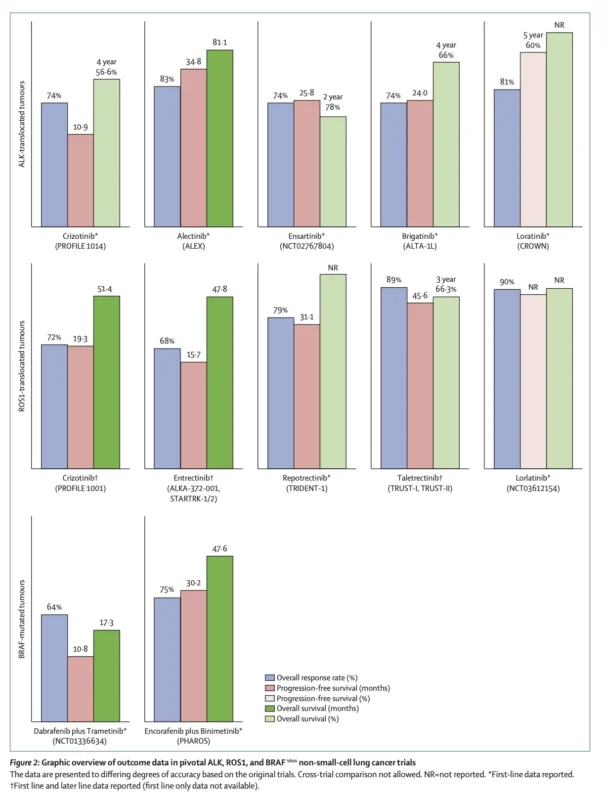
The CROWN trial established the extraordinary durability of first-line lorlatinib. At five years, 60% of patients remained progression-free, with an HR for progression or death of 0.19 versus crizotinib. With seven years of follow-up, median PFS was still not reached and the estimated seven-year PFS rate remained 55%. Intracranial control was particularly durable, with no new intracranial progression events reported after the first 30 months of therapy in the updated analysis.
These results demonstrate why CNS penetration has become a defining property of next-generation targeted agents. In molecularly driven NSCLC, preventing brain metastases can be as important as controlling extracranial disease.
But long survival also changes how toxicity should be assessed. Hyperlipidemia, weight gain, edema, neuropathy, and neurocognitive effects with lorlatinib may persist for years, whereas other ALK inhibitors such as alectinib have different chronic toxicity profiles. As patients remain on targeted therapies for increasingly long periods, therapeutic quality can no longer be judged solely by response rate or median PFS.
The best first-line therapy must increasingly combine potency with durability, CNS activity, resistance coverage, and sustainable long-term tolerability.
ROS1 Is Following the Same Next-Generation Path
ROS1-positive disease has undergone a similar evolution. Crizotinib established the first targeted standard, with response rates around 68–72% and median PFS of approximately 16–19 months. Newer CNS-penetrant inhibitors are now producing substantially longer disease control.
Repotrectinib achieved a median PFS of 31.1 months in TKI-naïve patients, while taletrectinib produced a median PFS of 46.1 months in TKI-naïve disease in pooled TRUST analyses. Both drugs also demonstrate activity against CNS disease and important resistance mutations, including ROS1 G2032R.
Development is continuing beyond currently available TKIs. Agents such as neladalkib in ALK-positive disease and zidesamtinib in ROS1-positive disease are specifically designed to retain activity against resistant tumors while maintaining CNS penetration.
This reinforces a broader principle: the evolution of targeted therapy increasingly involves designing the next drug around the weaknesses of the previous one.
KRAS Is Rapidly Moving Beyond G12C
Perhaps no part of the landscape better illustrates the expansion of precision oncology than KRAS.
Once considered undruggable, KRAS G12C became clinically targetable with sotorasib and adagrasib. Both drugs improved response rate and PFS compared with docetaxel in previously treated disease, although the therapeutic benefit remains more modest than that seen with highly oncogene-dependent targets such as ALK or RET.
The next generation of KRAS development is considerably broader. New G12C inhibitors are being combined with immunotherapy, chemotherapy, EGFR blockade, and SHP2 inhibition, while RAS(ON) agents directly target the active GTP-bound state.
Mutation-specific development is also moving into KRAS G12D. Zoldonrasib produced an ORR of 52% and median PFS of 11.1 months in a small previously treated NSCLC cohort, while additional G12D inhibitors and targeted degraders are progressing clinically.
Even more conceptually important are pan-RAS approaches. Daraxonrasib targets active RAS across multiple variants rather than one specific allele; in previously treated NSCLC with non-G12C KRAS mutations, the review reports an ORR of 38% and median PFS of 9.8 months.
The direction of development is therefore shifting from one drug for one KRAS mutation toward broader inhibition of the RAS signaling state itself.
Rare Drivers Are Becoming Clinically Relevant
The molecular long tail of NSCLC is also becoming increasingly actionable.
RET fusion-positive disease is one of the clearest examples. Selpercatinib has produced high systemic and intracranial response rates, including an ORR of approximately 84% in the first-line LIBRETTO-431 setting, with median PFS of 24.8 months.
HER2-mutant NSCLC has similarly transitioned from historically disappointing HER2-directed approaches toward active ADCs and mutation-selective TKIs. Trastuzumab deruxtecan established substantial activity in previously treated disease, while newer agents such as zongertinib reflect the shift toward more selective HER2 inhibition.
For MET exon 14 skipping disease, capmatinib and tepotinib have produced clinically meaningful activity, particularly in treatment-naïve patients. Capmatinib achieved an ORR of 68% with median PFS of 12.4 months in the first-line setting, while tepotinib produced a first-line ORR of 57%. Savolitinib has also shown activity in this molecular subgroup.
MET biology is also expanding beyond exon 14 skipping. In MET-high NSCLC, the MET-directed ADC telisotuzumab vedotin produced an ORR of 34.5%, median PFS of 5.5 months, and median OS of 14.3 months in the c-MET-high population, supporting another therapeutic approach based on protein expression rather than a canonical driver mutation.
NTRK and NRG1 illustrate why broad sequencing matters even when alterations are exceptionally rare. NRG1 fusions occur in fewer than 0.3% of NSCLC, yet HER2×HER3 bispecific targeting with zenocutuzumab has demonstrated clinical activity, including an ORR of 29% in previously treated NSCLC.
The practical implication is straightforward: rarity does not diminish actionability if the alteration is never tested for in the first place.
Precision Oncology Is Moving Beyond Classical Oncogenic Drivers
The review also looks beyond established kinase drivers toward molecular vulnerabilities that may define the next generation of targeted therapy.
One example is MTAP loss, present in approximately 13% of advanced NSCLC. MTAP deletion creates a biological dependency involving PRMT5, generating a synthetic-lethal opportunity for selective PRMT5 or MAT2A inhibition. Several agents are in early clinical development, although the discontinuation of anvumetostat despite initial activity illustrates how early signals must be validated rigorously.
Another emerging area is SMARCA4 deficiency, found in approximately 8–10% of NSCLC and associated with aggressive disease. Loss of SMARCA4 creates a dependency on the related chromatin-remodeling protein SMARCA2, which is now being explored with selective inhibitors and protein degraders. Clinical evidence, however, remains early.
STK11 and KEAP1 are different again. Rather than being conventional oncogenic drivers, these alterations identify biologically adverse subgroups associated with poorer prognosis and reduced benefit from PD-L1 monotherapy, especially when co-occurring with KRAS. Therapeutic approaches designed specifically for these tumors remain investigational.
These examples show that precision oncology is expanding beyond the classic question of which kinase should be inhibited. Future biomarkers may identify synthetic-lethal vulnerabilities, immune-resistant states, protein-expression phenotypes, and chromatin-remodeling dependencies.
CNS Control Is Becoming a Core Measure of Targeted-Therapy Quality
As systemic targeted therapies become more effective, the brain increasingly becomes a critical determinant of long-term disease control.
The development of highly CNS-penetrant EGFR, ALK, ROS1, RET, and other targeted agents has already changed practice. For many patients, clinicians can now prioritize effective systemic treatment with close CNS surveillance rather than routinely using immediate cranial radiotherapy.
However, the optimal integration of stereotactic radiotherapy remains unsettled. The review notes that in EGFR-mutated NSCLC, pooled randomized STARLET data did not demonstrate an improvement in 12-month intracranial PFS from adding stereotactic radiotherapy to osimertinib in patients with up to ten treatable brain metastases. Evidence for many rarer molecular subgroups is even more limited.
The future therefore requires trials that evaluate not only systemic PFS but also intracranial progression, neurocognition, quality of life, and the interaction between highly CNS-active targeted therapy and local treatment.
Oligoprogression Challenges the Traditional Definition of Treatment Failure
Targeted therapy has also changed how progression itself is interpreted. A patient may achieve prolonged systemic control while developing progression in only one or a few resistant lesions. Increasingly, stereotactic radiotherapy or surgery is used to ablate these sites while the effective targeted therapy is continued.
The objective is to delay the need for a completely new systemic treatment and preserve control of the tumor clones that remain sensitive to the current drug. However, the review emphasizes that the magnitude of benefit and the toxicity of this strategy remain incompletely defined, and randomized evidence is still awaited.
This illustrates an important evolution in metastatic oncology: radiographic progression does not necessarily mean global therapeutic failure. In selected molecularly driven cancers, the biology and distribution of progression may be more informative than RECIST progression alone.
Long-Term Tolerability Is Becoming an Efficacy Issue
When targeted therapy extends disease control for years, chronic toxicity becomes inseparable from treatment effectiveness. Metabolic, neurocognitive, dermatologic, gastrointestinal, and other adverse effects can lead to dose modification, polypharmacy, treatment interruption, and eventually discontinuation. Two drugs with similar response rates may therefore have very different value when treatment is expected to continue for several years.
The authors argue that future studies should give greater attention to time to treatment failure, longitudinal patient-reported outcomes, cumulative toxicity burden, and inclusion of older patients and those with comorbidities who remain underrepresented in pivotal trials.
This is particularly important as first-line choices become more crowded. The most intensive regimen is not automatically the optimal regimen for every patient.
From Static Biomarkers to Adaptive Treatment
The most forward-looking message from the review concerns what happens after treatment begins. Resistance mechanisms include on-target mutations, bypass signaling, drug-tolerant persister states, lineage plasticity, adaptive resistance, and failure of drug penetration into sanctuary sites such as the CNS.
Instead of studying these mechanisms retrospectively after conventional progression, the authors envision a future in which tissue and plasma profiling follow tumor evolution longitudinally. Adaptive clinical trials could then assign combinations or subsequent therapies according to resistance biology emerging in real time.
The conceptual progression is substantial:
- diagnosis → identify driver → choose therapy
is evolving toward:
- identify driver → treat → monitor evolution → detect resistance → adapt therapy → repeat.
Precision oncology is becoming less like a single treatment-selection event and more like continuous biological management of an evolving cancer.
Precision Medicine Cannot Work Without Access
The enormous scientific progress described in the review comes with an important global limitation. Comprehensive NGS profiling is increasingly routine in many high-income healthcare systems, yet access remains restricted in many low- and middle-income countries because of cost, infrastructure, tissue availability, and turnaround time. Even within Europe, substantial variation in testing and reporting can delay delivery of biomarker-matched therapy.
This creates a fundamental contradiction in modern lung cancer care. The number of targetable alterations can continue to increase, but those advances have little clinical value for patients who never receive adequate molecular testing.
Equitable precision oncology therefore requires more than developing better drugs. It requires faster testing, broader NGS availability, reliable access to brain imaging, molecularly informed multidisciplinary care, and affordable access to the therapies identified by those tests.
The Bottom Line
The 2026 Lancet Respiratory Medicine review demonstrates how rapidly the definition of “targetable” advanced NSCLC is expanding. Established molecular pathways including EGFR, ALK, ROS1, KRAS, BRAF, RET, HER2, MET, and NTRK are being joined by rarer fusions, novel RAS states, synthetic-lethal targets, and molecularly defined adverse subgroups.
The therapeutic objective is also evolving. The next generation of targeted treatment will need to provide not only high response rates but durable systemic and intracranial control, activity against resistant clones, sustainable long-term tolerability, and strategies for adapting therapy as the tumor evolves.
Perhaps the most important shift is therefore from precision treatment to adaptive precision treatment. Comprehensive molecular profiling identifies the disease at baseline; longitudinal tissue and ctDNA analysis may increasingly determine how that disease should be treated months or years later.
The future of advanced NSCLC will not be defined simply by finding more targets. It will depend on learning how to anticipate resistance, adapt treatment in real time, preserve CNS control, manage long-term toxicity, and ensure that molecular advances actually reach the patients who need them.
Reference
- Hendriks LEL, Lin JJ, Tan DSW, et al. Targeted therapies in advanced non-small-cell lung cancer: new biomarkers and treatment strategies. The Lancet Respiratory Medicine. Published online September 6, 2026. doi:10.1016/S2213-2600(26)00253-5.