Tattoos and cancer have become a growing topic of scientific interest as researchers investigate the long-term health effects of tattoo ink. Recent studies have examined whether tattoos may increase the risk of certain cancers, particularly lymphoma and melanoma. While some findings suggest a possible association, others have found no increased risk, leaving the relationship between tattoos and cancer uncertain.
Tattoo pigments can remain in the skin for years, and some particles can travel to nearby lymph nodes. Certain inks also contain chemicals that have raised concerns about their long-term safety. However, current scientific evidence does not establish that tattoos cause cancer.
Understanding what research has found about tattoos and cancer, how tattoo ink affects the body, and which precautions may reduce health risks can help people make informed decisions about their skin health.
Is There a Link Between Tattoos and Cancer?
There is currently no confirmed causal relationship between tattoos and cancer. Some studies have reported possible associations with lymphoma and melanoma, but the findings have not been consistent across different populations.
One reason researchers are interested in this question is the composition of tattoo ink. Certain pigments and contaminants may contain potentially harmful substances, and some ink particles can travel through the lymphatic system. Whether these exposures contribute to cancer development in humans remains unclear (IARC, 2026).
It is important to understand the difference between an association and a cause. Finding a higher cancer rate among people with tattoos does not necessarily mean that tattoos caused those cancers. Other factors, including smoking, sun exposure, skin type, and lifestyle, may influence the results.
For example, a reported 21% increase in relative cancer risk does not mean that 21% of tattooed people will develop cancer. It means the estimated risk was 21% higher than that of the comparison group. The actual number of additional cases depends on how common the cancer is.
The more established health risks of tattooing include infections, allergic reactions, and skin inflammation. Researchers continue to investigate whether long-term tattoo exposure is associated with cancer.
What Does Recent Research Say About Tattoos and Cancer?
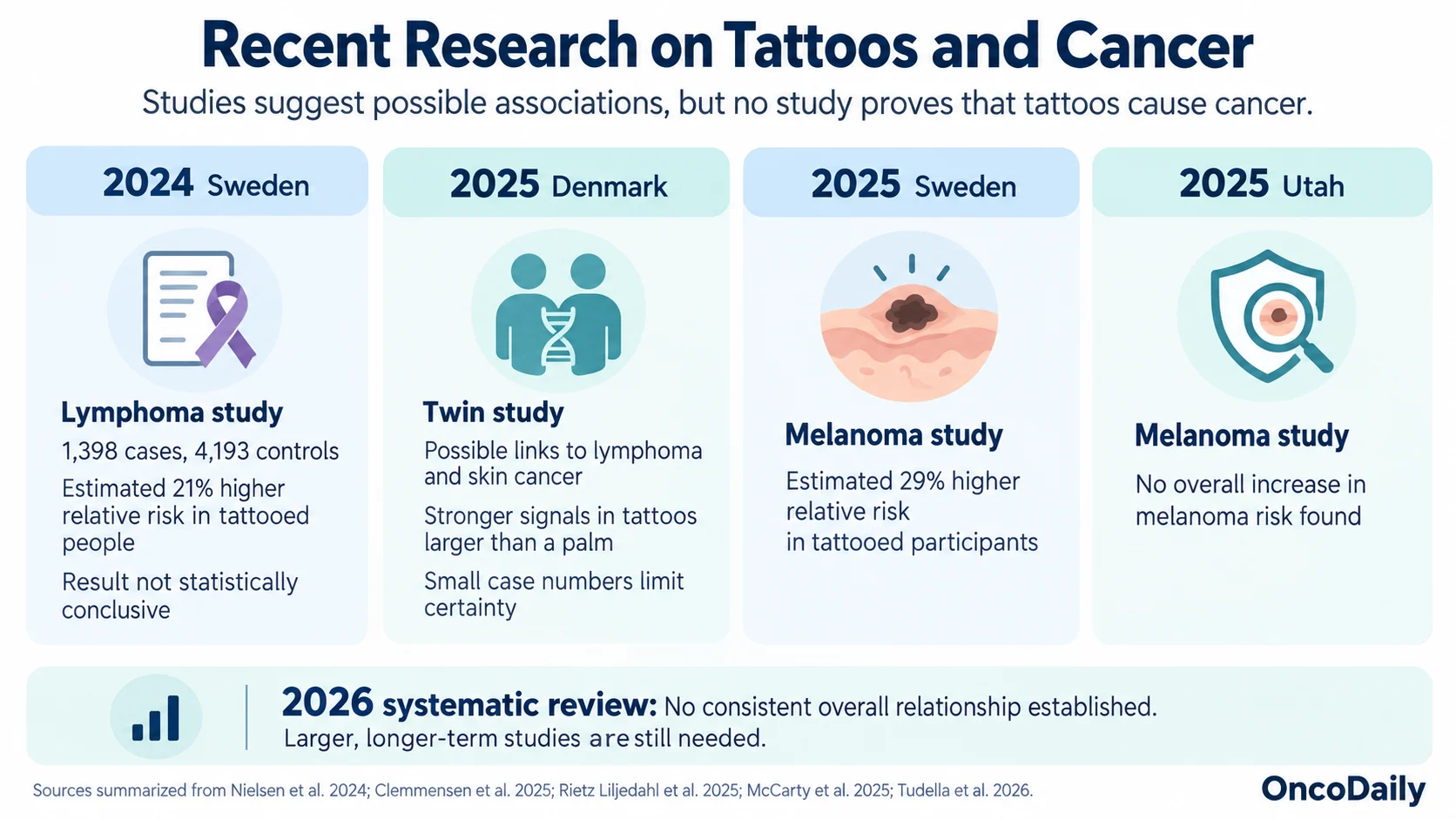
Several studies published between 2024 and 2026 have investigated the relationship between tattoos and cancer, particularly lymphoma and melanoma. Their findings have raised important questions, but they have not provided a definitive answer.
A 2024 Swedish study involving 1,398 lymphoma patients and 4,193 controls reported an estimated 21% higher relative risk of lymphoma among tattooed individuals. However, the main result was not statistically conclusive, and researchers found no consistent relationship between tattoo size and lymphoma risk (Nielsen et al., 2024).
In 2025, a Danish twin study also reported possible associations between tattoos, lymphoma, and skin cancer. Some of the strongest associations were observed among people with tattoos larger than the palm of a hand, although the relatively small number of cancer cases limited the certainty of the findings (Clemmensen et al., 2025).
Studies examining melanoma have produced different results. A Swedish study reported a 29% higher relative risk of melanoma among tattooed participants, while a study conducted in Utah found no overall increase in melanoma risk (Rietz Liljedahl et al., 2025; McCarty et al., 2025).
A systematic review and meta-analysis published in 2026 also examined the available evidence. Its findings did not establish a consistent relationship between tattoos and cancer, reinforcing the need for larger studies with longer follow-up (Tudella et al., 2026).
These differences may reflect variations in study methods, tattoo exposure, sun protection, skin type, and other risk factors. Many studies also rely on people recalling when they received tattoos, their size, and other details, which can affect the accuracy of the results.
Are Tattoos Associated With Lymphoma and Other Blood Cancers?
Lymphoma is a cancer that develops in lymphocytes, a type of white blood cell involved in the immune system. Researchers have become interested in whether tattoos could affect lymphoma risk because tattoo pigments can accumulate in lymph nodes.
The Swedish study by Nielsen et al. (2024) suggested a possible increase in lymphoma risk among tattooed individuals, including certain subtypes such as diffuse large B-cell lymphoma and follicular lymphoma. However, the estimates were uncertain, and the study could not establish a direct connection between tattoo exposure and lymphoma.
The Danish twin study found that people with tattoos larger than the palm of a hand had approximately 2.7 times the estimated lymphoma hazard compared with those without tattoos. This finding raised questions about whether greater ink exposure might influence risk, although the number of affected participants was small (Clemmensen et al., 2025).
One possible explanation is that tattoo pigments remain in lymph nodes and may influence immune activity or inflammation over time. However, pigment accumulation has not been shown to cause lymphoma in humans.
Research concerning other blood cancers, including leukemia and multiple myeloma, is more limited and has not demonstrated a consistent association with tattoos.
Lymphoma remains relatively uncommon, and the available findings should not be interpreted as evidence that people with tattoos are likely to develop blood cancer.

Can Tattoos Increase the Risk of Melanoma and Skin Cancer?
Current research has not established tattoos as a cause of melanoma or other skin cancers. Although some observational studies have suggested a possible association, others have found no increased risk.
A Swedish study published in 2025 reported a 29% higher relative risk of melanoma among tattooed participants. In contrast, research from Utah found no overall association between tattoos and melanoma. The Utah researchers also observed lower melanoma rates among some participants with more extensive tattoo exposure, although this does not mean tattoos protect against melanoma (Rietz Liljedahl et al., 2025; McCarty et al., 2025).
Evidence concerning other skin cancers is also mixed. Research from Sweden found no significant increase in cutaneous squamous cell carcinoma, while the Danish twin study reported possible associations with certain skin cancers.
One important factor is ultraviolet (UV) radiation, a well-established cause of skin cancer. Sun exposure, tanning-bed use, skin type, and family history may influence melanoma risk and make it difficult to determine whether tattoos have an independent effect.
Melanoma can develop within tattooed skin, but reported cases are uncommon. Their occurrence does not necessarily mean tattoo ink caused the cancer (Kluger et al., 2025).
There is also a practical concern: dark tattoo pigments can make changes in existing moles harder to recognize. This may complicate early detection, particularly when a suspicious lesion develops within a heavily tattooed area.
How Does Tattoo Ink Affect the Skin and Lymph Nodes?
During tattooing, needles deposit ink into the dermis, the deeper layer of the skin. Much of the pigment remains there, held inside immune cells called macrophages. Some particles, however, can travel through lymphatic vessels and accumulate in nearby lymph nodes.
Tattoo inks contain different pigments and chemical compounds, including metals, polycyclic aromatic hydrocarbons (PAHs), and aromatic amines. Some of these substances have potentially carcinogenic properties, although their presence in tattoo ink does not automatically mean that tattooing causes cancer (Czaczkowska et al., 2026).
Tattooing also produces an inflammatory response as the skin heals. In most people, this settles, but some develop persistent irritation, allergic reactions, or small inflammatory nodules called granulomas.
A 2025 experimental study found that tattoo pigments accumulating in lymph nodes could trigger prolonged immune activity. While this provides insight into how tattoo ink interacts with the immune system, it does not demonstrate that this inflammation leads to cancer in humans (Capucetti et al., 2025).
Researchers are also investigating whether tattoo size and color influence long-term health risks. Larger tattoos generally involve greater pigment exposure, while different colors may contain different chemical substances. However, there is not enough evidence to identify a particular tattoo color or size as a confirmed cancer risk factor.
The long-term effects of pigment accumulation remain an important area of research.
How Can You Reduce the Health Risks of Tattoos?
Although not every tattoo-related health risk can be prevented, choosing a professional tattoo studio and taking proper care of the skin can reduce the likelihood of complications.
Before getting a tattoo, choose a licensed studio that follows appropriate hygiene and sterilization procedures. Tattoo artists should use sterile, single-use needles, clean equipment, and properly labeled inks. Poor hygiene or contaminated products can lead to bacterial infections and, in some circumstances, transmission of hepatitis B or C (FDA, 2026).
After tattooing, following the recommended aftercare instructions can help the skin heal and reduce infection risk. Once healed, tattooed skin should be protected from excessive sun exposure using clothing or broad-spectrum sunscreen with SPF 30 or higher.
Avoid tattooing directly over existing moles, as pigments can make changes in their appearance more difficult to detect. The European Academy of Dermatology and Venereology recommends keeping moles visible, particularly in people with multiple moles or a history of melanoma (EADV, 2024).
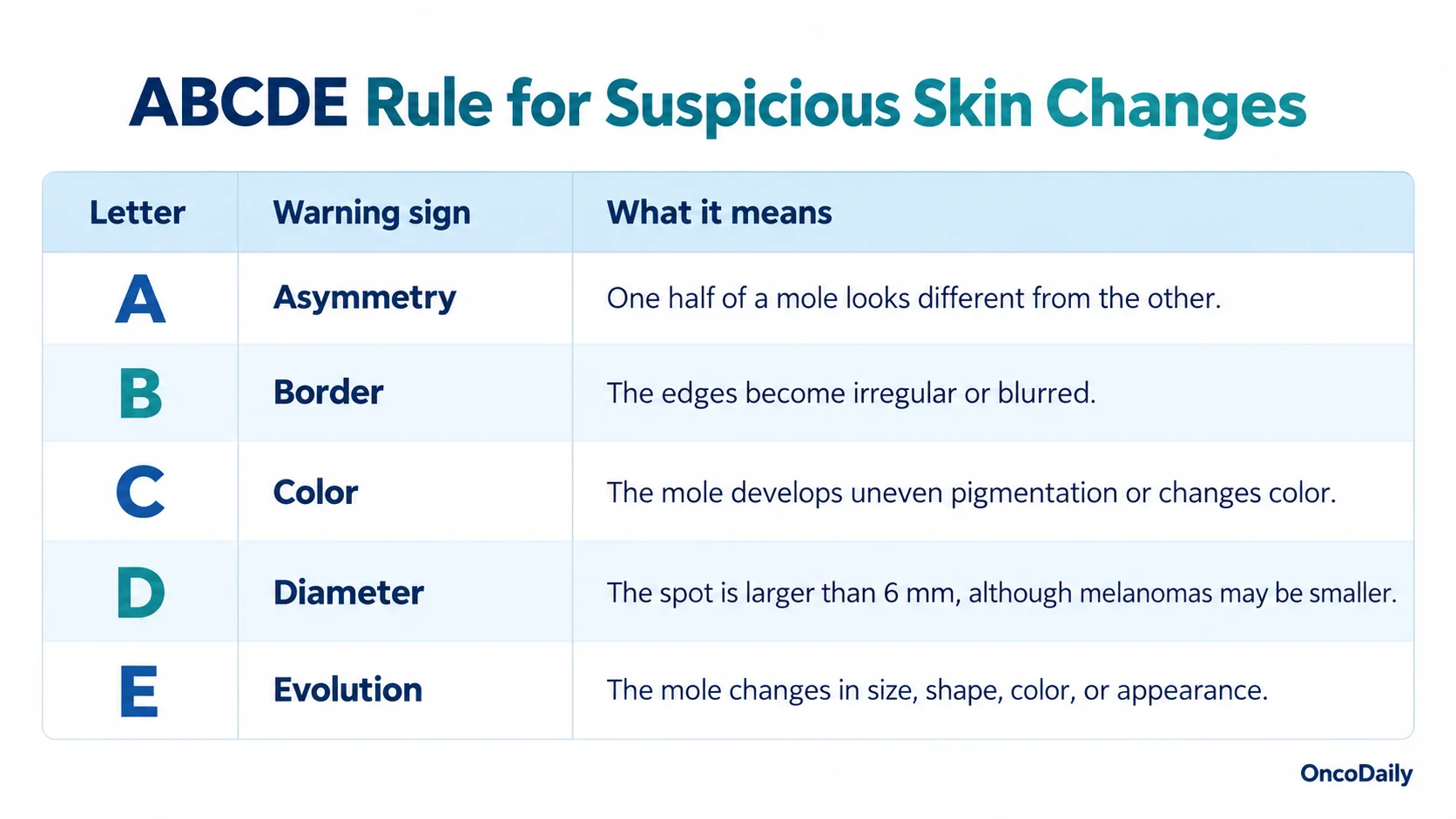
The ABCDE rule can help identify suspicious changes:
- A – Asymmetry: One half of a mole looks different from the other.
- B – Border: The edges become irregular or blurred.
- C – Color: The mole develops uneven pigmentation or changes color.
- D – Diameter: The spot is larger than 6 mm, although melanomas may be smaller.
- E – Evolution: The mole changes in size, shape, color, or appearance.
New or changing spots, persistent bleeding, unusual growths, or sores that do not heal should be examined by a dermatologist.
There is currently no evidence that tattoo removal prevents cancer. Laser removal breaks down pigments into smaller particles and can cause irritation, pigmentation changes, or scarring. Anyone considering removal should discuss the procedure with a qualified dermatologist.
Are Tattoos Safe During or After Cancer Treatment?
Getting a tattoo during active cancer treatment is generally discouraged, particularly when treatment affects the immune system, blood counts, or wound healing.
Chemotherapy can lower white blood cell counts, making it more difficult for the body to fight infections. Low platelet counts may also increase bleeding and bruising during tattooing. These risks are especially important for patients who are already recovering from surgery or receiving treatments that affect skin healing (Foster and Sokhn, 2023).
After cancer treatment, getting a tattoo may be possible once the patient has recovered sufficiently. However, the timing depends on the type of treatment, blood counts, skin condition, and overall health.
Patients who have undergone surgery or radiation should avoid tattooing over areas that have not fully healed. For breast cancer survivors, decorative tattoos over surgical scars require particular care, as scars may take a year or longer to mature. Patients who have undergone lymph node removal or radiation should also discuss tattoo placement with their medical team, particularly if they have lymphedema (Breast Cancer Now, 2024).
There is no universal waiting period after cancer treatment. Patients considering a tattoo should first speak with their oncology team to determine whether the timing and location are appropriate.
If increasing redness, swelling, discharge, worsening pain, or fever develops after tattooing, medical assessment is important because these may be signs of infection.
FAQ
Can tattoos cause cancer?
Current research has not established that tattoos cause cancer. Some studies suggest possible associations with lymphoma and melanoma, but the findings remain inconsistent, and further research is needed.
Do tattoos increase the risk of lymphoma?
Some studies have reported a higher relative risk of lymphoma among people with tattoos. However, a direct causal relationship has not been proven, and lymphoma remains relatively uncommon.
Can tattoo ink cause melanoma or skin cancer?
There is no conclusive evidence that tattoo ink causes melanoma or other skin cancers. However, dark tattoo pigments can make changes in existing moles harder to detect.
Are certain tattoo colors more likely to cause cancer?
No specific tattoo color has been proven to increase cancer risk. Different inks contain different pigments and chemicals, but their long-term effects are still being studied.
Is it safe to get a tattoo after cancer treatment?
Getting a tattoo may be safe after recovery, depending on blood counts, immune function, and wound healing. Patients should consult their oncology team before tattooing, particularly after chemotherapy, surgery, or radiation therapy.