Contact Interventional Radiotherapy (cIRT) has emerged as a key treatment modality for non-melanoma skin cancers (NMSC), such as basal cell carcinoma (BCC) and squamous cell carcinoma (SCC), which collectively account for more than 80% of skin cancers worldwide.
This approach is particularly advantageous due to its precision in dose delivery, resulting in excellent cosmetic outcomes. Furthermore, for patients who are unfit for surgery or have comorbidities, cIRT serves as a reliable option that avoids significant disfigurement.
Recent advancements in applicator designs, particularly the use of curved applicators, have shown promising results in enhancing dose distribution, especially in complex anatomical regions.
This study explores the impact of applicator curvature on the dosimetric parameters and introduces the concept of the “Nautilus Effect”, a phenomenon describing how curvature-induced changes affect dose coverage and the therapeutic window (TW).
Materials and Methods
In this study, twelve Regions of Interest (ROIs) were contoured using the Oncentra Brachy treatment planning system. These ROIs, in the form of three-dimensional circular crowns, were designed with uniform thickness (t = 5 mm) and varying radii (R) ranging from 15 mm to 255 mm.
Each ROI represented a clinical target volume (CTV), which was treated using a Flexitron afterloader system. Dwell positions were activated for each catheter to ensure full coverage of the CTV depth, maintaining a uniform treatment dose of 5 Gy. The primary dosimetric parameters measured included the therapeutic window (TW) and the mean dose delivered to the CTV.
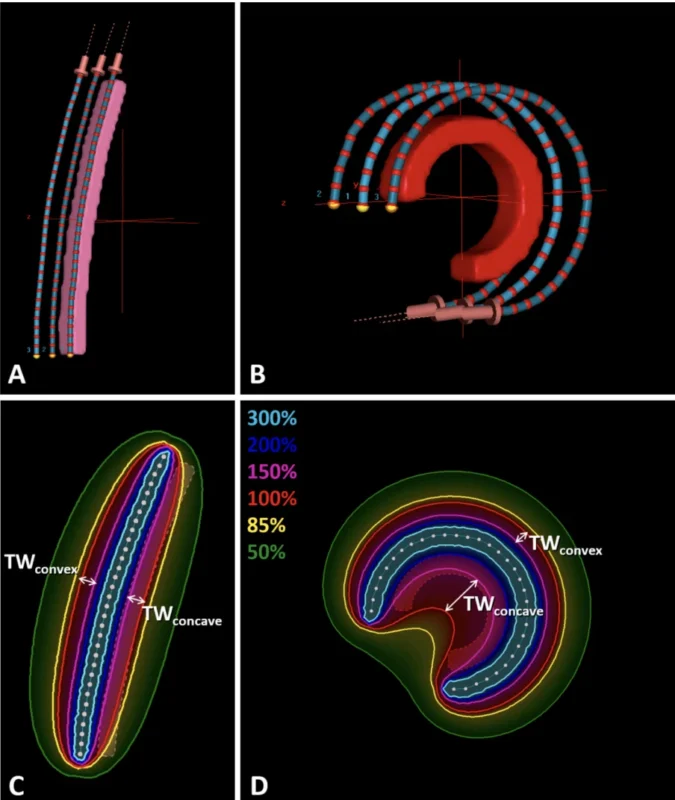
Examples of CTVs with the least (A) and greatest (B) curvature, illustrating how the catheters ensure full coverage of the CTV depth while using the same number of activated dwell positions (32 per catheter). (C) and (D) depict the method used to measure TW convex and concave for the same two CTV examples.
Results
The study demonstrated a clear relationship between applicator curvature and dose distribution. As the curvature increased, the concave therapeutic window (TW) decreased, while the convex TW showed an increase. This finding illustrates the influence of curvature on dose distribution: in concave regions, increased curvature enhances dose coverage, while in convex regions, dose coverage is more challenging.
The concept of the “Nautilus Effect” was confirmed, showing that varying curvatures lead to asymmetric changes in the therapeutic window, with concave regions experiencing a reduction in TW, while convex regions experience a widening of TW. These findings underscore the potential of curved applicators to optimize dose delivery in anatomically challenging regions.
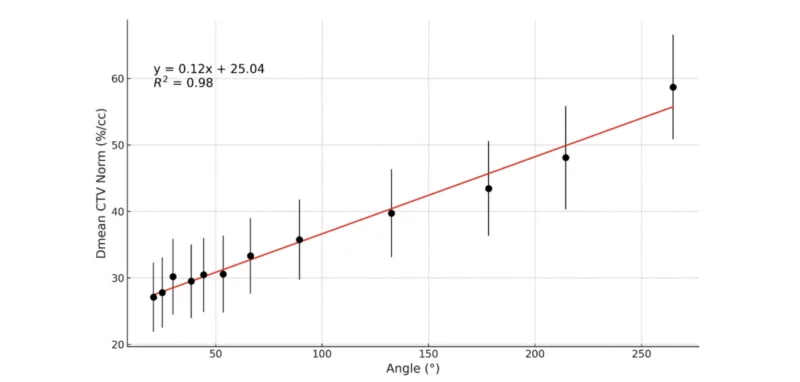
Correlation between the mean dose delivered to the CTV (Dmean CTV) normalized to the CTV Volume (%) and the curvature angle (◦) of the applicator.
Discussion
The results highlight the crucial role of applicator curvature in optimizing dose distribution for skin cancer treatment. The positive correlation observed between increased curvature and enhanced dose coverage is significant. Notably, the “Nautilus Effect” offers insight into how curvature-induced changes in dose distribution affect clinical outcomes.
In concave regions like the ear, curved applicators provide better conformity to the lesion, ensuring more effective radiation delivery. Conversely, convex regions, such as the area between the eyes, present a greater challenge due to the difficulty of achieving optimal dose distribution.
Previous studies have shown similar results, with findings indicating that deviations in dose delivery can be as high as 15% when curvature is not accounted for during treatment planning.
Brachytherapy for Skin Cancer: Types, Success Rate, Side Effects And More
Conclusions
This study underscores the importance of applicator curvature in enhancing dose distribution and therapeutic outcomes in cIRT for NMSC. The introduction of the “Nautilus Effect” provides a new understanding of how curvature affects the therapeutic window and dose coverage in complex anatomical regions.
Future clinical validation and the development of personalized curvature applicators will be critical in advancing treatment strategies for patients with NMSC.
This article is based on the work published in Physica Medica, and is available in full here.
Discover more articles like this on OncoDaily.
Written by Nare Hovhannisyan, MD