Classical Hodgkin lymphoma (cHL) is highly curable, but patients with primary refractory disease or relapse still require carefully sequenced salvage treatment. For transplant-eligible patients, salvage therapy followed by autologous stem cell transplantation remains a standard approach. What has changed is the treatment used to reach transplantation. Brentuximab vedotin (BV) and PD-1 inhibitors can produce deep metabolic responses and have increasingly moved into salvage strategies.
That has also changed the place of radiotherapy. In relapsed/refractory cHL, it is now used for a specific residual problem: a PET-positive site, a localized relapse, or a bulky or resistant lesion that BV or PD-1 blockade did not fully control.
Modern involved-site radiotherapy (ISRT), IMRT/VMAT, image guidance, and deep-inspiration breath hold allow smaller treatment volumes and better normal-tissue sparing than historical radiation fields, and current ILROG guidance formalizes this selective approach, with doses generally around 30-36 Gy depending on the clinical setting and PET helping define both the indication and treatment volume.
Modern Salvage Therapy Is Producing Deeper Responses Before ASCT
Incomplete response to salvage and persistent FDG-PET positivity before ASCT are among the strongest predictors of treatment failure and relapse. Complete response rates with salvage therapy have improved considerably with BV and, more recently, PD-1 blockade compared with traditional chemo-based regimens, with CMR rates reaching 81% with BV-DHAP and 95% with pembrolizumab-GVD, respectively. KEYNOTE-204 showed a clear PFS advantage for pembrolizumab over BV.
In a retrospective study of 1,280 patients undergoing ASCT, PD-1-based salvage was associated with a 2-year post-ASCT PFS of 88.2%, versus 70.2% after BV without PD-1 inhibition and 67.4% after chemotherapy alone.
You can also read:
Peri-Transplant RT for Residual and High-Risk Disease
Evidence for peri-transplant RT comes mainly from retrospective studies and suggests that its value is concentrated in patients with a higher risk of locoregional failure. In the Wilke series, consolidative RT after ASCT was associated with a 2-year PFS of 67%, compared with 42% without RT, although no OS benefit was observed.
Milgrom and colleagues found no significant PFS or OS advantage in the overall cohort but reported a lower risk of local relapse after adjustment, especially in patients with primary refractory disease or persistent PET hypermetabolism at ASCT.
Radiotherapy After Brentuximab Vedotin
Direct evidence for RT after BV is still limited. One of the main published series included 19 patients treated with RT after failure of BV and/or checkpoint inhibitors. Modern IMRT or VMAT was directed at hypermetabolic residual lesions.
All evaluable patients achieved a complete metabolic response. One-year PFS was 84.4%, local control was 100%, and no grade 3 or higher toxicity was reported. Subsequent relapses occurred mainly outside the irradiated volume. The cohort was small and heterogeneous, and some patients had also received immune checkpoint inhibitors, limiting conclusions about RT specifically after BV.
Combining Radiotherapy With PD-1 Blockade
Radiation can promote tumor-antigen release, inflammatory signaling, antigen presentation, and immune-cell recruitment within the tumor microenvironment. These effects provide a biological basis for combining RT with checkpoint blockade, although the clinical relevance of systemic immune effects, including the proposed abscopal effect, remains uncertain in cHL. The optimal radiation dose, fractionation, and timing relative to PD-1 therapy are also undefined.
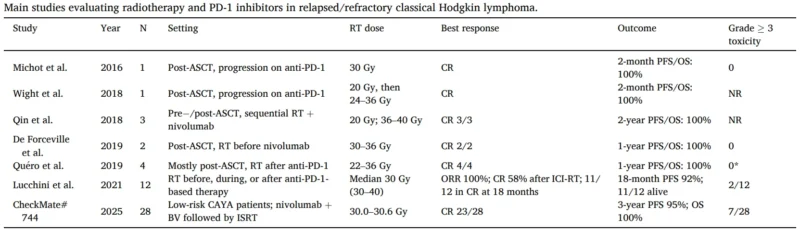
Four heavily pretreated patients in the Quéro series achieved complete metabolic responses after anti-PD-1 therapy followed by ISRT, even though all developed grade 1-2 pulmonary toxicity. In an Italian multicenter series of 12 patients receiving RT before, during, or after PD-1 blockade, ORR was 100%, and 11 of 12 patients were in CR at a median follow-up of 18 months. Several patients underwent subsequent transplantation, and two developed grade 3 interstitial pneumonitis.
You can also read:

Can RT Help Some Patients Avoid Transplantation?
CheckMate 744 explored a different strategy in children, adolescents, and young adults with low-risk R/R cHL. The cohort included patients aged 5-30 years with localized, previously nonirradiated relapse occurring more than 12 months after frontline treatment. Patients received nivolumab plus BV, with BV-bendamustine intensification for inadequate response, followed by consolidative ISRT at 30.0-30.6 Gy.
Among 28 patients, 93% achieved a complete metabolic response before ISRT. Three-year PFS was 95%, OS was 100%, and none underwent ASCT. The population was highly selected and differs substantially from the heavily pretreated adults represented in most RT-PD-1 reports. Still, the study provides prospective evidence that systemic immunotherapy and modern ISRT can be incorporated into a response-adapted, transplant-free strategy for selected low-risk patients.
Patterns of Progression Can Inform RT Selection
In a series of 69 patients treated with immune checkpoint inhibitors, 41 developed progression. More than half of these progressions occurred exclusively at sites already present before checkpoint therapy. Among patients who began treatment with five or fewer involved sites, the cumulative incidence of progression potentially amenable to local therapy was 34%. Greater baseline disease burden was associated with a higher risk of progression.
Persistent FDG avidity may represent viable lymphoma, but immune-related inflammation, pseudoprogression, and flare reactions can produce similar findings. Clinical evolution, repeat imaging, LYRIC criteria, and histologic confirmation when feasible can help distinguish residual lymphoma from an immune-related PET finding before committing a patient to local therapy.
.sciencedirect.com
RT and PD-1 Blockade in Prospective Studies
Several ongoing studies are testing RT in combination with PD-1 blockade. A phase II study is evaluating four cycles of pembrolizumab followed by response-adapted ISRT, using 20 Gy after complete metabolic response and 36-40 Gy for histologically confirmed residual disease.
The ICI-RT-1 study is evaluating RT combined with nivolumab or pembrolizumab, and the RadVax trial is studying low-dose irradiation of sites that remain metabolically active after nivolumab.
Positioning RT in R/R Hodgkin Lymphoma
Radiotherapy retains a clinically relevant but increasingly focused place in R/R cHL, and modern techniques make these interventions more conformal with less exposure of surrounding organs than historical fields.
What’s missing is the randomized evidence: no prospective trial currently defines the optimal integration of RT with checkpoint inhibition, and patient selection, sequencing, target volumes, and dose remain largely guided by small, non-randomized series, particularly for mediastinal disease, where pulmonary toxicity remains a real concern.