Despite remarkable advances in immunotherapy, most patients with metastatic non-small cell lung cancer (NSCLC) eventually develop resistance to PD-1 blockade. The challenge is particularly pronounced in tumors with low or absent PD-L1 expression, where responses to first-line chemoimmunotherapy are often limited and second-line treatment options remain disappointing.
After progression on anti-PD-1 therapy, standard chemotherapy produces objective responses in only a small minority of patients, leaving clinicians with few effective strategies to overcome acquired immune resistance.
Could combining radiotherapy with dual immune checkpoint blockade reactivate antitumor immunity?
The phase II RECLAIM trial investigated exactly this question by evaluating ipilimumab, nivolumab, and subablative radiotherapy in patients with metastatic NSCLC whose tumors expressed little or no PD-L1 and had progressed after first-line PD-1–based treatment.
Why Radiotherapy May Enhance Immunotherapy
Radiotherapy is traditionally viewed as a local treatment, but growing evidence suggests it can also function as an immune modulator.
Radiation induces immunogenic tumor cell death, leading to the release of tumor antigens that can prime new T-cell responses. At the same time, activation of the cGAS–STING pathway promotes type I interferon signaling and converts an immunologically “cold” tumor microenvironment into a more inflamed state.
Adding CTLA-4 blockade may further amplify this process by enhancing T-cell priming within lymph nodes, while PD-1 inhibition restores exhausted T-cell function inside tumors.
Together, this combination has the potential to generate a systemic immune response capable of attacking even non-irradiated metastatic lesions, a phenomenon often referred to as the abscopal effect.
Radiotherapy’s Abscopal Effect: Mechanisms, Challenges
Study Design
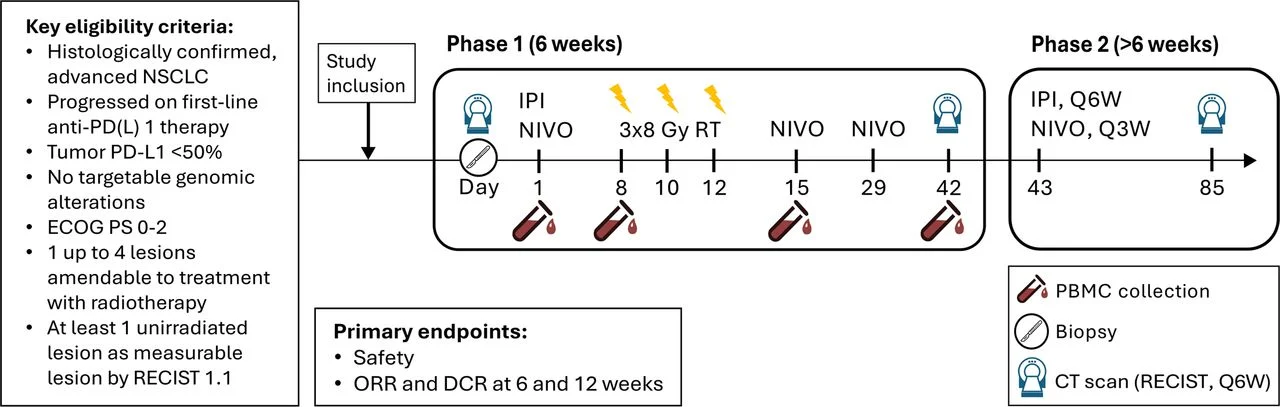
RECLAIM was a prospective, single-arm phase II trial that enrolled 31 evaluable patients with metastatic NSCLC.
Eligible patients had:
- PD-L1 expression <50% (most had <1%)
- Disease progression after first-line chemotherapy plus anti-PD-1 therapy
- At least one lesion suitable for radiotherapy and another measurable lesion outside the radiation field
Treatment consisted of:
- Ipilimumab 1 mg/kg every 6 weeks
- Nivolumab every 2–3 weeks
- Subablative radiotherapy (3 × 8 Gy) delivered to one to four tumor lesions
Importantly, responses were assessed only in non-irradiated lesions, allowing investigators to determine whether systemic immune activation had occurred rather than simply measuring the local effects of radiation.
Clinical Activity Beyond Irradiated Tumors
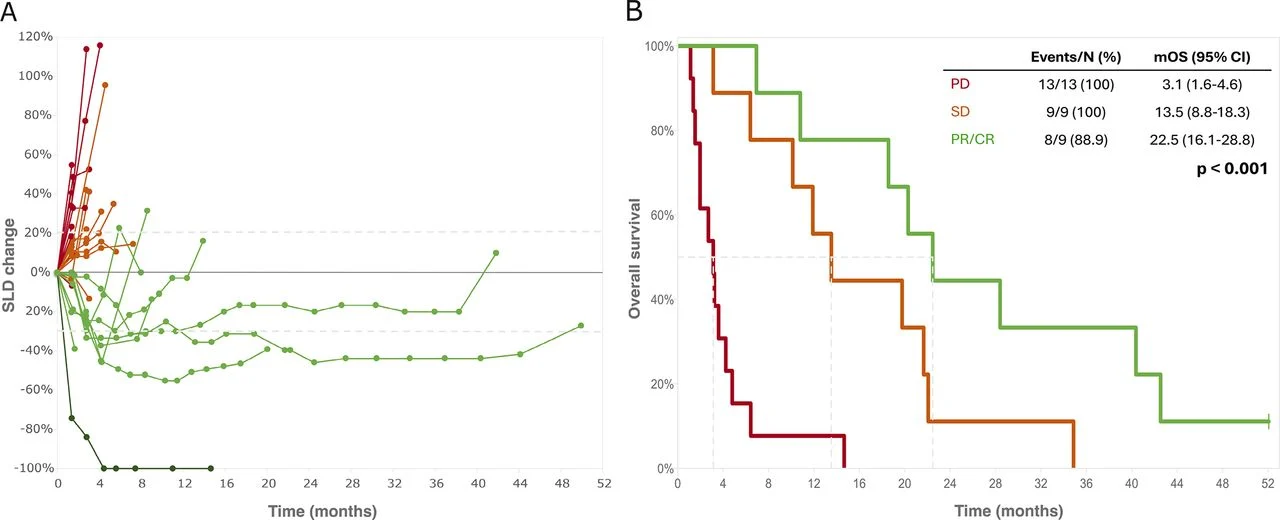
Although early response rates were modest, several patients experienced delayed yet durable tumor regression.
Key Findings
- Objective response rate (ORR):7% at 6 weeks
- 10% at 12 weeks
- 29% as best overall response
Disease control rate (DCR):
- 58% at 6 weeks
- 39% at 12 weeks
Median duration of response:
- 13.3 months
Notably, many responses continued to deepen months after treatment initiation, illustrating one of the unique characteristics of immune-mediated tumor control.
Survival Improved Among Responders
Clinical benefit translated into substantial survival differences.
Median overall survival was:
- 3.1 months for patients with progressive disease
- 13.5 months for stable disease
- 22.5 months for patients achieving partial or complete response
Similarly, progression-free survival increased from 1.4 months in progressors to 9.7 months in responders.
PD-L1 Was Not Predictive
One of the most interesting findings was that baseline PD-L1 expression did not predict benefit.
Response rates were similar regardless of whether tumors expressed PD-L1 below 1% or between 1–49%, suggesting that this multimodal strategy may overcome some of the biological limitations associated with PD-L1–low disease.
This observation supports the concept that immune activation generated by radiotherapy and CTLA-4 blockade may compensate for an initially non-inflamed tumor microenvironment.
Immune Monitoring Revealed Early T-Cell Activation
Beyond clinical outcomes, RECLAIM incorporated extensive immune profiling.
Peripheral blood analyses demonstrated:
- Early expansion of effector-memory CD4+ and CD8+ T cells
- Increased expression of activation markers including Ki67, HLA-DR, CD39, and CTLA-4
- Stronger immune activation among patients who ultimately responded to treatment
These findings provide biological evidence that the treatment combination successfully reactivated systemic antitumor immunity.
Tumor tissue analyses also showed that responders had higher baseline IDO1 expression, suggesting this marker may deserve further investigation as a potential biomarker for response.
Safety Profile
As expected with dual checkpoint inhibition, treatment-related toxicity was common but generally manageable.
- Grade 3 treatment-related adverse events occurred in 26% of patients.
- Immune-related adverse events were reported in 68%, most commonly rash and thyroid dysfunction.
- Approximately 16% discontinued treatment because of immune-related toxicity.
- No grade 4 or grade 5 treatment-related toxicities were observed.
Overall, the safety profile was consistent with previous studies evaluating nivolumab plus ipilimumab.
Clinical Perspective
The RECLAIM trial addresses one of the most important unanswered questions in immuno-oncology: how to overcome resistance after progression on PD-1 inhibitors.
Although the study was relatively small and lacked a randomized control arm, it demonstrates that combining subablative radiotherapy with dual checkpoint inhibition can induce durable systemic responses in a subset of patients who otherwise have limited treatment options.
Perhaps even more importantly, the immune analyses suggest that radiotherapy does far more than shrink irradiated tumors—it may reshape systemic immunity by enhancing T-cell activation and restoring antitumor immune responses.
These findings also reinforce growing interest in the abscopal effect, a phenomenon that has fascinated oncologists for decades but remains difficult to reproduce consistently in clinical practice.
Conclusion
The phase II RECLAIM trial provides encouraging evidence that ipilimumab, nivolumab, and subablative radiotherapy can generate meaningful and durable responses in selected patients with PD-L1–low or PD-L1–negative metastatic NSCLC after failure of first-line PD-1–based therapy.
While randomized trials are needed to confirm these findings, RECLAIM highlights a promising strategy for overcoming immunotherapy resistance by combining local radiation with systemic immune activation. As researchers continue to optimize radiation dose, treatment sequencing, and patient selection, multimodal immunotherapy may offer a new therapeutic avenue for patients with few remaining options.
Read Full Article Here