Hodgkin lymphoma (HL) has one of the highest cure rates in hem-oncology, and treatment decisions increasingly balance disease control against the short- and long-term consequences of therapy. The 2026 European Hematology Association (EHA) Clinical Practice Guidelines emphasise PET-adapted therapy, reducing unnecessary treatment exposure, and integrating PD-1 inhibition earlier in the course.
The changes are most evident in advanced classic Hodgkin lymphoma (cHL), where BrECADD has replaced escalated BEACOPP as the preferred intensive approach for younger fit patients and nivolumab plus AVD as another highly active first-line strategy. In relapse, PD-1 inhibitor-containing salvage therapy is increasingly used before autologous stem cell transplantation. Early-stages remain more dependent on chemotherapy plus radiotherapy, and PET response can identify settings in which radiotherapy may be omitted.
Diagnosis and PET/CT-Based Risk Stratification
Excisional lymph-node biopsy is preferred, with core needle biopsy used when excision is not feasible. Baseline FDG-PET/CT combined with clinical risk factors determines stage and treatment allocation, and has largely removed the need for routine bone marrow biopsy at diagnosis. Early-stage disease is divided into favorable and unfavorable groups. Under the German Hodgkin Study Group classification, stage I/II disease without risk factors is favorable.
Large mediastinal mass, extranodal involvement, elevated erythrocyte sedimentation rate, and involvement of at least three nodal areas define unfavorable features. Stage IIB disease with a large mediastinal mass or extranodal involvement is treated as advanced disease.
Pretreatment evaluation should include blood counts and biochemistry, cardiac assessment, pulmonary function testing, HBV, HCV and HIV screening, and pregnancy testing when appropriate. Reproductive counseling should be offered before treatment to patients of reproductive age who wish to have children. Interim PET/CT is recommended when the result will determine subsequent treatment.
Early Favorable cHL: Combined-Modality Treatment Remains Standard
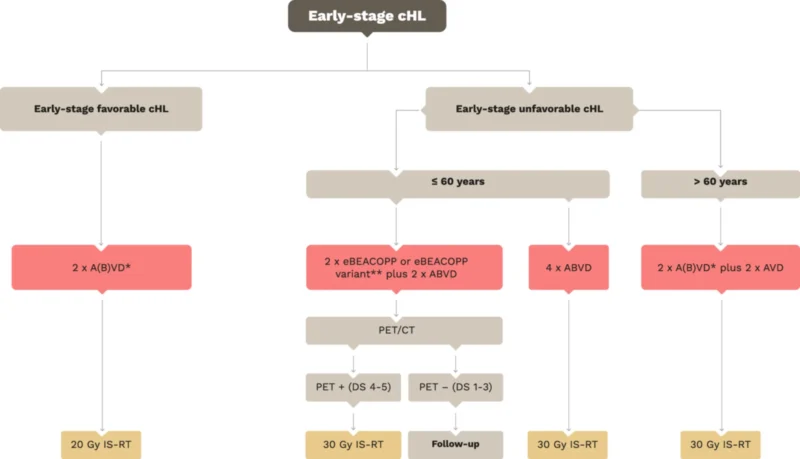
For early-stage favorable cHL, the recommended treatment remains two cycles of ABVD followed by 20 Gy involved-site radiotherapy (IS-RT). The GHSG HD10 trial established that reducing both chemotherapy and radiation exposure could maintain excellent disease control. At 10 years, PFS was 87.2% with two cycles of ABVD plus 20 Gy radiotherapy compared with 87.4% after four cycles of ABVD plus 30 Gy, corresponding OS rates were 94.1% and 93.6%.
A negative PET after chemotherapy does not routinely eliminate the need for radiotherapy in this group. RAPID, H10F, and HD16 all showed lower disease control when radiotherapy was omitted after a negative PET. Three-year PFS in RAPID was 90.8% without radiotherapy versus 94.6% with it, 5-year PFS was 87.1% versus 99% in H10F and 86.1% versus 93.4% in HD16. Follow-up analyses confirmed the difference.
Radiotherapy omission can still be discussed in selected patients who achieve complete metabolic remission when its expected long-term risks are considered greater, incorporating age, sex, lymphoma location, and radiation exposure to critical organs.
Early Unfavorable cHL: PET Response Can Reduce Radiotherapy Exposure
For patients aged ≤60 years with early unfavorable cHL, the guideline recommends two cycles of escalated BEACOPP followed by two cycles of ABVD (the “2+2” strategy), with subsequent treatment determined by PET/CT.
HD14 demonstrated better disease control with 2+2 compared with four cycles of ABVD followed by radiotherapy: 10-year PFS was 91.2% vs 85.6%. HD17 subsequently tested whether radiotherapy could be omitted after 2+2 in patients with a negative end-of-treatment PET. Five-year PFS was 95.9% without radiotherapy vs 97.7% with combined-modality treatment.
A procarbazine-free approach can also be considered. Two cycles of eBEACOPDac or another procarbazine-free eBEACOPP variant followed by two cycles of ABVD are alternatives, again with 30 Gy IS-RT reserved for PET-positive disease. The rationale comes from advanced-disease experience suggesting similar efficacy with lower acute and long-term toxicity. Direct data for these variants in early unfavorable cHL are lacking. A less intensive strategy is: four cycles of ABVD followed by 30 Gy IS-RT, for patients where an escalated BEACOPP-based approach is not preferred.
H10U also tested PET adaptation after two cycles of ABVD. Among PET-negative patients, noninferiority of chemotherapy alone could not be demonstrated compared with combined-modality treatment, with 5-year PFS of 89.6% vs 92.1%. Six cycles of chemotherapy alone can nevertheless be considered in selected PET-negative patients. Avoiding radiotherapy by giving more chemotherapy does not eliminate late toxicity, additional anthracycline exposure can itself increase cardiovascular and second-cancer risk.
For PET-positive disease after two ABVD cycles, H10U initially suggested benefit from escalation to eBEACOPP, but this advantage was no longer evident with follow-up approaching 10 years. Age also matters: in patients >60 years, bleomycin should be limited to no more than two cycles because of increased pulmonary toxicity, and omission should be considered in patients >70 years.
Modern Radiotherapy Uses Smaller Treatment Volumes
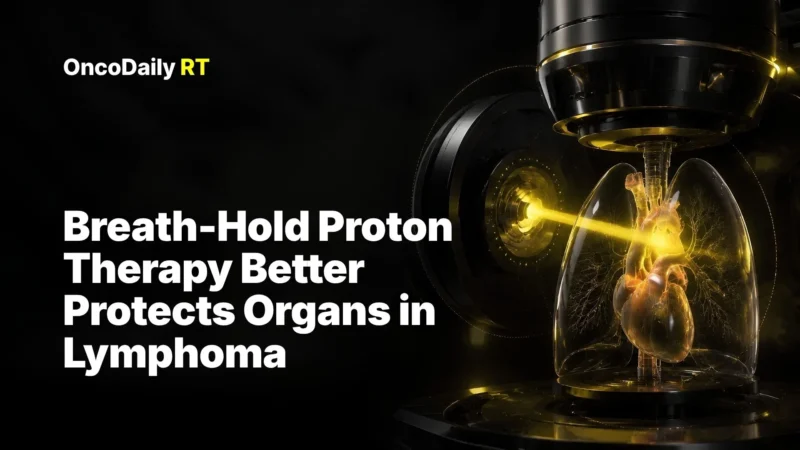
When radiotherapy is required, involved-site approaches are recommended. Modern conformal techniques include intensity-modulated radiotherapy, volumetric-modulated arc therapy and, in selected patients such as young adults, proton therapy. Deep-inspiration breath hold is recommended for mediastinal disease to reduce exposure of the heart and lungs. These techniques expose substantially smaller volumes of normal tissue than the extended-field radiotherapy used historically.
You can also read about
Advanced cHL: BrECADD as the Preferred Intensive Approach
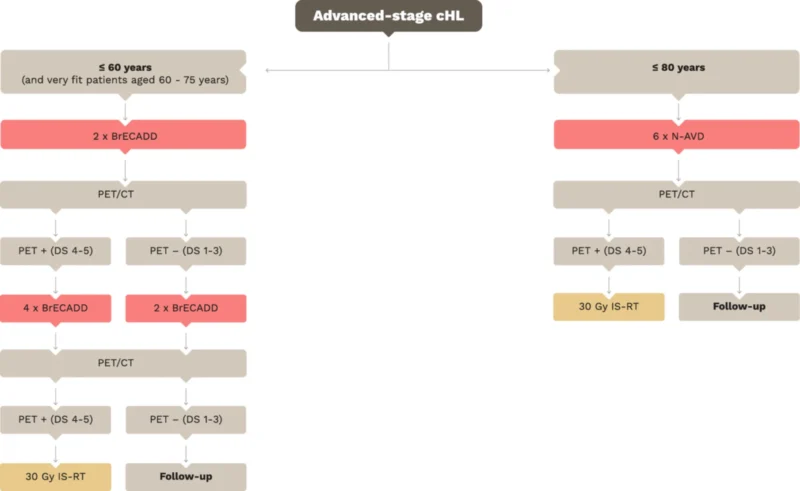
For younger patients aged ≤60 years with advanced cHL, BrECADD is now the recommended intensive first-line regimen.
The randomized HD21 trial compared BrECADD (brentuximab vedotin, etoposide, cyclophosphamide, doxorubicin, dacarbazine and dexamethasone) with eBEACOPP in patients aged 18 to 60 years. At 5 years, PFS was 93.6% with BrECADD compared with 90.6% with eBEACOPP, while OS was 98% in both groups. BrECADD also reduced higher-grade hematologic toxicity, transfusion requirements, polyneuropathy and infertility.
Treatment duration is PET-adapted. Patients with a negative PET/CT after two cycles, defined as Deauville score ≤3, receive four cycles in total. Those with a positive interim PET, defined as Deauville score ≥4, receive six cycles. Patients with PET-positive residual disease or partial metabolic remission should be considered for 30 Gy IS-RT using modern planning techniques.
N-AVD Moves Checkpoint Inhibition Into First-Line
Six cycles of N-AVD provide an alternative first-line strategy for younger patients and are the preferred approach for many older patients.
In SWOG S1826, N-AVD was compared with BV-AVD in patients aged 12 to 84 years. After a median follow-up of 3.1 years, 3-year PFS was 91% with N-AVD vs 82% with BV-AVD, while 3-year OS was 98% and 97%, respectively. Among patients aged 18 to 60 years, 3-year PFS was 91% with N-AVD and 85% with BV-AVD.
For younger patients, the guideline positions N-AVD as a less intensive alternative to BrECADD. The two strategies have not been compared directly and cross-trial PFS percentages cannot establish superiority of either regimen.
If neither preferred strategy is available, alternatives include PET-adapted eBEACOPP-based therapy, eBEACOPDac, six cycles of BV-AVD, or PET-adapted ABVD/AVD. ECHELON-1 showed a 6-year OS of 93.9% with BV-AVD vs 89.4% with ABVD.
BrECADD, eBEACOPP, eBEACOPDac and BV-AVD carry substantial risks of neutropenia and febrile neutropenia. Primary G-CSF and cotrimoxazole prophylaxis are recommended, with intensified antibacterial prophylaxis during aplasia incorporated into the HD21 approach.
Older Patients With Advanced cHL
For fit patients >60 years who can receive multiagent treatment, N-AVD is the preferred approach. In the older subgroup of S1826, 3-year PFS was 82% with N-AVD vs 58% with BV-AVD, and 2-year OS was 96% vs 85%. N-AVD was also better tolerated. BV-AVD has been less convincing in this population, while neutropenia, febrile neutropenia and neuropathy were more frequent.
BrECADD can be considered in very fit older patients. In a phase II cohort of patients aged 61 to 75 years, 2-year PFS was 92% and OS 91%, although hematologic toxicity and infectious complications were substantial. Sequential BV followed by AVD is another studied approach, producing 2-year PFS of 84% and OS of 93% with apparently less hematologic and infectious toxicity than concurrent BV-AVD.
When neither BV nor PD-1 inhibition is available, patients suitable for multiagent chemotherapy can receive up to two cycles of ABVD followed by four cycles of AVD. As in early unfavorable disease, bleomycin exposure should be limited for the same pulmonary toxicity reasons.
For patients who cannot tolerate multiagent chemotherapy, treatment options are limited and cure is unlikely. Single-agent BV or PD-1 inhibition can be used, but neither generally provides durable disease control.
Relapsed cHL: Achieving CMR Before Transplant Is Critical
Refractory disease is defined as progression during first-line treatment or relapse within 3 months after treatment ends. Relapse within 12 months is considered early relapse, after ≥12 months – late relapse. Biopsy confirmation should be obtained whenever possible.
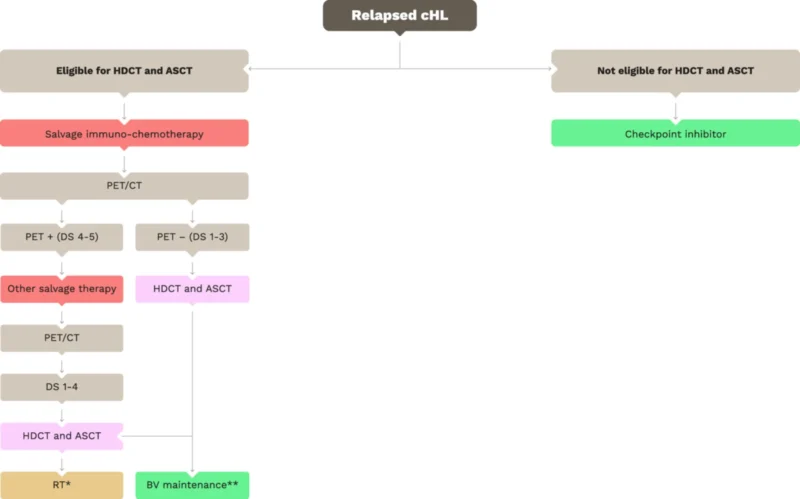
For most eligible patients with refractory or relapsed cHL, high-dose chemotherapy followed by ASCT remains the standard strategy. Selected fit patients >65 years may still be candidates.
The objective of salvage treatment is to reach ASCT in complete metabolic remission (CMR, Deauville score ≤3). This has major prognostic importance: 5-year PFS is approximately 75% for patients entering transplant in CMR compared with only 25% to 30% among patients who remain PET-positive.
PD-1 Inhibition Has Changed Pre-Transplant Salvage Therapy
PD-1 inhibitor-containing combinations have pushed metabolic response rates higher. Pembrolizumab-GVD, pembrolizumab-ICE and nivolumab-ICE have produced CMR rates of ~87% to 95%, with reported 2-year survival rates reaching 96% among patients undergoing ASCT.
A chemotherapy-free strategy with BV plus nivolumab produced a CMR rate of 67%, but estimated 3-year PFS was 91% among patients who proceeded directly to ASCT after the combination.
Where available, a PD-1 inhibitor combined with chemotherapy is therefore the preferred salvage strategy. Sequential treatment is also possible: PD-1 inhibition can be given first, with chemotherapy added if the response is insufficient.
An important limitation is that relatively few patients in these salvage studies had already received BV or PD-1 inhibitors during first-line treatment. As checkpoint inhibition moves into frontline cHL, the evidence supporting the same strategies after relapse becomes less directly applicable.
The Role of BV, Radiotherapy and Maintenance
BV plus chemotherapy remains an option when PD-1 inhibitors are unavailable, when progression occurs during or shortly after PD-1 inhibition, and particularly in BV-naive patients. Single-agent BV can also be considered, but its CMR rate is lower.
For high-risk patients responding to salvage therapy who have not previously received BV, or who previously responded to it, BV maintenance after ASCT for up to 16 doses should be considered. In AETHERA, 5-year PFS was 59% with BV maintenance versus 41% with placebo. High-risk features included primary refractory disease, early relapse and extranodal involvement at relapse.
Patients who remain in partial metabolic remission before ASCT can be considered for IS-RT to residual PET-positive sites. Radiotherapy can be administered before or after transplantation, with timing individualized according to disease location and anticipated toxicity. The standard conditioning regimen remains BEAM, and stem-cell collection should be performed early.
Selected patients with late relapse after initial treatment for early favorable cHL may be treated with intensive conventional chemotherapy, optionally combined with targeted agents and radiotherapy, without automatically following the standard salvage-ASCT pathway.
After ASCT Failure, Previous Treatment Determines the Next Step
For patients who relapse after ASCT and have never received a PD-1 inhibitor, checkpoint inhibition for up to 2 years is recommended. With single-agent PD-1 inhibition, median PFS is approximately 14 months. Patients achieving an early complete response appear most likely to experience prolonged disease control, though most eventually relapse after treatment discontinuation, and median response duration in patients achieving CMR does not exceed approximately 2.5 to 3 years.
Response assessment after PD-1 therapy requires additional care because immune activation can mimic disease progression. TARC and circulating tumor DNA may improve response assessment but remain investigational.
For patients already exposed to both BV and PD-1 inhibition, no single preferred sequence exists. Clinical-trial participation is encouraged. Treatment should be individualized based on prior sensitivity, with early donor evaluation for alloSCT in appropriate candidates.
AlloSCT After PD-1 Inhibition
AlloSCT should be considered for eligible patients who respond after ASCT failure and for fit patients with disease refractory to or progressing after PD-1 inhibition.
Prior PD-1 inhibition may improve disease control before transplant but increases immune toxicity. Reported 2-year OS after PD-1 exposure followed by alloSCT is approximately 82%, compared with 65% historically, while grade II-IV and grade III-IV acute graft-versus-host disease occur in approximately 40% and 20% of patients, respectively. PD-1 inhibition should therefore be discontinued at least six weeks before alloSCT.
For patients with relapsed/refractory cHL who are not candidates for high-dose chemotherapy and ASCT, treatment is individualized according to fitness, comorbidities and prior therapy. PD-1 inhibitor monotherapy is generally preferred. Chemotherapy with or without PD-1 inhibition and BV when checkpoint inhibition is unsuitable remain options, and localized relapse may be treated with radiotherapy with or without a PD-1 inhibitor.
Follow-Up Should Focus on Late Toxicity
After end-of-treatment imaging confirms remission, routine surveillance PET/CT or CT is not recommended in asymptomatic patients. Follow-up should focus on clinical assessment and late treatment-related complications.
Long-term surveillance should address second malignancies, cardiovascular and pulmonary disease, thyroid and gonadal dysfunction, infertility, fatigue, neuropsychiatric effects, neuropathy, bone health and sexual dysfunction. Blood pressure and lipids should be assessed annually where possible, with annual thyroid-stimulating hormone testing after neck irradiation.
Patients who received radiotherapy involving breast tissue before age 36 should undergo annual mammography and/or breast MRI beginning eight years after radiotherapy, but not before age 25. Cumulative doxorubicin exposure should also be considered when assessing breast cancer risk.
NLPHL Is Therapeutically Different From Classic Hodgkin Lymphoma
Nodular lymphocyte-predominant Hodgkin lymphoma (NLPHL) accounts for approximately 5% of HL and has distinct biology and treatment. Lymphocyte-predominant cells retain a B-cell phenotype and express CD20, supporting the use of anti-CD20 therapy. NLPHL is more often diagnosed at an early stage and generally follows a more indolent course.
Stage IA NLPHL without clinical risk factors should be treated with 30 Gy IS-RT alone, which achieved 8-year PFS of 91.9% and OS of 99% in prospective-study analyses. Adding chemotherapy does not improve outcomes in this group.
For other early-stage disease, brief ABVD-based chemotherapy, optionally combined with rituximab and followed by radiotherapy, is an option. In stage II-IV disease, retrospective data support adding rituximab to chemotherapy, with 5-year PFS of 89.6% vs 72.7% with chemotherapy alone. R-CHOP, bendamustine-rituximab and R-CVP are alternatives for advanced disease, although prospective long-term data are limited. Selected asymptomatic patients can undergo active surveillance.
Relapse should be biopsied because approximately 10% of patients develop transformation to aggressive B-cell non-Hodgkin lymphoma within 10 years. Indolent relapse can often be managed with anti-CD20 therapy, radiotherapy, or chemotherapy with or without anti-CD20 treatment, only a minority require high-dose chemotherapy and ASCT. BV and PD-1 inhibitors have no established role in NLPHL.
What the Guidelines Leave Unanswered
In relapsed disease, PD-1-based salvage has improved the ability to achieve complete metabolic remission before ASCT, but earlier use of PD-1 inhibitors and BV is creating a new sequencing hardship for which evidence remains limited.
You can also read about