Teclistamab-cqyv (Tecvayli), a bispecific BCMA-directed CD3 T-cell engager, combined with subcutaneous daratumumab (Darzalex Faspro), has demonstrated a major survival advantage in patients with relapsed/refractory multiple myeloma (R/R MM) following 1–3 prior lines of therapy. Updated results from the phase III MajesTEC-3 trial, presented at the ASH 2025 Meeting, confirmed that the Tec-Dara regimen significantly improves progression-free and overall survival compared with standard daratumumab-based regimens.
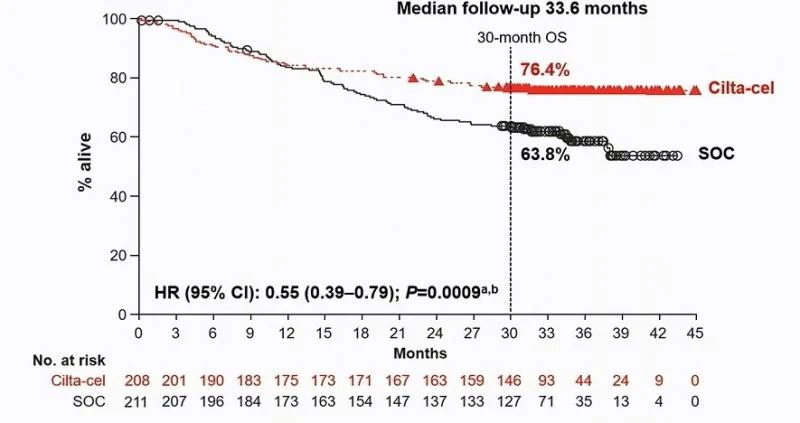
At 36 months, overall survival reached 83.3% with Tec-Dara vs 65.0% with daratumumab + pomalidomide/dexamethasone (DPd) or daratumumab + bortezomib/dexamethasone (DVd). This corresponded to a 54% reduction in risk of death (HR 0.46; 95% CI 0.32–0.65; P<.0001). Progression-free survival results were similarly striking — median PFS was not reached with Tec-Dara compared with 18.1 months in the control arm, representing an 83% lower risk of disease progression or death (HR 0.17; 95% CI 0.12–0.23). The 3-year PFS rates were 83.4% vs 29.7%, respectively.
The depth of response favored Tec-Dara, with complete response or better in 81.8% vs 31.1% with control therapy. Minimal residual disease (MRD) negativity at 10⁻⁵ sensitivity was achieved in 89.3% of patients vs 63.0%, and the median duration of response has not yet been reached, indicating sustained benefit.
MajesTEC-3 Study Design
MajesTEC-3 enrolled 587 patients with R/R MM previously treated with 1–3 regimens, including lenalidomide and a proteasome inhibitor. Patients were randomized 1:1 to receive Tec-Dara or DPd/DVd. The median age was 65 years. Prior BCMA-directed therapy or anti-CD38-refractory disease were exclusion criteria.
Dosing schedule (subcutaneous, step-up initiated):
- Teclistamab 1.5 mg/kg weekly (cycles 1–2) → 3 mg/kg q2w (cycles 3–6) → q4w (cycle 7+)
- Daratumumab SC 1800 mg weekly (cycles 1–2) → q2w (cycles 3–6) → q4w thereafter
- Steroid-free regimen after Cycle 1 Day 8 — patient-friendly feature
Primary endpoint: PFS
Key secondary endpoints: OS, CR rate, MRD negativity, QoL, safety
Safety and Tolerability
The safety profile was consistent with expectations for BCMA-targeted therapy. Cytokine release syndrome was common but mild, limited to grade 1–2 events and fully resolvable. Neutropenia remained the most frequent hematologic toxicity (78.4% vs 82.8%). Grade 3/4 infections occurred more often in the Tec-Dara arm (54.1% vs 43.4%), particularly during the first six months, but incidence declined after adoption of IVIG replacement and antimicrobial prophylaxis, which were later integrated into protocol guidance.
Neurotoxicity (ICANS) was rare (1.1%). Treatment discontinuation was low (4.6% with Tec-Dara vs 5.5% control), and fewer deaths occurred in the experimental arm (15.9% vs 33.1%). These findings suggest that Tec-Dara is tolerable long-term, especially once infection-prevention strategies are implemented.
Conclusion
MajesTEC-3 demonstrates that teclistamab + daratumumab offers deep, durable responses and meaningful survival benefits for patients with relapsed/refractory multiple myeloma earlier in treatment settings. With high CR/MRD negativity rates and a manageable toxicity profile, Tec-Dara has strong potential to become a new standard of care in second-line and beyond, expanding upon its current FDA approval for patients who have received ≥4 prior therapies.
You Can Watch More on OncoDaily Youtube TV