
Immune checkpoint inhibitors have changed lung cancer care, but the way clinical trials measure their benefit may still be catching up. In non-small cell lung cancer (NSCLC), anti–PD-1 and anti–PD-L1 therapies can produce durable disease control, delayed survival separation, and benefits that extend beyond first progression. This creates a major question for trial design: does conventional progression-free survival fully capture the long-term value of immunotherapy?
A new systematic review and meta-analysis by Jimenez-Labaig and colleagues, published in the Journal for ImmunoTherapy of Cancer, suggests that second-event endpoints such as EFS2, PRFS2, and PFS2 may provide a stronger reflection of durable benefit after anti–PD-(L)1-based therapy than traditional first-event endpoints (Jimenez-Labaig et al., 2025).
Why Second-Event Endpoints Matter
Traditional endpoints such as event-free survival, disease-free survival, and progression-free survival measure the time to first recurrence or progression. These endpoints are useful, but they may not fully reflect what happens after immunotherapy. Unlike chemotherapy, immune checkpoint inhibitors can reshape immune memory, influence subsequent treatment response, and produce long-lasting disease control even after the initial treatment period (Robert, 2020; Waldman et al., 2020).
Second-event endpoints go one step further. EFS2, PRFS2, and PFS2 capture the time from randomization to progression, recurrence, or death on the next line of therapy. In other words, they help answer a clinically important question: does early immunotherapy improve the entire treatment journey, not just the first treatment interval?
This is particularly relevant in NSCLC, where immunotherapy is now used across metastatic, locally advanced, perioperative, and adjuvant settings. If early anti–PD-(L)1 therapy improves outcomes even after subsequent therapy, it supports the argument that timing and sequencing matter.
What The Meta-Analysis Included
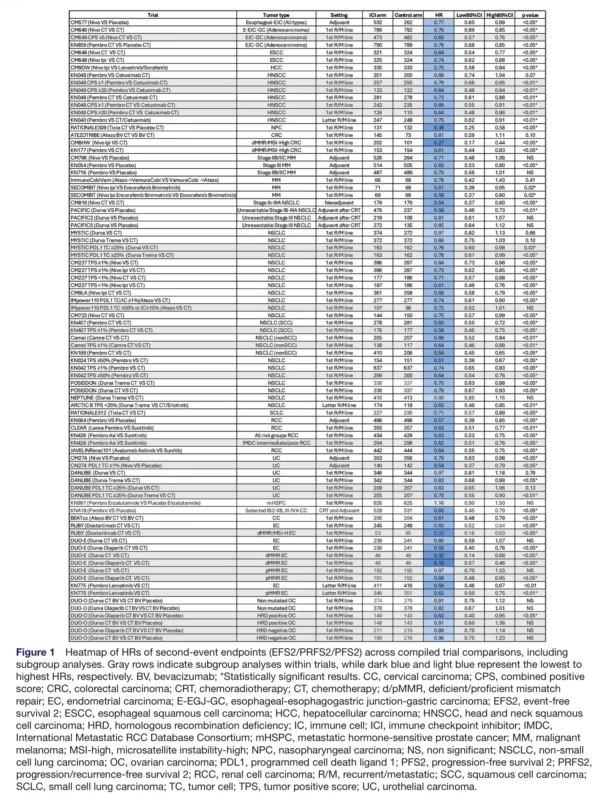
The authors reviewed randomized phase II and III trials involving anti–PD-(L)1-based therapy in solid tumors. From 2,078 citations, 47 randomized clinical trials met inclusion criteria, representing 58 intervention comparisons and 34,973 patients (Jimenez-Labaig et al., 2025).
NSCLC was the most represented tumor type, with 17 randomized trials included. This makes the findings especially important for lung oncology. The analysis included both curative-intent and recurrent/metastatic settings, allowing the investigators to examine whether second-event benefits were consistent across different stages of disease.
The median follow-up across trials ranged widely, from 9.1 to 73.7 months. Most trials were phase III studies, and the majority evaluated anti–PD-1 or anti–PD-L1 agents either alone or in combination with chemotherapy, CTLA-4 inhibitors, antiangiogenic agents, or other systemic therapies.
Early Anti–PD-(L)1 Therapy Improved Second-Event Outcomes
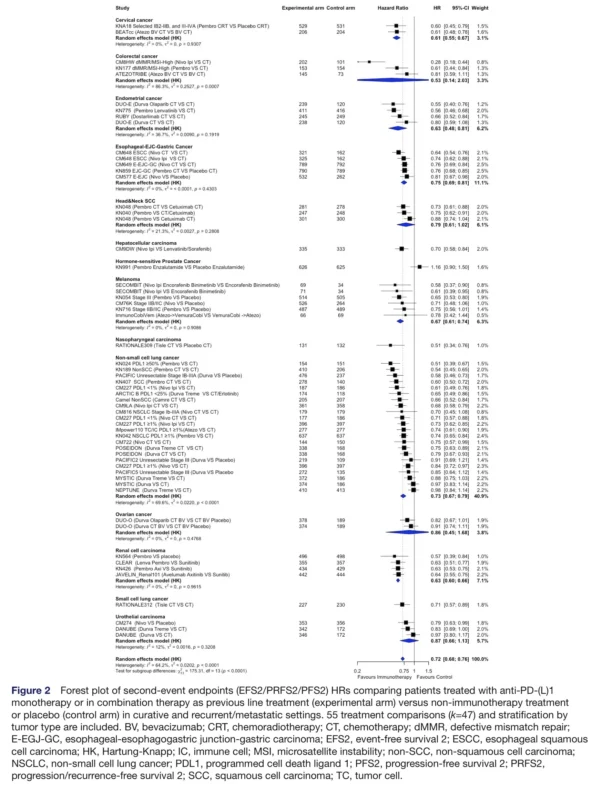
Across all tumor types and settings, early anti–PD-(L)1 therapy significantly improved second-event endpoints. The pooled hazard ratio for EFS2, PRFS2, or PFS2 was 0.72, meaning early immunotherapy was associated with a 28% relative reduction in the risk of second progression, recurrence, or death compared with non-immunotherapy control arms (Jimenez-Labaig et al., 2025).
Importantly, this benefit was consistent in both curative and recurrent/metastatic settings. In curative-intent trials, the pooled HR was 0.72. In recurrent or metastatic trials, the pooled HR was also 0.72. This consistency suggests that the durable effects of immunotherapy may not be limited to one disease stage.
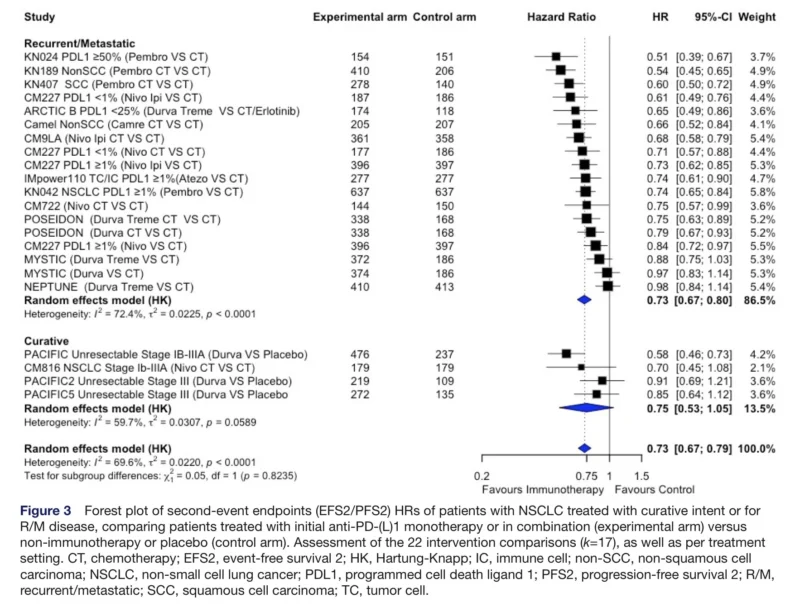
For lung cancer, the signal was especially strong. In NSCLC, across 17 randomized trials and 22 intervention comparisons, anti–PD-(L)1-based therapy was associated with a pooled HR of 0.73 for second-event outcomes. This supports the idea that early immune activation may produce benefits that extend beyond initial progression.
NSCLC Stands Out
The NSCLC subgroup is one of the most clinically relevant parts of this analysis. In recurrent/metastatic NSCLC, the pooled HR for PFS2 was 0.73, showing a significant reduction in the risk of second progression or death. Although the curative-intent NSCLC subgroup had wider uncertainty, the overall direction remained favorable (Jimenez-Labaig et al., 2025).
The study also found that higher initial objective response rates with immunotherapy were associated with stronger second-event benefits, particularly in recurrent/metastatic NSCLC. This suggests that early tumor shrinkage after ICI therapy may reflect deeper immune activation and more durable disease control.
Another important observation was that delayed immunotherapy in control arms did not appear to fully compensate for not receiving immunotherapy earlier. In NSCLC trials, 56% of patients in non-ICI arms received subsequent immunotherapy compared with only 16% in ICI arms. Yet earlier ICI exposure remained associated with better second-event outcomes (Jimenez-Labaig et al., 2025). This finding supports the growing clinical view that immunotherapy timing matters.
Stronger Surrogates For Overall Survival
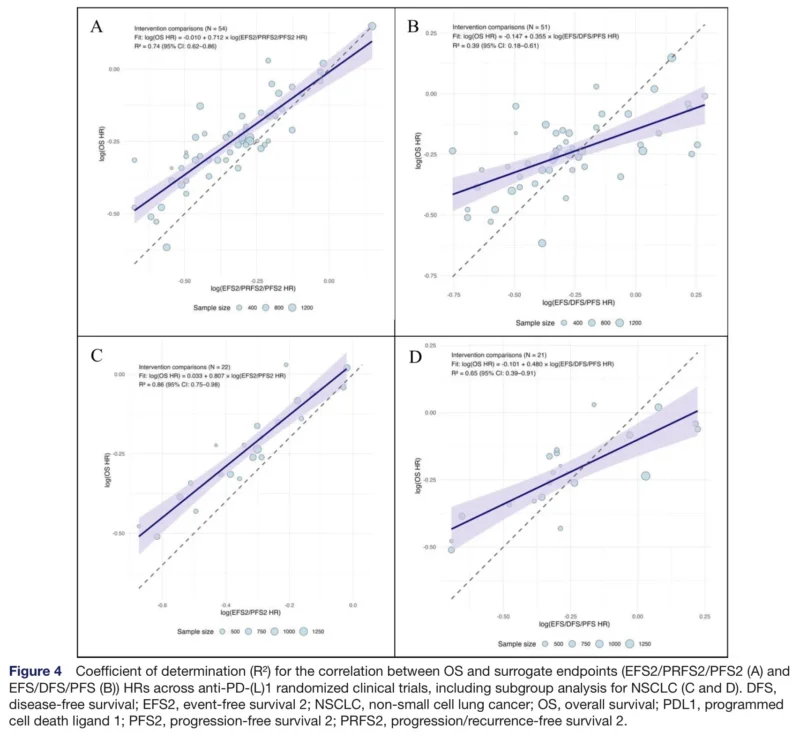
Perhaps the most important finding is that second-event endpoints correlated more strongly with overall survival than conventional first-event endpoints.
Across all randomized trials reporting both overall survival and second-event outcomes, the correlation between EFS2/PRFS2/PFS2 and overall survival was strong, with an R² of 0.74. By comparison, the correlation between conventional EFS/DFS/PFS and overall survival was weaker, with an R² of 0.39 (Jimenez-Labaig et al., 2025).
In NSCLC, the difference was even more striking. EFS2/PRFS2/PFS2 correlated with overall survival at an R² of 0.86, compared with 0.65 for traditional first-event endpoints. This suggests that second-event endpoints may better capture the long-term survival impact of immunotherapy in lung cancer trials.
This matters for trial design, regulatory review, and clinical decision-making. Overall survival remains the gold standard, but it requires long follow-up and can be confounded by crossover and post-progression treatments. A stronger intermediate endpoint could help trials mature faster while still preserving clinical relevance.
What This Means For Immunotherapy Sequencing
The findings support earlier use of anti–PD-(L)1 therapy in appropriate patients, particularly in NSCLC. The analysis does not mean every patient with every solid tumor benefits from early immunotherapy, and it does not eliminate the need for biomarker-based selection. However, it strengthens the argument that immunotherapy can influence the full disease course, not only the first progression event.
This is especially important as ICIs move earlier in lung cancer treatment. In resectable NSCLC, neoadjuvant and perioperative approaches are becoming increasingly important, supported by trials such as CheckMate 816 (Forde et al., 2022). In unresectable stage III NSCLC, durvalumab after chemoradiotherapy has already established long-term benefit through the PACIFIC trial (Spigel et al., 2022). In metastatic NSCLC, pembrolizumab-based and other ICI-based regimens have reshaped first-line care (Reck et al., 2021; Rodríguez-Abreu et al., 2021).
Second-event endpoints may help clarify whether these earlier interventions truly improve long-term sequencing outcomes.
Limitations That Matter
The authors appropriately highlight several limitations. First, the analysis was based on trial-level data rather than individual patient-level data. Second, definitions and censoring rules for second-event endpoints varied across studies. Third, many second-event analyses were post hoc rather than prespecified. Fourth, subsequent therapies were not standardized, which may introduce bias.
There was also heterogeneity across tumor types, treatment settings, and immunotherapy regimens. These issues mean the findings should not be interpreted as proving causality. Instead, they provide strong evidence that second-event endpoints deserve more formal, prespecified inclusion in future immunotherapy trials.
Clinical Takeaway
For lung oncology, this meta-analysis sends a clear message: first progression may not tell the full story of immunotherapy benefit.
In NSCLC, second-event endpoints appear to correlate strongly with overall survival and may better capture durable disease control after early anti–PD-(L)1 therapy. As immunotherapy continues moving into earlier disease settings, EFS2, PRFS2, and PFS2 could become increasingly important for understanding true long-term benefit.
The next generation of lung cancer trials should not only ask whether immunotherapy delays first progression. They should ask whether it improves the entire treatment pathway.
Conclusion
The systematic review and meta-analysis by Jimenez-Labaig et al. provides strong support for the routine inclusion of second-event endpoints in anti–PD-(L)1 randomized trials. For NSCLC, where the evidence was especially strong, EFS2, PRFS2, and PFS2 may serve as more clinically meaningful surrogates for overall survival than conventional first-event endpoints.
In the immunotherapy era, durable benefit is not always captured at first progression. Second-event endpoints may help the field measure what truly matters: whether early immunotherapy changes the long-term course of disease.