Hansoh Pharmaceutical Group has announced positive phase III results for risvutatug rezetecan, also known as Ris-Rez, in patients with advanced or relapsed small-cell lung cancer.
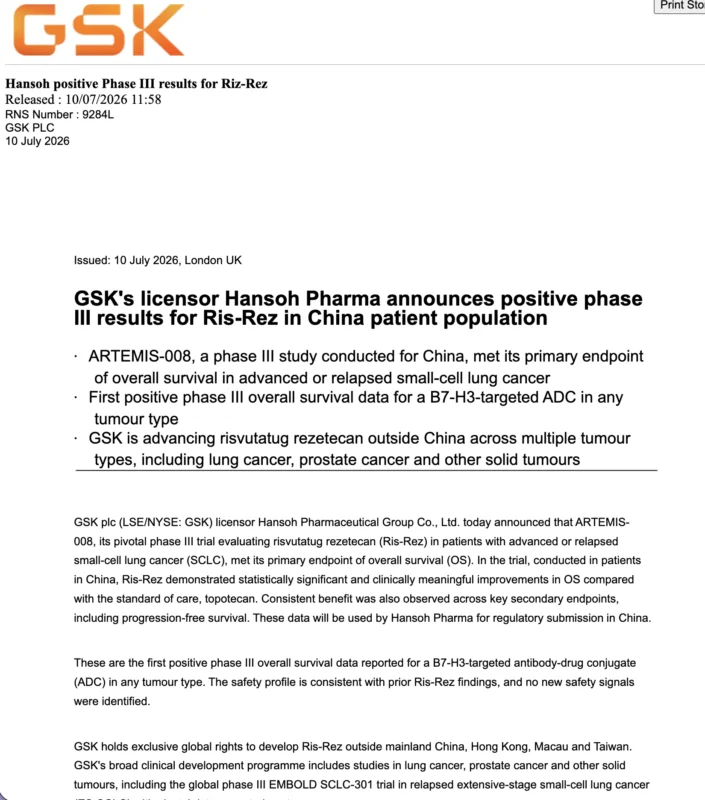
The ARTEMIS-008 trial, conducted in China, met its primary endpoint of overall survival. According to the announcement, Ris-Rez demonstrated a statistically significant and clinically meaningful improvement in overall survival compared with standard-of-care topotecan.
The study also showed consistent benefit across key secondary endpoints, including progression-free survival. Detailed efficacy data, including median overall survival, hazard ratios, response rates, and safety-event rates, were not included in the announcement.
These results are expected to support a regulatory submission by Hansoh Pharma in China.
A Phase III Milestone for B7-H3-Targeted ADCs
The announcement marks the first positive phase III overall survival data reported for a B7-H3-targeted antibody-drug conjugate in any tumor type, according to GSK and Hansoh Pharma.
B7-H3, also known as CD276, has emerged as a therapeutic target of interest across several solid tumors. It is highly expressed in small-cell lung cancer tumors and has also been studied across non-small cell lung cancer and other malignancies [2,3].
For small-cell lung cancer, this target is particularly relevant because most patients with extensive-stage disease relapse after initial treatment and have limited treatment options in later lines.
Why This Matters in Relapsed SCLC
Extensive-stage small-cell lung cancer remains one of the most aggressive thoracic malignancies.
Although first-line chemoimmunotherapy has improved outcomes for some patients, relapse is common. After progression, treatment options are limited, and prognosis remains poor.
Topotecan has long been used as a standard later-line comparator in relapsed SCLC, but outcomes remain modest and treatment burden can be substantial.
In this context, an antibody-drug conjugate showing an overall survival benefit in a phase III setting represents an important development. However, full interpretation will require presentation or publication of the complete ARTEMIS-008 dataset.
About Risvutatug Rezetecan
Risvutatug rezetecan is an investigational B7-H3-targeted antibody-drug conjugate.
It is composed of a fully human anti-B7-H3 monoclonal antibody linked to a topoisomerase inhibitor payload.
GSK acquired exclusive worldwide rights to develop and commercialize Ris-Rez outside mainland China, Hong Kong, Macau, and Taiwan. Hansoh Pharma retains rights in those territories.
The agent has received several regulatory designations, including orphan drug designations in small-cell lung cancer from the US FDA and Japan’s Ministry of Health, Labour and Welfare, and an EMA orphan designation in pulmonary neuroendocrine carcinoma, a category that includes SCLC.
Ris-Rez has also received EMA PRIME designation for relapsed or refractory extensive-stage SCLC and US FDA breakthrough therapy designations for relapsed or refractory extensive-stage SCLC and relapsed or refractory osteosarcoma [4-10].
GSK’s Global Development Strategy
Outside China, GSK is advancing Ris-Rez across multiple tumor types, including lung cancer, prostate cancer, and other solid tumors.
The company’s global development program includes EMBOLD SCLC-301, a phase III trial in relapsed extensive-stage small-cell lung cancer. GSK stated that pivotal data from EMBOLD SCLC-301 are expected next year.
Hesham Abdullah, Senior Vice President and Global Head of Oncology R&D at GSK, described the ARTEMIS-008 results as an important milestone and said they further support B7-H3 as a promising target across lung cancer and other solid tumors.
Safety and Next Steps
According to the announcement, the safety profile of Ris-Rez in ARTEMIS-008 was consistent with prior findings, and no new safety signals were identified.
No additional safety details were provided.
The next important step will be disclosure of the full phase III dataset, including survival curves, treatment exposure, adverse events, discontinuation rates, subgroup outcomes, and quality-of-life findings.
For now, ARTEMIS-008 provides early confirmation that B7-H3-directed ADC therapy may become clinically relevant in relapsed SCLC.
The Bottom Line
ARTEMIS-008 met its primary endpoint of overall survival in patients with advanced or relapsed small-cell lung cancer in China.
Risvutatug rezetecan improved overall survival compared with topotecan and showed consistent benefit across secondary endpoints, including progression-free survival.
The announcement represents the first positive phase III overall survival result for a B7-H3-targeted ADC in any tumor type.
Full clinical data are still needed to define the magnitude of benefit, safety profile, and future role of Ris-Rez in the SCLC treatment landscape.
References
- Mountzios G, et al. Tarlatamab in small-cell lung cancer after platinum-based chemotherapy. New England Journal of Medicine. 2025;393:349-361. doi:10.1056/NEJMoa2502099.
- Getu AA, Tigabu A, Zhou M, Lu J, Fodstad Ø, Tan M. New frontiers in immune checkpoint B7-H3 (CD276) research and drug development. Molecular Cancer. 2023;22:43. doi:10.1186/s12943-023-01751-9.
- Altan M, Pelekanou V, Schalper KA, et al. B7-H3 expression in NSCLC and its association with B7-H4, PD-L1 and tumor-infiltrating lymphocytes. Clinical Cancer Research. 2017;23:5202-5209. doi:10.1158/1078-0432.CCR-16-3107.
- GSK. GSK receives US FDA Breakthrough Therapy Designation for its B7-H3-targeted antibody-drug conjugate in relapsed or refractory extensive-stage small-cell lung cancer.
- GSK. GSK’s B7-H3-targeted antibody-drug conjugate, risvutatug rezetecan, granted Orphan Drug Designation for small-cell lung cancer in Japan.
- GSK. GSK’s B7-H3-targeted antibody-drug conjugate receives EMA Priority Medicines designation in relapsed extensive-stage small-cell lung cancer.
- GSK. GSK’s B7-H3-targeted antibody-drug conjugate receives Orphan Drug Designation in the EU.
- GSK. GSK’s B7-H3-targeted antibody-drug conjugate receives US FDA Breakthrough Therapy Designation in late-line relapsed or refractory osteosarcoma.