Patients with non-small cell lung cancer who have never used tobacco represent a clinically distinct population. Many tumors in this group harbor actionable genomic alterations, but treatment decisions become more difficult when no targetable driver is found. In this setting, the benefit of immune checkpoint inhibitors remains less clearly defined, and reliable predictors of response are still needed.
A new study by Gariazzo, Elkrief, Concannon, and colleagues, published in Clinical Cancer Research, evaluated clinical outcomes and biomarkers of response to PD-(L)1 blockade in patients with metastatic NSCLC without actionable genomic alterations and no history of tobacco exposure (Gariazzo et al., 2026).
Why This Study Matters
Immune checkpoint inhibitors are a major part of metastatic NSCLC treatment, but their benefit is often linked to tumor immunogenicity. Tobacco-associated NSCLC usually has a higher mutational burden, which can make tumors more visible to the immune system. In contrast, NSCLC in never-smokers often has lower tumor mutational burden and different biology, raising uncertainty about the expected benefit from PD-(L)1-based therapy when no actionable alteration is present.
This study focused on a difficult clinical question: among never-smokers with AGA-negative NSCLC, which patients are most likely to benefit from immune checkpoint blockade?
Study Design
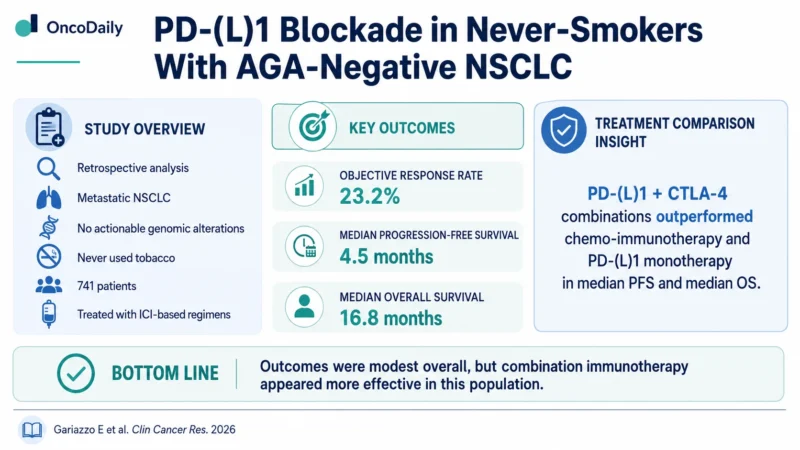
The investigators retrospectively analyzed 741 patients with metastatic, actionable genomic alteration-negative NSCLC who had never smoked and were treated with immune checkpoint inhibitor-based regimens across multiple independent cohorts.
The study examined clinical outcomes, treatment regimen differences, tumor-infiltrating lymphocyte density, multiplexed immune biomarkers, and transcriptomic correlates of response. TIL densities were quantified using a machine learning-based algorithm, while immune cell markers were assessed by multiplexed immunofluorescence. Transcriptomic correlates were analyzed in the SU2C cohort.
Overall Outcomes Were Modest
Across the full cohort, outcomes with PD-(L)1-based therapy were modest. The objective response rate was 23.2%, median progression-free survival was 4.5 months, and median overall survival was 16.8 months (Gariazzo et al., 2026).
These results highlight that never-smoker, AGA-negative NSCLC should not be treated as uniformly immune-resistant, but also not as uniformly sensitive to immunotherapy. The population appears heterogeneous, with some patients deriving clear benefit and others progressing early.
Very High PD-L1 and TMB Identified Better Responders
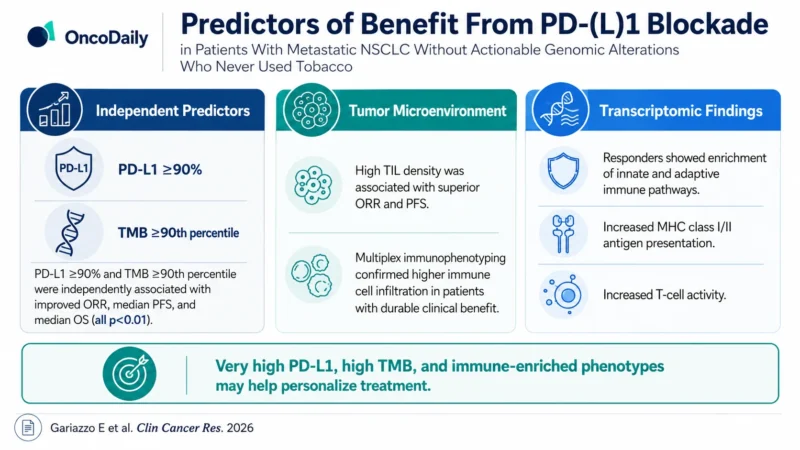
The strongest clinical biomarker signals came from very high PD-L1 expression and high tumor mutational burden. PD-L1 ≥90% and TMB ≥90th percentile were independently associated with improved objective response rate, progression-free survival, and overall survival, with all reported p values below 0.01 (Gariazzo et al., 2026).
This is important because standard PD-L1 thresholds such as 1% or 50% may not fully capture the subgroup most likely to benefit in never-smokers. The study suggests that very high PD-L1 expression, rather than PD-L1 positivity alone, may be more informative in this population.
Similarly, high TMB may identify a subset of never-smokers whose tumors are more immunogenic despite the absence of tobacco exposure.
Combination Immunotherapy Showed a Stronger Signal
The study also reported that PD-(L)1 plus CTLA-4 combinations outperformed chemo-immunotherapy and PD-(L)1 monotherapy in terms of median progression-free survival and median overall survival (Gariazzo et al., 2026).
This finding is clinically relevant because it suggests that dual checkpoint blockade may help overcome some of the immune limitations seen in never-smoker NSCLC. However, because the analysis was retrospective, treatment selection bias remains possible. Prospective validation is needed before this can be considered definitive.
Immune-Enriched Tumors Were More Likely to Benefit
Beyond PD-L1 and TMB, the investigators found that response was associated with an immune-enriched tumor microenvironment. Transcriptomic analysis showed enrichment of innate and adaptive immune pathways in responders, including increased MHC class I and II antigen presentation and greater T-cell activity (Gariazzo et al., 2026).
High tumor-infiltrating lymphocyte density was also associated with superior objective response rate and progression-free survival. Multiplexed immunophenotyping further confirmed that patients with durable clinical benefit had higher immune cell infiltration.
These findings reinforce an important point: in never-smoker AGA-negative NSCLC, immunotherapy benefit may depend less on smoking history itself and more on whether the tumor has an active, pre-existing immune microenvironment.
Clinical Meaning
This study helps refine the treatment discussion for a challenging NSCLC subgroup. Patients who never used tobacco and lack actionable genomic alterations are often difficult to classify biologically. They do not fit the classic smoking-associated immunotherapy-responsive model, but they also do not have a targetable oncogenic driver.
The data suggest that very high PD-L1 expression, high TMB, high TIL density, and immune-enriched transcriptomic features may identify patients more likely to benefit from PD-(L)1 blockade. The study also raises the possibility that PD-(L)1 plus CTLA-4 combinations may be more effective than other ICI-based regimens in selected patients.
At the same time, the overall median PFS of 4.5 months shows that many patients still experience limited benefit. Better biomarker selection remains essential.
Conclusion
Gariazzo and colleagues provide one of the clearest analyses of immunotherapy outcomes in never-smokers with metastatic AGA-negative NSCLC. The study shows that PD-(L)1 blockade can produce meaningful responses in a subset of patients, but outcomes remain variable.
Very high PD-L1 expression, high TMB, dense immune infiltration, and immune-enriched molecular profiles may guide personalization of immune checkpoint inhibitor therapy in this population. The findings also support further evaluation of dual checkpoint blockade strategies for selected patients with never-smoker, AGA-negative NSCLC.