OptiTROP-Lung05 is the first randomized phase 3 study to show a significant progression-free survival benefit with an antibody-drug conjugate plus pembrolizumab compared with pembrolizumab alone in the first-line treatment of PD-L1–positive advanced non-small cell lung cancer.
Presented by Caicun Zhou from Shanghai East Hospital, Tongji University, the study evaluated sacituzumab tirumotecan (sac-TMT), a TROP2-directed antibody-drug conjugate, in combination with pembrolizumab for patients with treatment-naïve locally advanced or metastatic NSCLC without EGFR or ALK alterations (Zhou et al., 2026).
Why This Study Matters
Pembrolizumab has been a key first-line standard for patients with PD-L1–positive advanced NSCLC, particularly in tumors without actionable EGFR or ALK alterations. However, many patients still experience early disease progression, especially in the PD-L1 TPS 1–49% group, where single-agent immunotherapy can be less effective.
Sac-TMT introduces a different strategy. As a TROP2-directed antibody-drug conjugate, it delivers a cytotoxic payload to tumor cells while pembrolizumab restores antitumor immune activity through PD-1 blockade. The biologic rationale is that ADC-induced tumor cell death may complement immune checkpoint inhibition by increasing antigen release, immune priming, and tumor vulnerability to immunotherapy (Hong et al., 2025).
How OptiTROP-Lung05 Was Designed
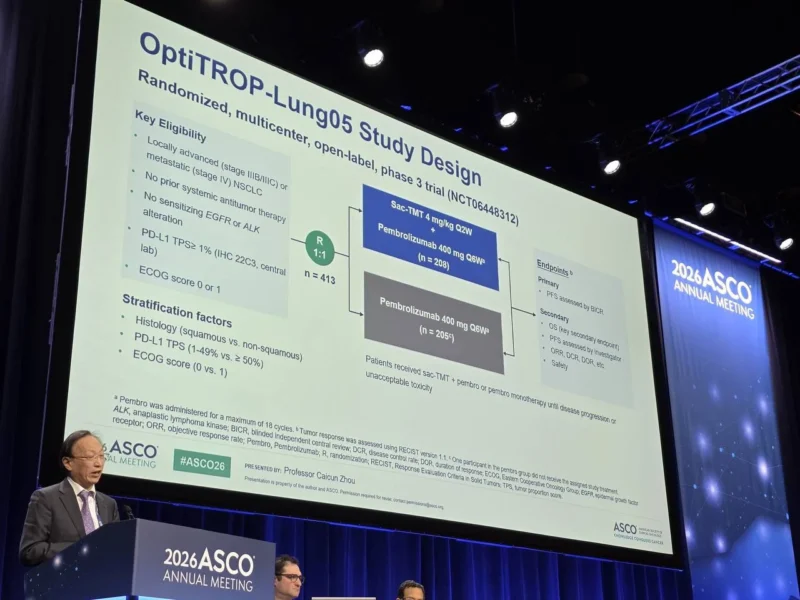
OptiTROP-Lung05 was a randomized phase 3 trial enrolling patients with treatment-naïve, locally advanced or metastatic NSCLC who had PD-L1 TPS ≥1% by the 22C3 assay and no EGFR or ALK alterations.
A total of 413 patients were randomized 1:1 to receive either: Sac-TMT 4 mg/kg every 2 weeks plus pembrolizumab 400 mg every 6 weeks, or pembrolizumab 400 mg every 6 weeks alone.
Patients were stratified by PD-L1 expression, histology, and ECOG performance status. The primary endpoint was progression-free survival by blinded independent central review according to RECIST 1.1. Overall survival was a key secondary endpoint (Zhou et al., 2026).
A Clear PFS Benefit
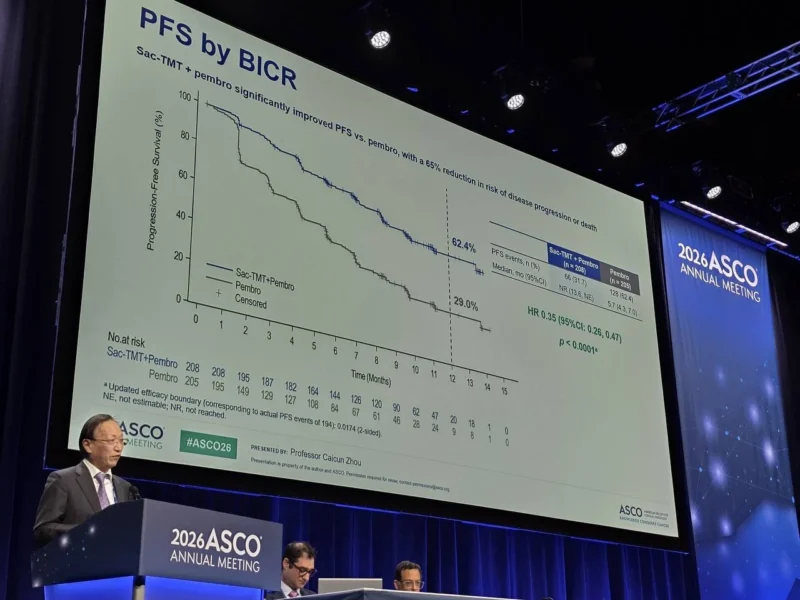
At the planned interim analysis, with a median follow-up of 10.5 months, the combination significantly improved progression-free survival.
Median PFS was not reached with sac-TMT plus pembrolizumab compared with 5.7 months with pembrolizumab alone. The hazard ratio was 0.35 with a 95% confidence interval of 0.26–0.47, and the result was highly statistically significant (p < 0.0001) (Zhou et al., 2026).
This represents a substantial reduction in the risk of progression or death and suggests that adding sac-TMT to pembrolizumab may deepen first-line disease control in PD-L1–positive advanced NSCLC.
Response Rates Were Also Higher
The objective response rate by blinded independent central review was also improved with the combination:
70.2% with sac-TMT plus pembrolizumab versus 42.0% with pembrolizumab alone.
This difference is clinically important because higher response rates can matter in advanced NSCLC, particularly for patients with symptomatic disease, high tumor burden, or the need for rapid disease control.
Benefit Across PD-L1 And Histology Subgroups
The progression-free survival benefit was observed across prespecified PD-L1 subgroups.
In patients with PD-L1 TPS 1–49%, the PFS hazard ratio was 0.28. In patients with PD-L1 TPS ≥50%, the hazard ratio was 0.47 (Zhou et al., 2026).
This is especially relevant because patients with TPS 1–49% often have a greater unmet need when treated with pembrolizumab monotherapy. The magnitude of benefit in this subgroup suggests that sac-TMT may help strengthen first-line treatment where single-agent PD-1 blockade may be insufficient.
The benefit was also consistent across histology. In non-squamous NSCLC, the PFS hazard ratio was 0.28, while in squamous NSCLC, it was 0.44. These findings support the potential use of the regimen across both major NSCLC histologic subtypes, although full subgroup details and longer follow-up will be important.
Overall Survival Is Still Immature
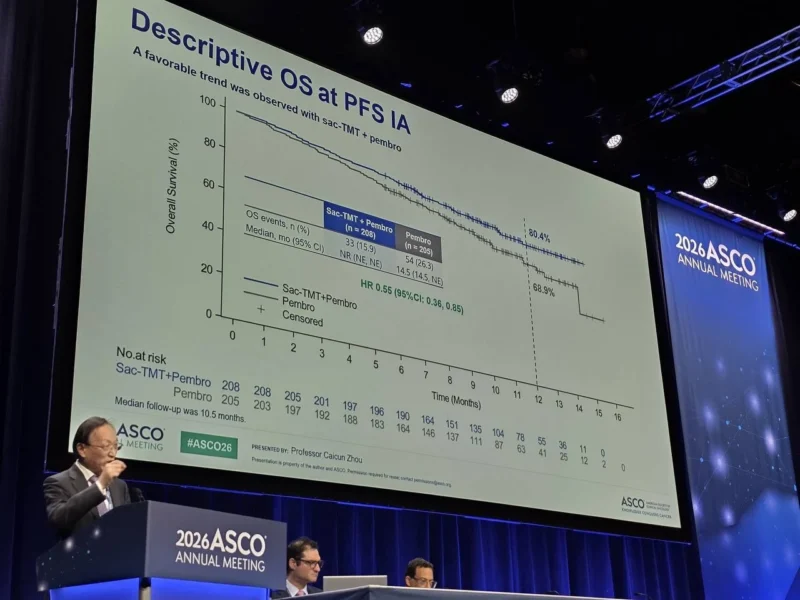
Overall survival data were not mature at the time of this interim analysis. However, a favorable trend was observed with sac-TMT plus pembrolizumab, with an OS hazard ratio of 0.55 and a 95% confidence interval of 0.36–0.85 (Zhou et al., 2026).
This signal is encouraging, but it should be interpreted cautiously until more mature survival data are available. In first-line advanced NSCLC, OS remains a critical endpoint, particularly when combination therapy adds toxicity and cost.
Safety Profile
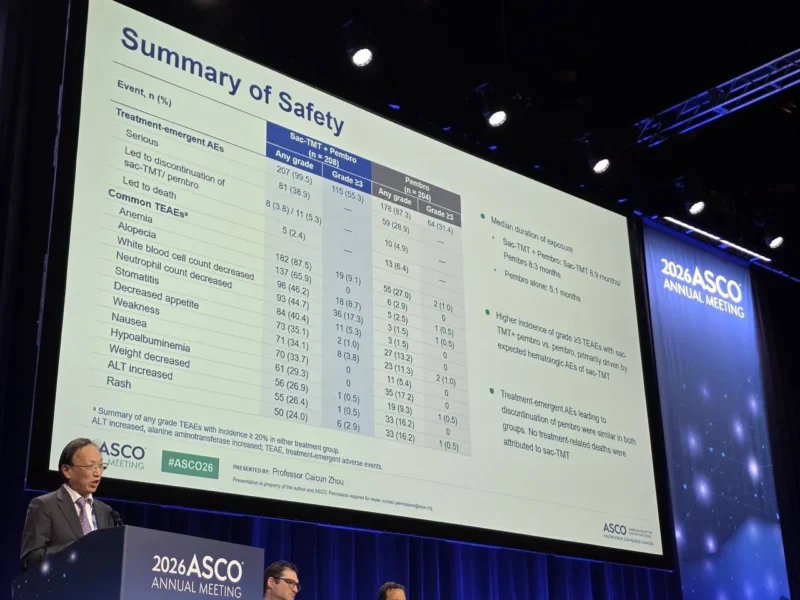
Grade 3 or higher treatment-emergent adverse events occurred more frequently with sac-TMT plus pembrolizumab than with pembrolizumab alone: 55.3% versus 31.4%.
The most common grade 3 or higher adverse events of special interest for sac-TMT were decreased neutrophil count, reported in 17.3%, anemia, reported in 9.1%, and stomatitis, reported in 5.3%.
Treatment-emergent adverse events led to discontinuation of sac-TMT in 3.8% of patients and pembrolizumab in 5.3% of patients in the combination arm. In the pembrolizumab-alone group, discontinuation of pembrolizumab occurred in 4.9% of patients (Zhou et al., 2026).
The investigators reported that the safety profile was generally manageable and consistent with the known profiles of the individual components, with no new safety signals observed.
Clinical Meaning
OptiTROP-Lung05 may represent an important step in the movement of antibody-drug conjugates into earlier NSCLC treatment settings. The study suggests that combining a TROP2-directed ADC with pembrolizumab can improve disease control compared with pembrolizumab alone in PD-L1–positive advanced NSCLC.
The most important finding is the magnitude of the PFS benefit. A median PFS not reached versus 5.7 months, together with a hazard ratio of 0.35, provides a strong efficacy signal. The benefit in both PD-L1 TPS 1–49% and TPS ≥50% groups also makes the result clinically relevant across the PD-L1–positive population.
However, several questions remain. Overall survival needs longer follow-up. The optimal positioning of sac-TMT plus pembrolizumab relative to chemoimmunotherapy and other emerging ADC-immunotherapy combinations remains to be defined. Patient selection, toxicity management, and access will also be important considerations if this regimen moves toward clinical use.
Key Takeaway
OptiTROP-Lung05 shows that sac-TMT plus pembrolizumab significantly improves progression-free survival compared with pembrolizumab alone in first-line PD-L1–positive advanced NSCLC without EGFR or ALK alterations.
The regimen produced a higher response rate and consistent PFS benefit across PD-L1 and histology subgroups, with a manageable safety profile and no new safety signals reported. If mature overall survival data confirm the early trend, sac-TMT plus pembrolizumab could become an important new first-line option for this population.