
Incidental lung nodules are common. The problem is what happens next.
A nodule may be clearly described in a radiology report. A follow-up recommendation may be written. But if no one owns the next step, the patient can disappear from the pathway.
That gap matters in lung cancer.
A study published as a pre-proof in CHEST Pulmonary evaluated whether a navigator-centered lung nodule program using natural language processing could reduce loss to follow-up and support earlier lung cancer diagnosis.
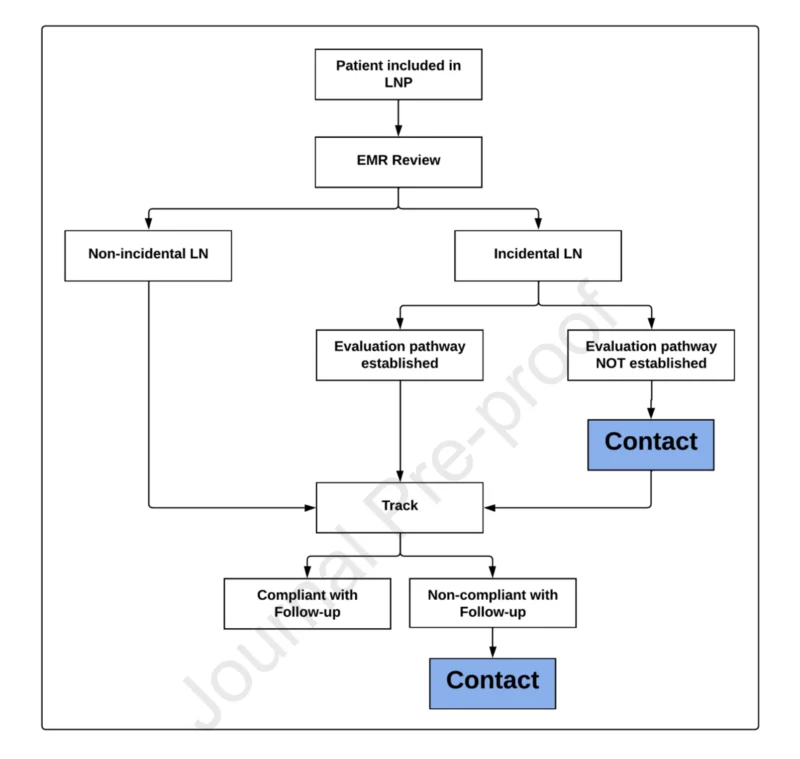
The program used natural language processing to identify radiology reports mentioning lung nodules and follow-up recommendations. Navigators then reviewed the electronic medical record to determine whether a follow-up plan already existed.
The goal was not to contact every patient with a nodule. It was to identify the patients at highest risk of falling through the cracks: those without a documented follow-up plan or those overdue for follow-up.
Over 32 months, the program included 5,439 patients. Among all patients included, loss to follow-up was 9.67%. Among contacted patients later diagnosed with primary non-small cell lung cancer, nearly 80% were diagnosed at stage I or II.
The findings suggest that a structured lung nodule pathway can turn an incidental imaging finding into an opportunity for earlier diagnosis.
Why Lung Nodules Are a Safety-Net Problem
Lung cancer remains the leading cause of cancer death worldwide.
Screening can reduce mortality, but screening uptake remains low. Another challenge is that many patients who develop lung cancer may not meet current screening eligibility criteria.
This makes incidental lung nodules clinically important.
Incidental nodules are detected outside formal lung cancer screening, often on CT scans performed for other reasons. In the United States, more than 1.5 million new incidental lung nodules are identified each year, and up to 5% are later diagnosed as lung cancer.
But follow-up is often inconsistent.
The authors note that more than half of incidental lung nodules may be lost to follow-up. Prior reports have shown high rates of missed work-up after indeterminate pulmonary nodules, and the authors’ own institutional review found follow-up adherence of only 41%.
This is the clinical gap the new program attempted to address.
How the Program Worked
The lung nodule program was launched in January 2023 at two hospitals within a large urban health system.
Natural language processing software reviewed radiology reports from imaging studies that included any part of the lungs. Reports were flagged only when they included both a lung nodule description and a recommendation for further evaluation.
Navigators then reviewed each case within 24–48 hours.
Patients were excluded if they had active cancer, if the radiologist stated no follow-up was needed, or if the nodule had benign features such as perifissural morphology, calcification, stability for at least two years, or features suggesting infection or inflammation.
Included patients were classified as having either non-incidental or incidental nodules.
Non-incidental nodules were monitored for follow-up compliance.
For incidental nodules, the key question was whether a follow-up plan was documented in the electronic medical record.
If a plan was present, the patient was monitored. If a plan was absent, the navigator attempted direct engagement. Patients were also contacted if follow-up became overdue.
This workflow was designed to focus navigator time where the risk of missed care was highest.
What the Program Found
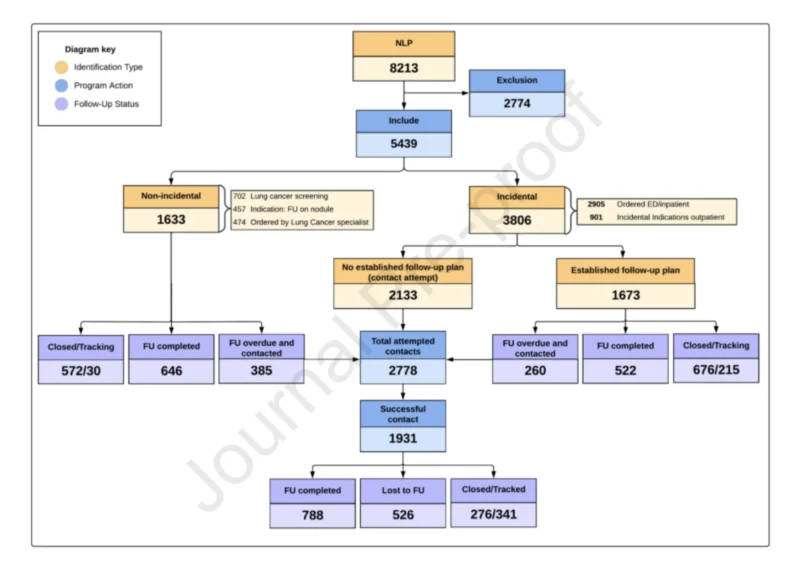
Between January 2023 and September 2025, the NLP tool flagged reports for 8,213 patients with potential lung nodules.
After exclusions, 5,439 patients were included in the lung nodule program.
Among them:
- 1,633 patients had non-incidental nodules and were monitored.
- 3,806 patients had incidental nodules.
Of the incidental nodule group, 44% had a documented follow-up plan and were monitored. The remaining 56% had no documented plan and became candidates for navigator outreach.
Overall, navigators attempted to contact 2,778 patients, either because no follow-up plan was documented or because follow-up was overdue.
They successfully contacted 1,931 patients, or 69.5%.
Among contacted patients, 526 were later classified as lost to follow-up. This represented 27.2% of contacted patients but only 9.67% of all patients included in the program.
For a clinical problem where published loss-to-follow-up rates can exceed 50%, this is an important signal.
Earlier Lung Cancer Detection Was a Key Finding
Among the 1,931 contacted patients, 49 were diagnosed with cancer.
This included 44 cases of non-small cell lung cancer.
Of those 44 NSCLC cases:
- 30 were stage I
- 5 were stage II
- 5 were stage III
- 4 were stage IV
That means 35 of 44 patients, or 79.5%, were diagnosed at stage I or II.
Among patients who were monitored but not contacted, 84 were diagnosed with NSCLC. In this group, 33 of 84 were stage I or II.
The authors did not statistically compare contacted and monitored patients because some patients in the monitored group may have received care or staging outside the health system.
Still, the contacted group is clinically important. These were patients without an obvious documented pathway or patients overdue for follow-up. In that high-risk group, navigator engagement was associated with a high proportion of early-stage diagnoses.
That is the central message of the study.
A radiology finding alone is not enough. A system must convert that finding into timely care.
What Did Navigation Trigger?
Navigator outreach led to substantial downstream care.
Among contacted patients, the program generated:
- 1,469 outpatient visits
- 1,046 imaging encounters
- 109 invasive diagnostic procedures
Outpatient visits included lung nodule clinic visits and other clinic visits. Imaging included CT, PET, chest radiography, and low-dose CT. Procedures included navigational or robotic bronchoscopy and CT-guided transthoracic biopsy.
This matters because follow-up is not a single event. It is a pathway.
A patient may need repeat imaging, specialist evaluation, PET imaging, biopsy, surgery, radiotherapy, or surveillance. Without coordination, each step can become another point of failure.
The navigator-centered model created a system for keeping patients visible.
The Equity Signal Matters
The study also identified disparities in patient engagement.
Contact was less successful among patients with Medicaid and those without insurance compared with patients with other insurance types. Engagement was also lower among Black patients compared with White and Asian patients.
Among patients who were successfully contacted, however, racial differences in follow-up completion were not statistically significant.
The authors interpreted this as suggesting that socioeconomic barriers, rather than race itself, may be the primary driver of follow-up adherence once contact is achieved.
This is an important point for implementation.
A lung nodule program cannot only be a technology project. It must also address insurance barriers, contact instability, transportation, health literacy, trust, access to primary care, and specialty care availability.
NLP may find the nodule.
Navigation must still reach the person.
Safety Was Carefully Tracked
Any lung nodule program can create harm if it leads to unnecessary invasive procedures.
Most lung nodules are not cancer. Over-testing can expose patients to biopsy complications, anxiety, radiation, and cost.
In this study, among the first 4,852 patients included in the program, 204 patients underwent 238 invasive procedures, including 175 navigational or robotic bronchoscopies and 63 CT-guided biopsies.
Pneumothorax was the most common complication. The rate was higher after CT-guided biopsy than after bronchoscopic biopsy.
The authors reported no major hemorrhage and no other major complications.
This safety assessment is important because early detection programs must balance benefit and harm. The goal is not to biopsy every nodule. It is to ensure that nodules needing follow-up are not forgotten.
What This Study Does Not Prove
This was a retrospective observational study from two hospitals in one health system.
It was not a randomized trial.
The results may not generalize to every setting, especially health systems with different radiology workflows, electronic medical record structures, patient populations, payer models, or navigator resources.
The NLP algorithm also had limitations. It flagged only reports that included both a nodule description and a radiologist recommendation. The authors reported a sensitivity of 56.6%, with most false negatives lacking a follow-up recommendation.
This means the program may miss nodules if recommendations are absent from the report.
The study also cannot fully determine whether patients labeled as lost to follow-up received care outside the health system.
Finally, cost-effectiveness remains unknown. The authors note that broader adoption will require formal economic evaluation, particularly in resource-constrained settings.
Why This Matters for Lung Cancer Care
The study highlights a practical gap in lung cancer early detection.
Formal lung cancer screening is important, but many lung cancers arise outside screening programs. Some patients are ineligible. Some are eligible but unscreened. Some are never-smokers. Some are diagnosed after incidental imaging.
A lung nodule program can serve as a safety net for this population.
The value is not only the technology. It is the workflow.
Natural language processing can identify reports. Navigators can review records, confirm whether a plan exists, contact patients, facilitate visits, and monitor completion.
Together, these steps turn passive radiology recommendations into active follow-up.
The Bottom Line
This CHEST Pulmonary study suggests that a navigator-centered lung nodule program using natural language processing can reduce follow-up gaps and support earlier lung cancer diagnosis.
Among 5,439 patients included in the program, loss to follow-up was 9.67% overall.
Among contacted patients diagnosed with NSCLC, nearly 80% were diagnosed at stage I or II.
The findings do not prove that the program improves survival. They do not replace lung cancer screening. They also require validation in other systems and formal cost-effectiveness evaluation.
But the message is clinically strong: incidental lung nodules need a pathway, not just a report.
In lung cancer, early diagnosis often depends on whether the health system notices the patient before the cancer progresses.
References
- Zulueta JJ, Qi J, Lam N, Ayoub N, Wang HY, Sanjuan M, et al. Navigator-centered lung nodule program using natural language processing improves follow-up and early lung cancer detection. CHEST Pulmonary. 2026. doi:10.1016/j.chpulm.2026.100282.
- Gould MK, Tang T, Liu ILA, et al. Recent trends in the identification of incidental pulmonary nodules. American Journal of Respiratory and Critical Care Medicine. 2015;192(10):1208–1214.
- Pyenson BS, Bazell CM, Bellanich MJ, Caplen MA, Zulueta JJ. No apparent workup for most new indeterminate pulmonary nodules in US commercially insured patients. Journal of Health Economics and Outcomes Research. 2013;6:118–129.
- Singh H, Koster M, Jani C, et al. Nodule Net: a centralized prospective lung nodule tracking and safety-net program. Respiratory Medicine. 2022;192.
- Osarogiagbon RU, Liao W, Faris NR, et al. Lung cancer diagnosed through screening, lung nodule, and neither program: a prospective observational study of the DELUGE in the Mississippi Delta cohort. Journal of Clinical Oncology. 2022;40(19):2094–2105.
- MacMahon H, Naidich DP, Goo JM, et al. Guidelines for management of incidental pulmonary nodules detected on CT images: from the Fleischner Society 2017. Radiology. 2017;284(1):228–243.