CHRYSALIS-2 was presented during ASCO 2026 with updated overall survival data for first-line amivantamab plus lazertinib in patients with atypical EGFR-mutated advanced non-small cell lung cancer. The analysis focused on the treatment-naïve population from Cohort C of the global phase 1/2 study, a clinically important group because atypical EGFR mutations are associated with poorer long-term outcomes with EGFR-targeted therapies compared with classical EGFR exon 19 deletion or L858R mutations.
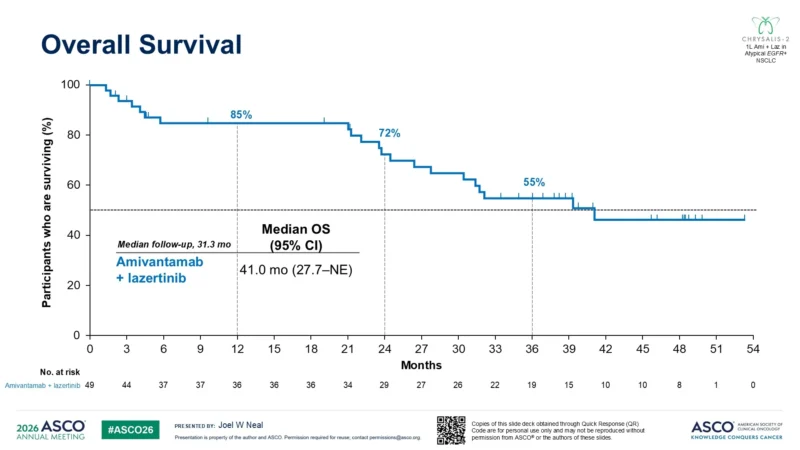
With longer follow-up, first-line amivantamab plus lazertinib showed a median overall survival of 41.0 months. The findings add long-term survival context to previously reported efficacy data from CHRYSALIS-2, including an objective response rate of 57%, median duration of response of 20.7 months, and median
Background
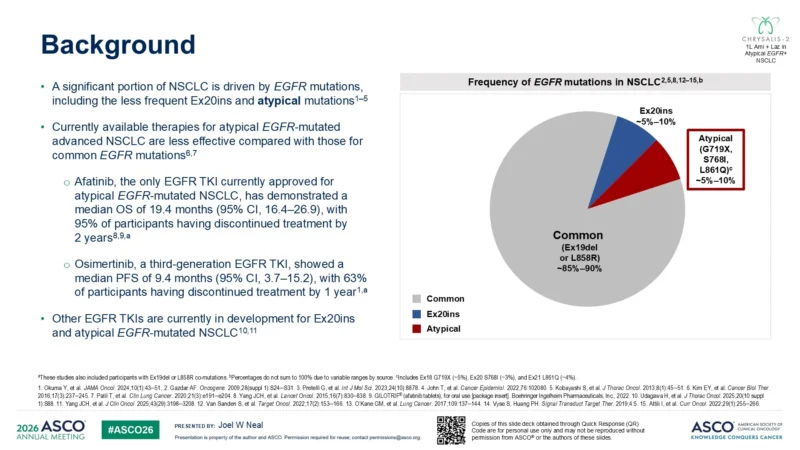
Atypical EGFR-mutated NSCLC represents a challenging subgroup within EGFR-driven lung cancer. Unlike classical EGFR mutations, atypical EGFR alterations have generally been associated with less consistent responses and worse long-term outcomes with available EGFR-targeted therapies. Afatinib is approved for atypical EGFR-mutated NSCLC, but earlier data reported a median overall survival of 19.4 months in patients with atypical EGFR mutations.
Amivantamab-based regimens are already approved across several treatment settings in advanced NSCLC with classical EGFR mutations and EGFR exon 20 insertion mutations. In the phase 3 MARIPOSA trial, first-line amivantamab plus lazertinib significantly improved overall survival compared with osimertinib in EGFR-mutated NSCLC. Earlier CHRYSALIS-2 data in atypical EGFR-mutated NSCLC showed an objective response rate of 57%, median duration of response of 20.7 months, and median progression-free survival of 19.5 months, while overall survival was still immature.
This updated analysis reports longer-term overall survival data for patients with atypical EGFR-mutated advanced NSCLC who received first-line amivantamab plus lazertinib.
Methods
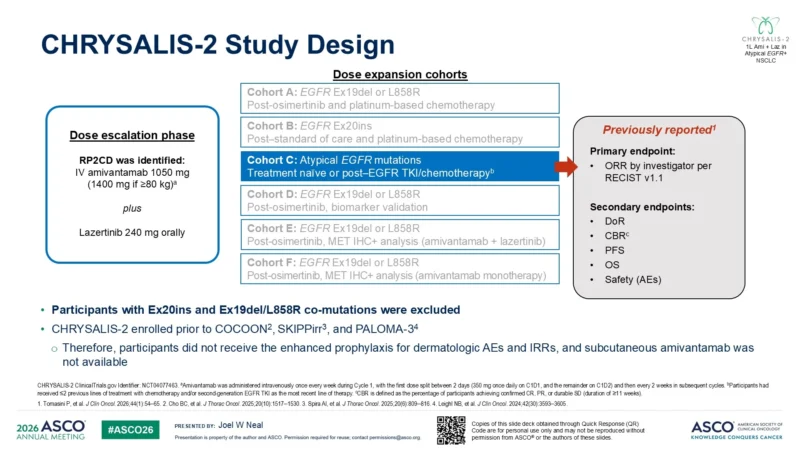
This analysis came from Cohort C of the global phase 1/2 CHRYSALIS-2 study. The cohort enrolled patients with atypical EGFR mutations, excluding EGFR exon 20 insertions and co-mutations with classical EGFR mutations.
Patients were either previously untreated or had received up to two prior lines of therapy, which could have included a first- or second-generation EGFR tyrosine kinase inhibitor. All enrolled patients received intravenous amivantamab plus lazertinib.
The primary endpoint was investigator-assessed objective response rate by RECIST v1.1, which had been previously reported. The current ASCO 2026 update focused on overall survival, a key secondary endpoint, in the treatment-naïve population of 49 patients.
Results
As of the October 31, 2025 data cutoff, the median follow-up was 31.3 months, with a range of 0.1 to 53.2 months.
In the treatment-naïve population, median overall survival was 41.0 months, with a 95% confidence interval of 27.7 months to not estimable. At landmark time points, 55% of patients were alive at 3 years, and 46% were alive at 4 years.
At the time of data cutoff, 20% of patients remained on first-line treatment. This included 10 of 49 patients, among whom 6 had confirmed responses and 4 had stable disease. Treatment duration among those still receiving therapy ranged from 2.5 to 4.4 years, with 7 patients receiving amivantamab treatment for more than 3 years.
Among patients whose disease had progressed and who discontinued first-line treatment, 71% received subsequent therapy. The most common subsequent regimen was platinum-based chemotherapy, used in 55% of these patients.
Safety
With longer follow-up, the safety profile remained consistent with prior reports. No additional safety signals were identified. This is important because prolonged treatment exposure is especially relevant in the first-line setting, where patients may remain on therapy for several years if disease control is maintained.
The abstract also noted that the recently FDA-approved subcutaneous formulation of amivantamab may further simplify the treatment experience for this regimen.
Key Takeaway
In the updated CHRYSALIS-2 analysis presented at ASCO 2026, first-line amivantamab plus lazertinib showed a median overall survival of 41.0 months in treatment-naïve patients with atypical EGFR-mutated advanced NSCLC. At 3 and 4 years, 55% and 46% of patients were alive, respectively, with 20% still receiving first-line treatment at data cutoff and no new safety signals identified with longer follow-up.