
Diffuse pleural mesothelioma remains one of the most difficult thoracic malignancies to treat. Despite advances in systemic therapy, there are still limited options designed to directly target tumor-cell vulnerabilities in this disease.
A new preclinical study published in the Journal of Thoracic Oncology explores whether amivantamab, a bispecific antibody targeting both EGFR and MET, could offer a new therapeutic approach for mesothelioma.
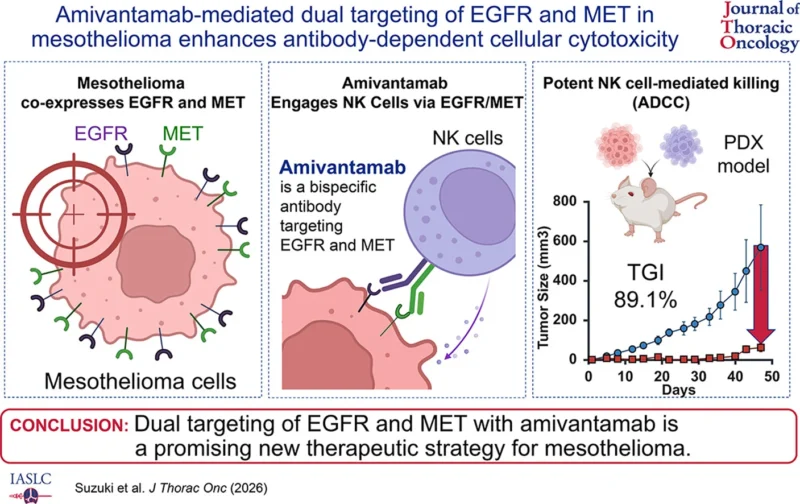
The study found that EGFR and MET are frequently co-expressed in diffuse pleural mesothelioma cells. Amivantamab bound preferentially to mesothelioma cells, inhibited EGFR and MET signaling, promoted receptor internalization, and induced natural killer cell-mediated antibody-dependent cellular cytotoxicity.
In patient-derived xenograft models, amivantamab combined with human natural killer cells significantly reduced tumor growth without overt toxicity.
These findings remain preclinical, but they provide a rationale for clinical investigation of dual EGFR/MET targeting in mesothelioma.
Why EGFR and MET Matter in Mesothelioma
Diffuse pleural mesothelioma is an aggressive malignancy arising from the pleural lining of the lung.
The disease is biologically complex and often difficult to treat, particularly after progression on first-line systemic therapy. Although immunotherapy and chemotherapy have improved outcomes for some patients, treatment resistance remains common.
EGFR and MET are receptor tyrosine kinases involved in cellular proliferation, survival, migration, and treatment resistance across several cancer types.
Previous studies have suggested that both receptors are frequently expressed in mesothelioma. However, the therapeutic relevance of co-targeting EGFR and MET in this disease has remained uncertain.
Amivantamab is a bispecific antibody designed to bind both EGFR and MET. It has established clinical activity in selected settings of non–small cell lung cancer, but its role in mesothelioma has not yet been defined.
Study Design
The researchers evaluated EGFR and MET expression across mesothelioma patient cohorts and cell lines using several complementary approaches.
These included:
- Transcriptomic analysis
- Single-cell RNA sequencing
- Immunohistochemistry
- Biochemical assays
- In vitro co-culture systems with peripheral blood
- mononuclear cells and natural killer cells
- Patient-derived xenograft models reconstituted with human natural killer cells
The goal was not only to determine whether EGFR and MET were present in mesothelioma cells, but also to assess whether amivantamab could trigger a therapeutically relevant immune response.
EGFR and MET Were Frequently Co-Expressed
Transcriptomic and single-cell RNA sequencing analyses showed frequent co-expression of EGFR and MET in diffuse pleural mesothelioma.
This co-expression was observed predominantly in malignant tumor cells rather than in surrounding nonmalignant cells.
Immunohistochemistry further confirmed protein expression of EGFR and MET across mesothelioma histologic subtypes.
The findings support the biological premise for dual receptor targeting. Rather than relying on inhibition of a single pathway, amivantamab may simultaneously interfere with two relevant signaling axes in mesothelioma cells.
Amivantamab Bound to Mesothelioma Cells and Blocked Signaling
In vitro experiments showed that amivantamab preferentially bound to diffuse pleural mesothelioma cells.
The antibody also promoted internalization of EGFR and MET receptors and inhibited ligand-induced signaling through both pathways.
This is important because receptor internalization may reduce the availability of EGFR and MET at the cell surface, while signaling inhibition may limit downstream proliferative and survival pathways.
However, direct inhibition of EGFR and MET signaling was only part of the observed antitumor effect.
The strongest findings involved immune-mediated cytotoxicity.
NK Cell-Mediated ADCC Appeared Central to Activity
Amivantamab induced dose-dependent cytotoxicity when mesothelioma cells were cultured with peripheral blood mononuclear cells or natural killer cells.
The data indicate that antibody-dependent cellular cytotoxicity, or ADCC, was a major mechanism of action.
ADCC occurs when an antibody binds tumor cells and recruits immune effector cells, particularly natural killer cells, through Fc receptor interactions. These immune cells can then directly kill the antibody-coated tumor cells.
This mechanism may be especially relevant in mesothelioma, where receptor expression alone may not be sufficient for durable tumor control.
The study suggests that amivantamab may act through a combination of:
- Dual EGFR and MET signaling blockade
- Receptor internalization
- Natural killer cell recruitment
- Antibody-dependent cellular cytotoxicity
Patient-Derived Xenograft Models Showed Tumor Growth Suppression
The investigators next evaluated amivantamab in mesothelioma patient-derived xenograft models.
Because these models used immunodeficient mice, the researchers reconstituted them with human natural killer cells to evaluate the immune-mediated component of treatment response.
The combination of amivantamab and natural killer cells significantly reduced tumor growth in multiple patient-derived xenograft models.
The study reported no overt toxicity in these models.
One representative model showed tumor growth inhibition of 89.1%, highlighting the potential importance of natural killer cell engagement in mediating antitumor activity.
These results reinforce that amivantamab’s preclinical activity in mesothelioma may depend substantially on immune-cell participation rather than receptor blockade alone.
Why This Finding Is Relevant
The study adds to a growing interest in biomarker-informed and immune-engaging treatment strategies for mesothelioma.
EGFR expression in mesothelioma has been recognized for years, but EGFR-targeted therapies have not consistently produced meaningful clinical benefit. One potential explanation is that simply inhibiting receptor signaling may be insufficient.
Amivantamab differs from conventional targeted therapies because it has a dual-targeting design and can recruit immune effector cells.
By engaging both EGFR and MET while facilitating natural killer cell-mediated killing, amivantamab may offer a broader mechanism of action than single-pathway inhibition.
The data also suggest that EGFR and MET co-expression could become relevant biomarkers for future clinical studies.
Important Limitations
This was a preclinical study.
The observed activity was generated in cell culture systems and patient-derived xenograft models, not in patients treated in a prospective clinical trial.
The efficacy of amivantamab in mesothelioma, the optimal patient population, the relevance of EGFR and MET expression levels, and the safety of this approach in clinical practice remain unknown.
In addition, the use of human natural killer cell-reconstituted mouse models is informative but cannot fully reproduce the complexity of the human tumor microenvironment.
Clinical trials will be required to determine whether the preclinical activity translates into clinically meaningful response rates, progression-free survival, overall survival, or improved quality of life.
What Comes Next
The study supports further evaluation of amivantamab in diffuse pleural mesothelioma.
Future clinical research may need to explore:
- Whether EGFR and MET co-expression predicts benefit
- The role of histologic subtype
- The contribution of natural killer cell activity and the immune microenvironment
- Potential combinations with chemotherapy, immune checkpoint inhibition, or other immune-enhancing approaches
- Biomarkers associated with resistance to EGFR/MET dual targeting
The study also raises a broader question for mesothelioma research: could treatment strategies that combine receptor targeting with innate immune activation improve outcomes in a disease with limited tumor-directed options?
Key Takeaway
Amivantamab demonstrated preclinical antitumor activity in diffuse pleural mesothelioma by engaging both EGFR and MET and promoting natural killer cell-mediated antibody-dependent cellular cytotoxicity.
Across mesothelioma models, EGFR and MET were frequently co-expressed in malignant cells. Amivantamab bound to tumor cells, inhibited receptor signaling, promoted receptor internalization, and reduced tumor growth in natural killer cell-reconstituted patient-derived xenograft models.
These results do not establish amivantamab as a treatment option for mesothelioma yet. However, they provide a strong rationale for clinical trials testing bispecific EGFR/MET targeting in this difficult-to-treat disease.