The third week of June brought together important updates across GI oncology, with 10 expert posts highlighting new publications, translational research, clinical practice discussions, prevention strategies, imaging innovation, and multidisciplinary advances across pancreatic, colorectal, anal, gastric, liver, and broader gastrointestinal cancers.
This week’s selection includes updates on the first Impact Factor for ESMO Gastrointestinal Oncology, real-world outcomes with TACE in hepatocellular carcinoma, recurrence patterns and treatment strategies in pancreatic ductal adenocarcinoma, local excision after chemoradiation in anal canal cancer, eIF4G2-dependent translation in pancreatic cancer progression, early-onset and late-onset GI cancers, definitions of conversion and neoadjuvant therapy in hepatocellular carcinoma, H pylori exposure in BRCA1/2 carriers, the PanTS open dataset for pancreatic cancer imaging, and pharmacist-led interventions for colorectal cancer prevention.
Together, these posts reflect the breadth of current GI oncology research and practice, from molecular biology and early detection to treatment selection, surgical decision-making, prevention, real-world evidence, and collaborative scientific progress.
Florian Lordick, MD, FESMO — Oncologist; Professor of Medicine at University of Leipzig; Head of Medical Oncology; Director of the Comprehensive Cancer Center Central Germany | Germany
“Today marks a very special milestone for ESMO Gastrointestinal Oncology: our journal has received its first Impact Factor. This achievement is an important recognition of the quality, relevance, and growing influence of the science published in our pages.
As Editors-in-Chief, Irit Ben-Aharon MD, PhD. and I are deeply grateful to everyone who contributed to this success.
A heartfelt thank you to our outstanding Associate Editors and Editorial Board members for their expertise, dedication, and commitment to scientific excellence. Thank you to the ESMO – European Society for Medical Oncology leadership and staff, and to our partners at Elsevier, whose professionalism and support have been instrumental in building this journal. And above all, thank you to the authors who entrusted us with their exciting and innovative research from the very beginning.
This first Impact Factor is not an endpoint—it is a starting point. Together, we have created a vibrant platform for the global gastrointestinal oncology community, and we are excited about the opportunities that lie ahead.
We look forward to continuing to publish impactful research, foster scientific exchange, and advance outcomes for patients with gastrointestinal cancers worldwide.
The future of ESMO Gastrointestinal Oncology is bright—and this is only the beginning.”
Sara De Dosso — Deputy Head of Medical Oncology and Lead of GI Cancer Program at IOSI; PD at Università della Svizzera italiana; Chair of the Certificate of Advanced Studies in GI Cancer at European School of Oncology | Switzerland
“Sara De Dosso shared a post from IOSI Oncology Institute of Southern Switzerland – EOC and wrote:
These results reflect years of collaboration, all working together to provide the best possible care for our patients. Proud to be part of such a fantastic multidisciplinary team! Teamwork Ente Ospedaliero Cantonale (EOC) Fondazione Epatocentro Ticino
And congratulations to Gayané von Schön-Angerer on completing her Master’s thesis! I’m proud of you!
IOSI Oncology Institute of Southern Switzerland – EOC shared:
New Publication! A 10-year real-world retrospective study from IOSI/EOC explores the role of transarterial chemoembolization (TACE) in patients with hepatocellular carcinoma (HCC).
Including 195 patients treated between 2013 and 2023, the study shows sustained tumour control and encouraging long-term outcomes, with a median overall survival of 56 months, exceeding previously reported ranges. Notably, patients with early-stage disease who were not candidates for surgery or ablation achieved particularly favorable progression-free survival.
The analysis also highlights the importance of multidisciplinary management, treatment adaptation, and the potential for conversion to curative-intent therapies, which was associated with markedly prolonged survival.
Congratulations to Dr. Gayané von Schön-Angerer and Dr. Guido Pesola, co-first authors of the article, PD Dr. Sara De Dosso, last author, and the multidisciplinary team of the Ente Ospedaliero Cantonale, along with collaborators across radiology, hepatology, and surgery.”
Giovanni Marchegiani — MD, PhD; Academic Pancreas Surgeon at the Hepato Pancreato Biliary and Liver Transplant Surgery Unit, Padova University Hospital | Italy
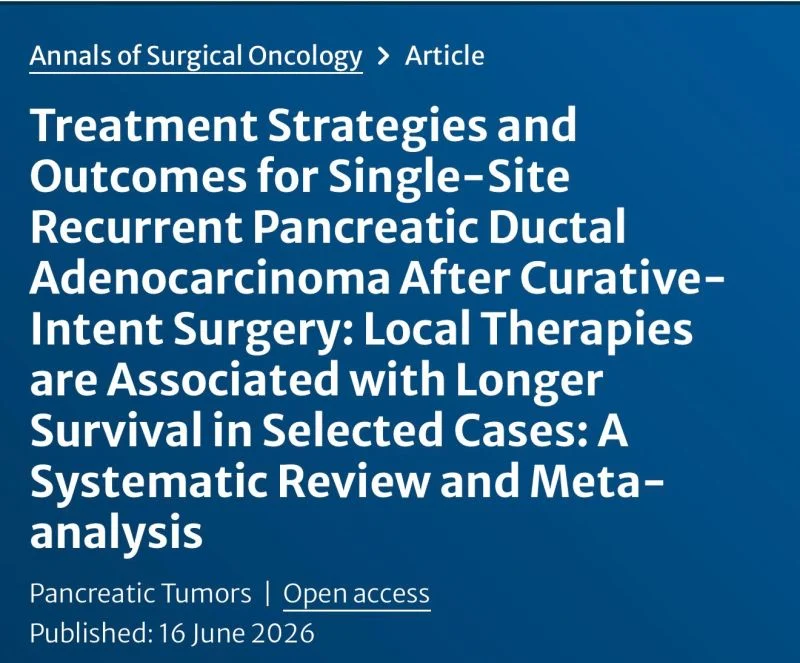
“Recurrence of PDAC patterns and new treatment strategies in Annals of Surgical Oncology
SR / MA 22 studies on single site recurrence — pattern matters!
Lung only recurrence > surgery longer survival
Selection bias huge but recurrence pattern-specific approach needed – liver only recurrence to be reassessed”
Majid Al Othman, MD — Unit Head of Radiation Oncology at Johns Hopkins Aramco Healthcare | Saudi Arabia
“Is local excision (LE) an option for salvage after definitive chemoradiation persistence or recurrence in ANAL CANAL cancer?
All current guidelines (NCCN 2026, ESMO 2021, ASCRS 2025) recommend abdomino-perineal resection (APR) rather than LE.
This retrospective large-database comparative analysis of 9000+ patients with stages I-III found a significant 5-year overall survival advantage for LE vs. APR: 75% vs. 46%! And APR was associated with a nearly 3-fold increase in mortality risk (HR = 2.94)!!
But it is far from being compelling enough to change practice.
APR patients had larger tumors, more stage III, higher-grade, and higher comorbidity scores.
Two-thirds of LE had positive margins of resection, compared with one-fourth in APR. This should tilt the balance in favor of APR, but it didn’t.
A ZERO-day median length of stay (LOS) in LE, compared with 7 days in APR, suggests that LE was mostly day-surgery outpatient procedures, which are unlikely to be curative-intent salvage procedures.
Missing important end points in salvage studies. No locoregional disease control data of PFS or LRR. No report of complications or quality of life.
The bottom line is that:
It is premature to use this study to contest the current APR standard of care, given the limitations mentioned above.
However, it is a hypothesis-generating dataset that should motivate prospective studies with strict patient selection criteria, balanced comparative groups, high-quality LE with appropriate curative intent, and relevant endpoints.
Your colorectal surgeons might have already read this article, which could be a worthwhile opportunity to explore their opinions on LE in this scenario.”
Álvaro Curiel-García, PhD — Associate Research Scientist at Columbia University Medical Campus | United States
“Thrilled and proud to share that I had the chance to collaborate on “eIF4G2-Dependent Translation Restrains Pancreatic Cancer Progression”, just published in AACR Journals Cancer Research.
This work identifies eIF4G2 as a translational checkpoint in Pancreatic Ductal Adenocarcinoma (PDAC) that acts as a barrier to that malignant plasticity. The study shows that loss of EIF4G2 selectively impairs translation of tumor suppressors like PTEN and CREBBP, triggering basal-like phenotypes, metastasis, and worse patient survival. Importantly, computational inference from human PDAC datasets confirmed that reduced eIF4G2 activity tracks with the most aggressive disease. Since PDAC is one of the deadliest cancers, partly because of its ability to dedifferentiate and disseminate, this work adds an important piece to understanding why these tumors become so aggressive.
It has been a real pleasure to work with Christine Chio and her laboratory on this. Congratulations to the whole team on a fantastic paper!”
José Perea García — General Surgeon and Digestive System Surgeon; Head of Surgery at Vithas Arturo Soria University Hospital; Professor of Surgery at European University of Madrid | Spain
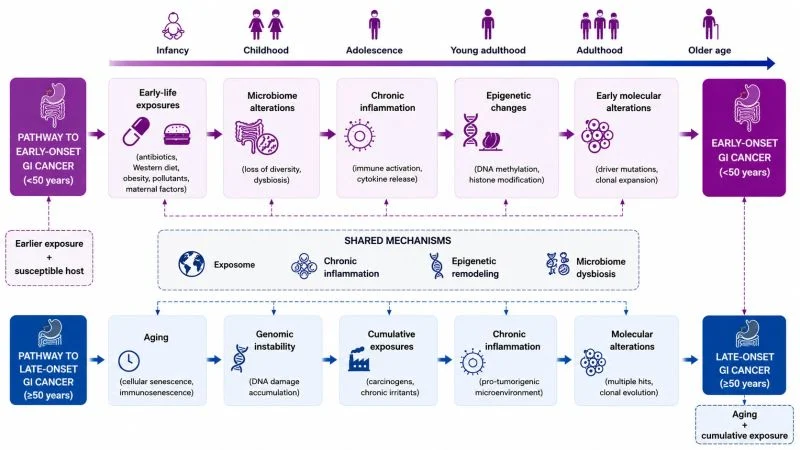
“Shared and differential mechanisms of early-onset and late-onset GI cancers.
Our Review on Expert Review in Anticancer Therapy journal published this week, a comparative approach not only to EOCRC but all the EO-GI cancers and their Later-onset counterpart.”
Hong Jae Chon — Professor of Medical Oncology at CHA Bundang Medical Center, CHA University School of Medicine | Republic of Korea
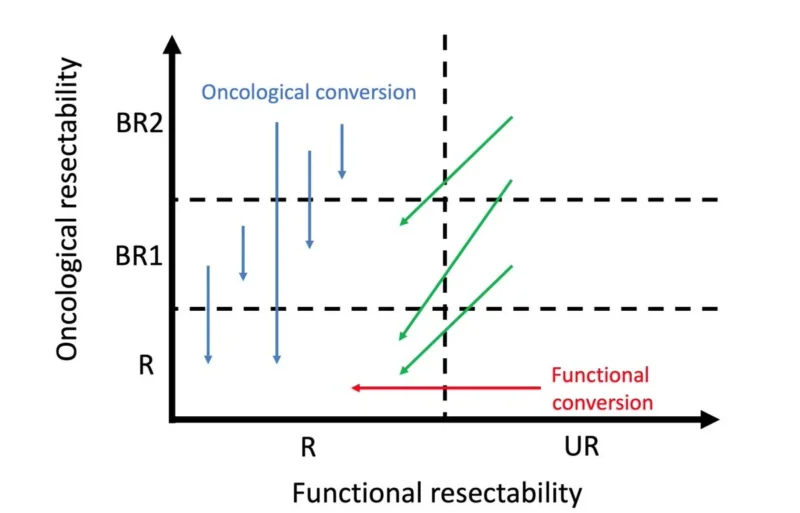
“How should conversion therapy and neoadjuvant therapy be defined for HCC in the era of modern systemic treatments?
Conversion therapy is curative-intent treatment (surgery or ablation) for initially unresectable HCC, requiring assessment of both oncological status and hepatic functional reserve.
Neoadjuvant therapy is preoperative treatment given to already-resectable patients with a pre-set surgical plan, and is distinct from conversion therapy.
Consensus guideline by Ichida et al. has recently been published in Liver Cancer.
Definition of Conversion Therapy and Neoadjuvant Therapy for Hepatocellular Carcinoma: A Consensus Guideline from the Japan Liver Cancer Association”
Bryson Katona — Jeffery and Cynthia King Associate Professor of Lynch Syndrome Research at University of Pennsylvania | United States
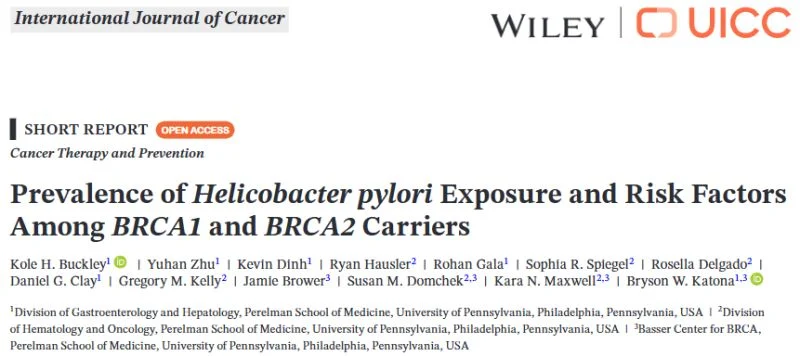
“Recent work has demonstrated that BRCA1 and BRCA2 carriers may be at increased risk for gastric cancer, and in east Asian populations this risk may be tied to prior H pylori exposure. While we have previously shown that active H pylori rates amongst US-based BRCA1/2 carriers undergoing pancreatic cancer screening is low (only 1%), the rate of H pylori exposure in US-based BRCA1/2 remained largely unexplored.
I am excited to share new work from our group, led by Kole H. Buckley, and in collaboration with the Men & BRCA Program at the Penn Medicine Basser Center for BRCA, where we assessed H pylori IgG seropositivity in a cohort of 1034 US-based BRCA1/2 carriers and found that approximately 1 in 6 BRCA1/2 carriers were H pylori IgG positive. Similar rates of seropositivity were also seen amongst other breast cancer risk genes associated with increased gastric cancer risk (PALB2, ATM, TP53). Future study of whether prior H pylori exposure increases gastric cancer risk in western BRCA1/2 carriers is of critical importance.”
Zongwei Zhou — Assistant Professor at The Johns Hopkins University | United States
“PanTS, the largest open dataset for pancreatic cancer, is live in The Johns Hopkins University Engineering Magazine:
Pancreatic cancer is the third leading cause of cancer death in the U.S. It is on track to be second by 2030. Even expert radiologists miss it early, when it is still small and still treatable.
That is the problem PanTS exists to solve.
AI-ready: pancreatic cancer is per-voxel annotated in 36,000 CT scans from 145 medical centers. Models trained on it detect tumors earlier and more accurately than any existing public dataset allows.
Open data is how we get there faster.
PanTS was built with NVIDIA’s MONAI Label, an open-source AI framework for medical imaging that supports interactive 3D segmentation and scalable, human-in-the-loop annotation workflows.”
Zuzana Majsniarová — Pharmacist; PhD Candidate at Comenius University in Bratislava | Slovakia
“I’m excited to share that our article focused on pharmacist-led interventions for colorectal cancer prevention has been published!
I would like to thank my supervisors Daniela Mináriková, Jana Sremanakova, co-authors and collaborators for their expertise, dedication, and teamwork throughout the whole review process.”
Find out 10 Must-Read Posts in GI Oncology from the second week of June on OncoDaily.