At the 2026 ASCO Annual Meeting, Kelvin K. Chan, MD, PhD, from Odette Cancer Centre, Sunnybrook Health Sciences Centre, presented a cost-utility analysis of the CHALLENGE trial evaluating a structured exercise program after adjuvant chemotherapy for colon cancer.
The phase 3 CHALLENGE trial demonstrated improved disease-free and overall survival with a 3-year structured exercise program compared with health education materials in participants with colon cancer who had completed adjuvant chemotherapy. This study evaluated the cost-effectiveness of the structured exercise program compared with health education materials.

You can read about Surgery Success Rate for Early-Stage Colon Cancer on OncoDaily.
Study Design
A prespecified economic evaluation was conducted using prospectively collected data from 889 trial participants. The base case adopted the Canadian public healthcare payer perspective and included direct healthcare costs, a 5-year time horizon, and a 1.5% discount rate.
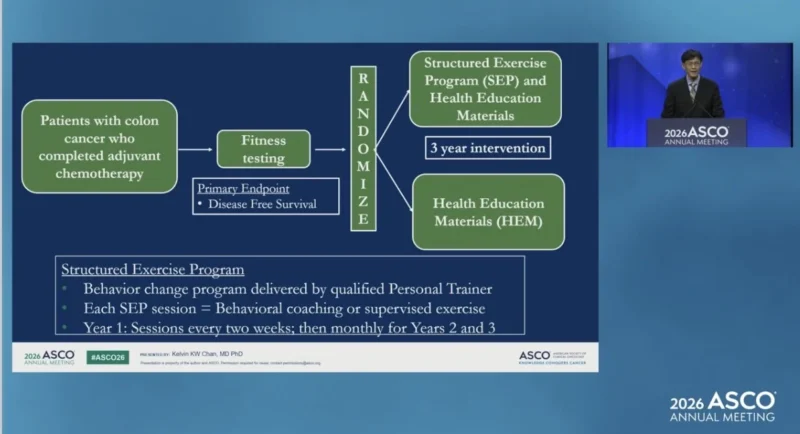
Participants were randomized to a structured exercise program plus health education materials or health education materials alone. The structured exercise program was a 3-year intervention delivered by qualified personal trainers, with sessions every two weeks during year 1 and monthly sessions during years 2 and 3.
Costs were reported in 2024 Canadian dollars and included the cost of the structured exercise program, recurrence or new primary cancer, anticancer therapy, and hospitalizations. Health utilities were calculated using SF-36 data mapped to SF-6D, and effects were measured as life-years and quality-adjusted life-years.
The analysis estimated incremental cost-effectiveness and cost-utility. Uncertainty was assessed using 1,000 bootstrap samples. Sensitivity and scenario analyses included changes to unit prices, indirect costs from lost productivity, a 10-year time horizon, alternative staff wages, 0% and 3% discount rates, and inclusion of overhead costs.
Results
In the base case, the structured exercise program was dominant over health education materials, meaning it was associated with lower costs and greater benefit.
The cost of the structured exercise program was $2,917 per patient. Mean total cost per participant was $31,957 in the structured exercise program group and $33,546 in the health education materials group, representing an incremental cost of −$1,589.
Mean total life-years were 4.72 with the structured exercise program and 4.66 with health education materials, with an incremental gain of 0.05 life-years. Mean total quality-adjusted life-years were 3.84 and 3.75, respectively, with an incremental gain of 0.10 QALYs.
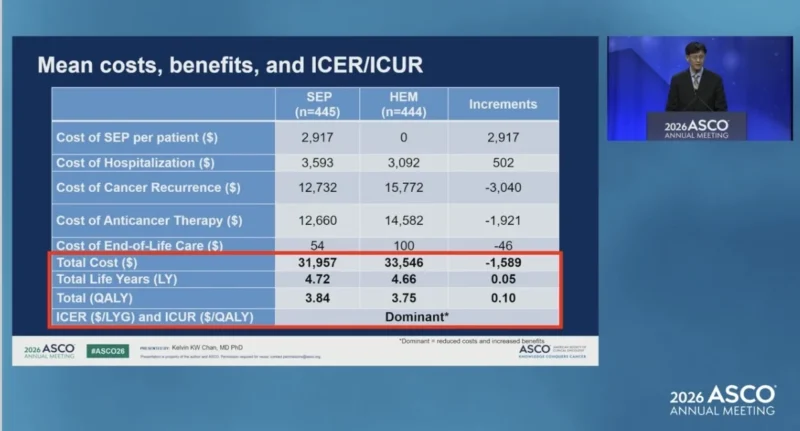
Major cost drivers included recurrence or new primary cancer costs and anticancer therapy costs. Costs for recurrence or new primary cancer were lower with the structured exercise program than with health education materials, at $12,732 versus $15,772. Anticancer therapy costs were also lower, at $12,660 versus $14,582. Hospitalization costs were higher in the structured exercise program group, at $3,593 versus $3,092.
The structured exercise program was dominant in 53% of bootstrap iterations and had an 80% probability of being cost-effective at a willingness-to-pay threshold of $50,000 per QALY. At a $100,000 per QALY threshold, the probability was 84%.
In sensitivity and scenario analyses, the structured exercise program remained dominant across all analyses except when overhead costs were included. With overhead costs included, the incremental cost-utility ratio was $4,405 per QALY. When indirect costs from lost productivity were included, cost savings were $1,067. With a 10-year time horizon, cost savings increased to $3,938.
Limitations
The base-case analysis used a Canadian public healthcare payer perspective. The presenters noted that findings were likely generalizable to other jurisdictions, although cost structures may differ across healthcare systems. Quality-of-life data were collected only during the first 5 years. The analysis also did not include some indirect costs, such as lost leisure time, informal caregiving costs, or employer costs related to replacing absent employees.
Conclusion
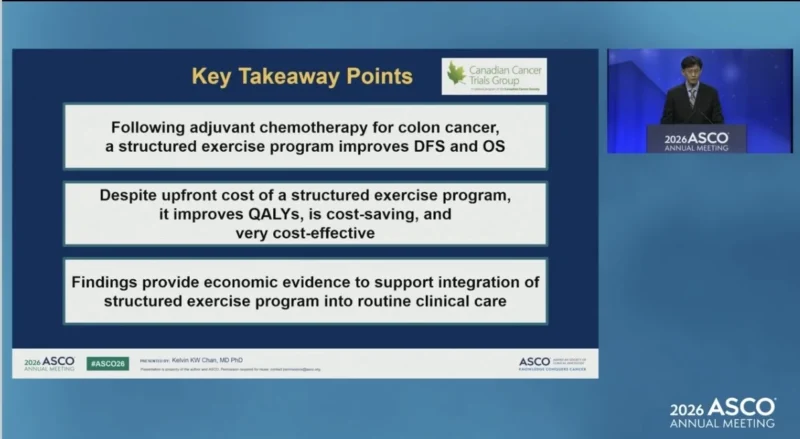
Following adjuvant chemotherapy for colon cancer, a structured exercise program improved disease-free and overall survival in the CHALLENGE trial. In this cost-utility analysis, the program was associated with higher quality-adjusted life-years, lower overall costs, and a high probability of being cost-effective compared with health education materials alone.
Despite the upfront cost of delivering the structured exercise program, lower costs related to cancer recurrence or new primary cancers and anticancer therapy contributed to overall cost savings. These findings provide economic evidence supporting the integration of structured exercise programs into routine clinical care for patients with colon cancer after adjuvant chemotherapy.
The full abstract is available on the official ASCO website.

You can also read about EPISODE-III at ASCO 2026 on OncoDaily.