
Cancer cachexia, also called cancer-associated cachexia, is a multifactorial syndrome defined by progressive skeletal-muscle loss, with or without loss of fat mass. Conventional nutritional support does not fully reverse it because reduced food intake and disease-driven catabolism occur together. Cancer-related anorexia describes the loss of appetite that often accompanies cachexia, but the terms are not interchangeable. A patient may eat less without having cachexia, and muscle loss may progress even when food intake appears adequate.
How Common Is Cancer Cachexia?
Reported prevalence varies with the cancer type, disease stage, timing of assessment, and diagnostic definition. The 2024 systematic review of 125 studies involving 137,960 patients finds that approximately 33% meet study-defined criteria, with estimates ranging from 13.9% to 56.5%. The burden is higher in some populations.
A 2025 meta-analysis reports a pooled prevalence of 50% in gastrointestinal cancers, while the prospective NEJ050A study identifies cachexia-related weight loss in 31.7% of 887 patients starting first-line therapy for advanced non-small cell lung cancer. These estimates are not interchangeable, but they show why routine screening matters. (Takaoka et al., 2024, Zhang et al., 2025, Miura et al., 2024).
Who Is at Higher Risk?
Risk rises when systemic inflammation, impaired intake, treatment toxicity, and limited physiological reserve overlap. Higher-risk groups include:
- Pancreatic, gastric, esophageal, lung, and head and neck cancers, which often combine systemic inflammation with impaired eating or digestion.
- Advanced or metastatic disease, particularly with high tumor burden, organ dysfunction, or sustained inflammation.
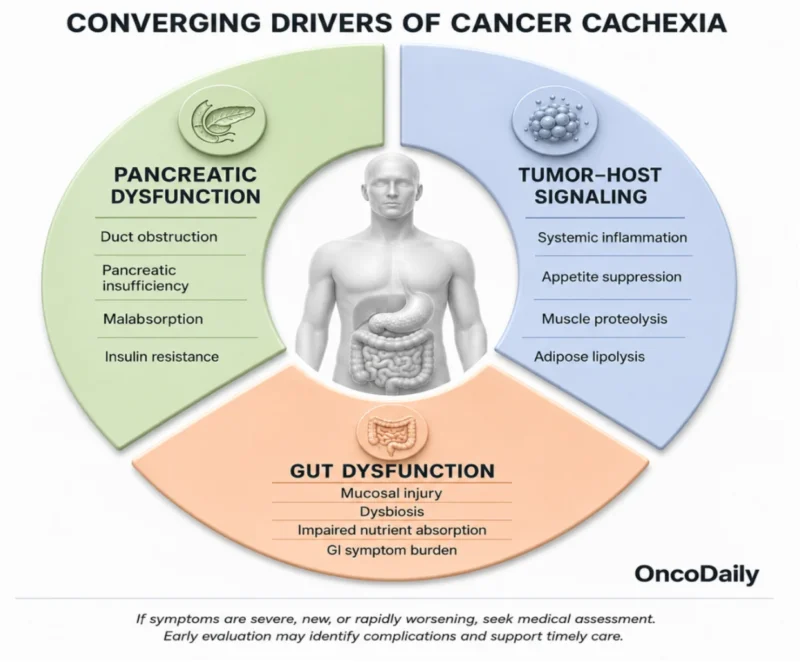
- Impaired eating or gastrointestinal function caused by dysphagia, early satiety, obstruction, pancreatic insufficiency, or malabsorption.
- Persistent treatment toxicities, including nausea, vomiting, diarrhea, mucositis, taste changes, xerostomia, pain, and fatigue.
- Low baseline reserve associated with sarcopenia, malnutrition, frailty, or poor functional status.(Arends et al., 2021, Baracos et al., 2018).
Why Does Cancer Cachexia Develop?
Cancer cachexia develops through a reinforcing biological cycle. Food intake falls while inflammatory and neuroendocrine signals accelerate tissue breakdown and weaken the response to nutrients. Tumor cells, stromal cells, and activated immune cells generate signaling networks that include interleukin-6, tumor necrosis factor-alpha, interleukin-1 beta, and other mediators.
Within skeletal muscle, these signals activate the ubiquitin-proteasome and autophagy-lysosomal systems, suppress anabolic pathways, impair mitochondrial function, and limit muscle regeneration. Protein degradation then exceeds synthesis, producing net loss of lean tissue. (Argilés et al., 2014, Baracos et al., 2018).
Inflammatory and tumor-derived signals also affect hypothalamic and hindbrain circuits that regulate hunger, satiety, nausea, and food aversion. One relevant mediator is growth differentiation factor 15, or GDF-15. GDF-15 activates the GFRAL-RET receptor complex in the hindbrain and suppresses food intake. Elevated circulating levels correlate with weight loss and mortality in several cancers, but not every patient shows GDF-15 elevation. Cachexia therefore represents several biological phenotypes rather than one universal pathway. (Lerner et al., 2015, Groarke et al., 2024).
Adipose lipolysis mobilizes triglyceride stores and reduces fat mass. Insulin resistance and altered glucose utilization disturb substrate handling. Resting energy expenditure rises in some patients and remains normal or reduced in others. The consistent abnormality is metabolic dysregulation, not a uniformly accelerated metabolism.
How Do Cancer Treatments Contribute to Cachexia?
Weight loss during treatment does not automatically mean that the cancer is progressing. Effective anticancer therapy may slow cachexia when tumor control reduces inflammatory signaling. The same therapy may intensify wasting when adverse effects limit eating, impair absorption, damage muscle, or reduce physical activity. The clinical question is whether appetite, hydration, and function recover between treatments or continue to decline from one cycle to the next. (Arends et al., 2021, NCI, 2024).
Chemotherapy, Targeted Therapy and Immunotherapy
Chemotherapy injures rapidly dividing cells in the oral and gastrointestinal mucosa. Mucositis, nausea, vomiting, dysgeusia, early satiety, diarrhea, and constipation then reduce intake or absorption. Infection, anemia, pain, and fatigue further reduce activity and accelerate deconditioning.
Some cytotoxic agents also disturb skeletal-muscle homeostasis independently of food intake. Oxidative stress, mitochondrial dysfunction, reduced protein synthesis, increased proteolysis, and impaired muscle regeneration contribute to treatment-related myopathy.
Repeated cycles become clinically important when appetite, strength, and activity do not return to baseline before the next treatment. Targeted therapy and immunotherapy produce different toxicity profiles, but persistent gastrointestinal, oral, endocrine, or inflammatory effects may lead to the same decline in intake and muscle reserve. Treatment-related anorexia alone does not establish cachexia. Risk rises when reduced intake persists alongside inflammation and muscle catabolism. (Coletti, 2018, Beltrà et al., 2021).
Radiotherapy
The treated anatomical region predicts the nutritional problem. Head and neck radiotherapy may cause mucositis, dry mouth, taste loss, painful swallowing, dysphagia, and trismus. A patient may begin avoiding solid food, taking longer to finish meals, or coughing during eating before substantial weight loss becomes visible. Thoracic radiotherapy may produce esophagitis and the sensation that food sticks behind the chest. Abdominal or pelvic radiotherapy may cause nausea, enteritis, diarrhea, and impaired absorption.
Acute symptoms often develop during treatment. Fibrosis, esophageal narrowing, salivary-gland dysfunction, and chronic bowel injury may persist or appear later. Continued weight loss after radiotherapy therefore requires assessment of swallowing, oral health, hydration, and gastrointestinal function rather than advice to increase calories alone. (NCI, 2024, King et al., 2016).
Why Prolonged Treatment Matters
Long treatment courses create a cumulative deficit when each cycle begins before intake and function fully recover. Hospitalization, infection, surgery, pain, and inactivity add further periods of muscle disuse. Repeated corticosteroid exposure may produce proximal weakness and insulin resistance. The patient may first notice slower walking, difficulty rising from a chair, or progressively longer recovery after each cycle.
This pattern promotes anabolic resistance, which means skeletal muscle responds less effectively to dietary protein and physical activity. Duration alone does not determine cachexia. Risk also depends on the treatment, dose, irradiated region, symptom burden, disease control, and pre-treatment muscle reserve. (NCI, 2024, Arends et al., 2021).
How Is Cancer Cachexia Diagnosed?
Cancer cachexia is a clinical diagnosis. No single symptom, laboratory test, or scan confirms it. International consensus criteria identify cachexia when any of the following is present:
- Unintentional weight loss of more than 5% within six months
- Weight loss of more than 2% with a body mass index below 20 kg/m²
- Weight loss of more than 2% with documented low skeletal-muscle mass
Weight alone does not show the full syndrome. Edema and ascites add fluid, while adipose tissue may conceal declining lean mass. Routine CT imaging may reveal skeletal-muscle depletion that body mass index does not detect. Assessment combines serial weight, baseline body mass index, food intake, nutrition-impact symptoms, muscle mass, physical function, performance status, and inflammatory activity. C-reactive protein, albumin, and hemoglobin characterize associated abnormalities, but none serves as a stand-alone cachexia biomarker. (Fearon et al., 2011).
The clinical continuum includes three stages. Pre-cachexia involves weight loss of 5% or less with early appetite or metabolic change, and progression is not inevitable. Cachexia includes established weight or muscle loss with declining function and reserve. Refractory cachexia occurs with progressive cancer that no longer responds to anticancer treatment, persistent catabolism, poor performance status, and an expected survival of approximately three months or less. Care at this stage prioritizes comfort, feasible intake, and patient-defined goals. (Fearon et al., 2011, Arends et al., 2021).
How Does Anemia Interact With Cancer Cachexia?
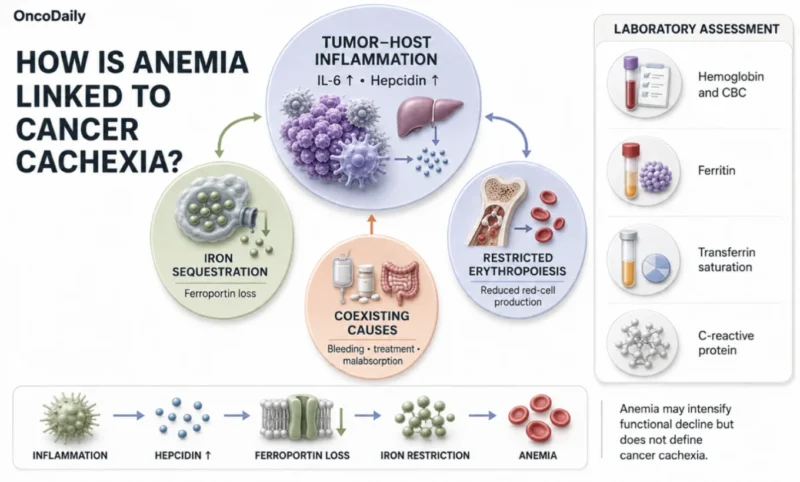
Anemia frequently accompanies cachexia but does not define it. Interleukin-6 increases hepatic hepcidin production, which degrades the iron exporter ferroportin. Intestinal iron absorption falls and iron remains trapped in storage cells, producing functional iron deficiency. Absolute iron deficiency instead reflects depleted stores from causes such as bleeding, malabsorption, surgery, or inadequate intake. Marrow suppression, renal dysfunction, hemolysis, and vitamin B12 or folate deficiency may coexist. (Nemeth et al., 2004, Aapro et al., 2018).
Reduced hemoglobin worsens fatigue, dyspnea, exercise intolerance, and functional decline. The phase III IRON-CLADtrial reports a better hemoglobin response with ferric carboxymaltose in chemotherapy-induced anemia, but no significant improvement in transfusion use or fatigue. The smaller ICaRAS feasibility trial reports higher hemoglobin and iron stores with ferric derisomaltose, while fatigue findings remain preliminary. Neither trial evaluates cachexia reversal. Intravenous iron therefore treats appropriately diagnosed iron deficiency, not cachexia itself. (Makharadze et al., 2021, Dickson et al., 2023)
How Is Cancer Cachexia Treated?
Management combines treatment of reversible causes, individualized nutrition, preservation of physical function, symptom control, and appropriate anticancer therapy. The plan changes with the cancer, organ function, treatment phase, cachexia stage, and the patient’s priorities. (Roeland et al., 2020; Arends et al., 2021).
Correcting Barriers to Intake
The first step is to identify treatable factors such as nausea, constipation, diarrhea, pain, mucositis, oral infection, depression, dysphagia, malabsorption, pancreatic insufficiency, or obstruction. An oncology dietitian then adapts meal size, texture, energy and protein density, hydration, and oral supplements to current symptoms and swallowing safety. Enteral or parenteral nutrition is not a routine treatment for cachexia. It is considered selectively when the gastrointestinal tract or oral intake is impaired by a potentially reversible problem and the expected clinical benefit justifies the burden. (Muscaritoli et al., 2021; Roeland et al., 2020).
Preserving Strength and Function
Individualized resistance and aerobic activity aims to preserve mobility, strength, and independence. Bone metastases, recent surgery, neuropathy, cardiopulmonary disease, infection, cytopenias, falls risk, baseline function, and treatment phase determine what is safe. In severe or refractory cachexia, maintaining transfers, walking, and daily activities is often more appropriate. (Ligibel et al., 2022)
Appetite-Directed Medication
ASCO states that clinicians may offer low-dose olanzapine once daily to adults with advanced cancer to improve appetite and weight gain. In a randomized trial of 124 patients starting chemotherapy for advanced gastric, hepatopancreaticobiliary, or lung cancer, weight gain greater than 5% occurs in 60% of participants receiving olanzapine and 9% receiving placebo over 12 weeks. Appetite, nutritional status, and quality-of-life measures also improve. (Sandhya et al., 2023; Roeland et al., 2023). Olanzapine remains off-label for cachexia in many jurisdictions. Sedation, orthostatic hypotension, metabolic effects, extrapyramidal symptoms, and drug interactions require assessment.
Which Treatments Are Under Study?
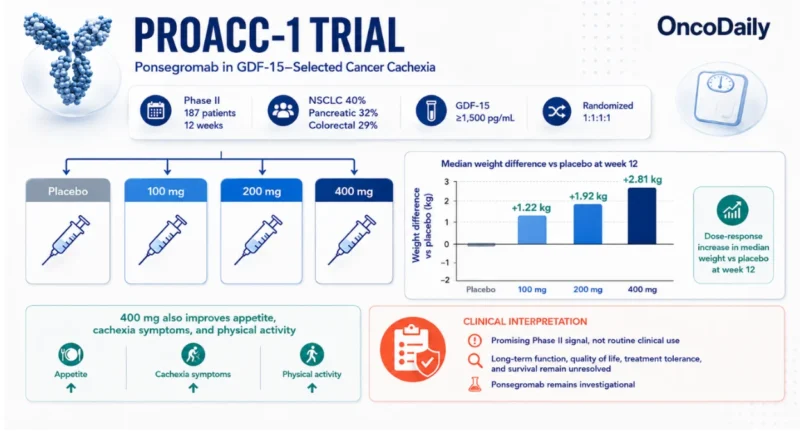
Ponsegromab, is an investigational monoclonal antibody targeting GDF-15. In the phase II PROACC-1 trial (NCT05546476), 187 patients with cancer cachexia and GDF-15 levels ≥1,500 pg/mL received ponsegromab or placebo. At 12 weeks, weight increased by 1.22, 1.92, and 2.81 kg relative to placebo with 100, 200, and 400 mg, respectively. The 400 mg dose also improved appetite, cachexia symptoms, and physical activity (Groarke et al., 2024). These findings support a phase II signal in a biomarker-selected population, but long-term effects on function, treatment tolerance, quality of life, and survival remain unknown.
The recruiting phase IIb/III RIVER-mPDAC trial (NCT06989437) is evaluating ponsegromab with first-line chemotherapy in patients with cachexia and metastatic pancreatic ductal adenocarcinoma. The study will assess whether earlier improvements in weight and appetite translate into broader clinical benefit, including survival.
What Does Daily Support Look Like?
Small, energy-dense meals often work better than large portions when early satiety is present. Oral nutritional supplements may fit between meals, while prescribed antiemetic, analgesic, bowel, and oral-care regimens reduce symptoms that interfere with eating. Monitoring includes intake, swallowing, strength, mobility, and symptom burden rather than body weight alone.
Family support is most effective when it preserves choice. Pressure to eat may increase conflict and distress because food cannot fully correct the underlying metabolic process. Offering small portions, preferred foods, and tolerable textures supports intake without turning every meal into a test. A family-centered pilot trial reports encouraging effects on eating-related distress and intake, but its small size does not establish efficacy. In refractory cachexia, comfort, relief of thirst or dry mouth, and foods requested by the patient take priority. (Bowers et al., 2024, Molassiotis et al., 2021).
Which Symptoms Require Urgent Assessment?
Sudden deterioration more often indicates an acute complication such as dehydration, infection, aspiration, electrolyte disturbance, or bowel obstruction. The oncology team’s written instructions and treatment-specific fever threshold take priority.
Contact the Cancer Care Team the Same Day
- Vomiting or diarrhea persists for more than 24 hours
- Mouth or throat pain prevents adequate fluid intake
- Urine becomes very dark, markedly reduced, or absent for eight hours
- Fever reaches the threshold established by the oncology team, particularly during chemotherapy or neutropenia
Seek Urgent or Emergency Care
- Liquids cannot be swallowed or retained
- Breathing difficulty, choking, or suspected aspiration develops
- Confusion, fainting, seizure, or profound weakness occurs
- Severe abdominal pain or distention develops with persistent vomiting or inability to pass stool or gas (American Cancer Society, 2024, American Cancer Society, 2026).
Chemotherapy-Induced Fatigue: Causes, Risk Factors, and Management
FAQ
What Distinguishes Cachexia From Malnutrition?
Malnutrition primarily reflects inadequate nutrient intake or absorption. Cachexia also includes inflammation-driven metabolic change and progressive muscle catabolism that nutrition alone does not fully reverse.
Does Eating More Reverse Cancer Cachexia?
Not by itself. Nutrition corrects avoidable deficits, while symptom control, physical support, and effective cancer treatment address additional drivers of tissue loss.
How Do Chemotherapy and Radiotherapy Influence Cachexia?
Treatment may reduce cachexia through tumor control or intensify it through nausea, mucosal injury, dysphagia, diarrhea, fatigue, and muscle toxicity.
Does Normal Body Weight Exclude Muscle Loss?
No. Fat mass, edema, ascites, or tumor mass may conceal clinically important skeletal-muscle depletion.
Does Weight Loss After Treatment Indicate Recurrence?
Not necessarily. Persistent toxicity, dehydration, infection, endocrine dysfunction, malabsorption, pain, depression, and medication effects also require assessment.
Does Cachexia Improve With Cancer Control?
It may stabilize or improve when treatment reduces tumor activity and nutrition-impact symptoms. Muscle recovery may still require nutrition support and rehabilitation.
When Does Weight Loss Require Urgent Care?
Urgent care is appropriate when weight loss accompanies inability to retain fluids, confusion, fainting, breathing difficulty, suspected obstruction, or fever during immunosuppressive treatment.