






Key takeaways
- Ponsegromab is an investigational monoclonal antibody targeting GDF-15, a biological driver of cancer cachexia.
- Phase 2 results showed dose-dependent weight gain, with the largest improvement at 400 mg every four weeks.
- Encouraging signals were also observed in appetite, physical activity, and skeletal muscle index.
- Ponsegromab is administered by subcutaneous injection and does not require intravenous preparation or an in-line filter.
- It is not currently approved by the FDA, European Commission, NMPA, or other major regulatory authorities.
- Larger Phase 2b/3 trials are needed to confirm effects on function, treatment tolerance, quality of life, and survival.
Ponsegromab is an investigational monoclonal antibody being developed for cancer cachexia, a wasting syndrome marked by involuntary weight loss, muscle loss, anorexia, fatigue, and functional decline. Unlike general appetite stimulants, ponsegromab targets a specific biological pathway: growth differentiation factor 15, or GDF-15.
The drug is not yet FDA-approved. Its main clinical evidence comes from a randomized Phase 2 trial in patients with cancer cachexia and elevated GDF-15 levels, presented at ESMO 2024 and simultaneously published in The New England Journal of Medicine. The next key question is whether ponsegromab can confirm these findings in larger registration-enabling trials, especially in metastatic pancreatic cancer.
What Is Ponsegromab?
Ponsegromab, also known as PF-06946860, is an investigational humanized monoclonal antibody being developed for cancer cachexia. It binds circulating growth differentiation factor 15, or GDF-15, and prevents activation of the GDF-15–GFRAL signaling pathway involved in appetite suppression, weight loss, and metabolic dysfunction.
Cancer cachexia is a complex metabolic syndrome characterized by involuntary weight loss, skeletal muscle wasting, reduced appetite, weakness, and functional decline. Unlike simple malnutrition, it is driven by tumor-related inflammation and metabolic changes and cannot usually be fully reversed by nutritional support alone.
Elevated GDF-15 may contribute to reduced food intake, loss of body weight, skeletal muscle wasting, and lower physical activity in patients with cancer. By neutralizing GDF-15, ponsegromab is designed to address an underlying biological driver of cachexia rather than only stimulating appetite or providing nutritional support.
Read more: Learn about cancer cachexia and World Cancer Cachexia Awareness Day on OncoDaily.
Why Target GDF-15 In Cancer Cachexia?
Cancer cachexia is not simply “not eating enough.” It is a complex metabolic syndrome driven by tumor biology, inflammation, altered energy balance, and muscle breakdown. Patients may continue losing weight even with nutritional support.
GDF-15 became an attractive target because it signals through the GFRAL pathway in the hindbrain, a region involved in appetite and weight regulation. Elevated GDF-15 has been associated with weight loss and skeletal muscle loss in cancer. By blocking circulating GDF-15, ponsegromab aims to reduce cachexia symptoms at the biological-driver level rather than only treating appetite secondarily.
Simple Mechanism
Ponsegromab binds GDF-15 in the blood. This prevents GDF-15 from activating its receptor pathway, mainly the GDF-15–GFRAL axis. The expected downstream effect is improved appetite, increased body weight, improved activity, and potentially preservation of skeletal muscle.
Simple mechanism:
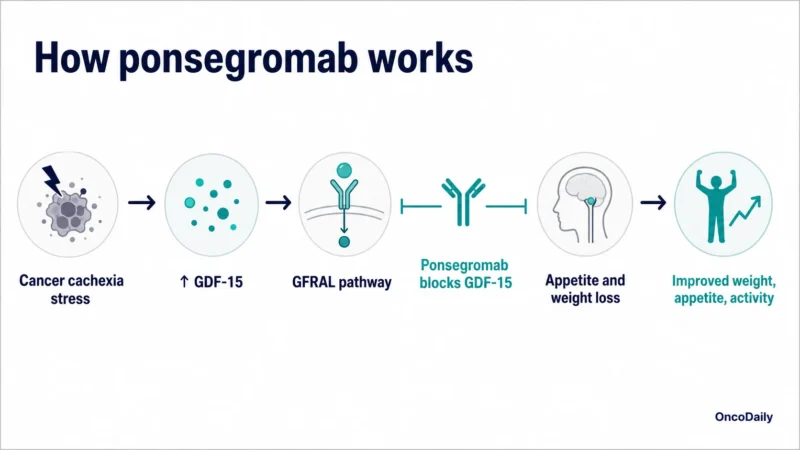
Figure. Ponsegromab blocks circulating GDF-15, a pathway involved in appetite suppression, weight loss, and cachexia-related functional decline.
Is Ponsegromab Approved?
No. Ponsegromab remains investigational and is not currently approved by the US Food and Drug Administration, the European Commission, or China’s National Medical Products Administration. It also has no approved indication from other major regulatory authorities.
Ponsegromab remains in late-stage clinical development, including the ongoing Phase 2b/3 RIVER-mPDAC trial in metastatic pancreatic cancer with cachexia. Therefore, it should not be used outside a clinical trial or another authorized investigational-access pathway.
How Is Ponsegromab Administered?
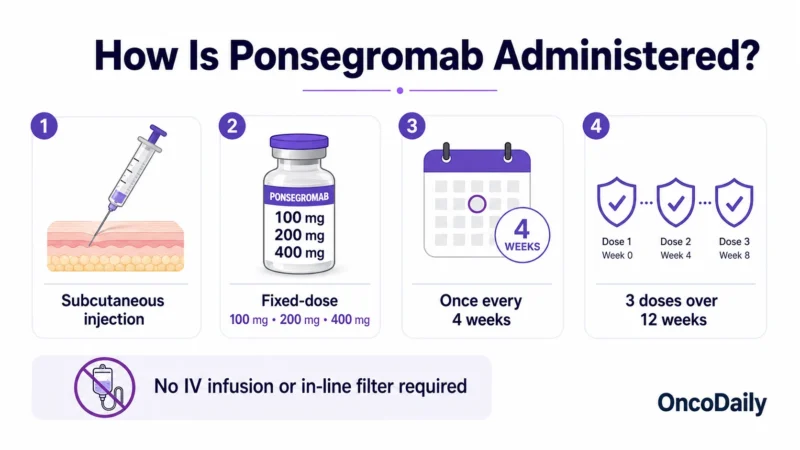
Ponsegromab is administered by subcutaneous injection, rather than as an intravenous infusion or oral medication. In the Phase 2 PROACC-1 trial, patients received fixed doses of 100 mg, 200 mg, or 400 mg once every 4 weeks, for a total of three doses during the initial 12-week treatment period. The injections were given without weight-based dose calculation. Because ponsegromab is injected subcutaneously, intravenous preparation, dilution, infusion tubing, and in-line filtration are not required. Routine premedication was not described as a standard requirement in the Phase 2 trial, although patients should still be monitored for injection-site reactions, hypersensitivity, and other treatment-emergent adverse events.
Pharmacokinetics and Drug Clearance
Ponsegromab is a monoclonal antibody and is therefore expected to be cleared mainly through normal protein-catabolism pathways, in which the antibody is broken down into small peptides and amino acids, rather than through CYP450 liver enzymes or conventional renal excretion. Its every-four-week dosing schedule reflects the prolonged systemic exposure typical of monoclonal antibodies. However, a precise terminal half-life, clearance value, time to steady state, and the effects of renal or hepatic impairment have not been fully reported in the publicly available Phase 2 cancer-cachexia results. These details remain investigational and should not be presented as established prescribing information because ponsegromab has not yet received regulatory approval. A dedicated pharmacokinetic study has evaluated single 100 mg and 400 mg subcutaneous doses, with extended follow-up because of the drug’s prolonged anticipated exposure.
Clinical Trials And Presented Data
The delopment of ponsegromab is centered on patients with cancer cachexia and elevated GDF-15. The most important data so far come from a Phase 1b first-in-patient study and a randomized Phase 2 trial, followed by ongoing Phase 2b/3 development in metastatic pancreatic cancer.
In the Phase 1b first-in-patient study, Crawford et al. evaluated ponsegromab in adults with advanced cancer, cachexia, and elevated GDF-15. The study was open-label and included a small number of patients. Ponsegromab was reported to be well tolerated, suppressed serum GDF-15, and showed preliminary signals of benefit, including body weight and patient-reported outcomes. These early findings supported further randomized testing. (Crawford et al., 2024).
The pivotal early efficacy signal came from the Phase 2 PROACC-1 trial, a randomized, double-blind, placebo-controlled 12-week trial. Patients had cancer cachexia, elevated serum GDF-15 of ≥1500 pg/mL, and non-small cell lung cancer, pancreatic cancer, or colorectal cancer. A total of 187 patients were randomized to ponsegromab 100 mg, 200 mg, 400 mg, or placebo, given subcutaneously every 4 weeks for three doses. The primary endpoint was change from baseline in body weight at week 12. (Groarke et al., 2024).
At ESMO 2024, the Phase 2 data were presented as a late-breaking Proffered Paper Presentation LBA82 and published simultaneously in The New England Journal of Medicine. Ponsegromab met the primary endpoint, with body-weight increases compared with placebo across all tested doses. At week 12, the placebo-adjusted mean body-weight changes were 2.02% with 100 mg, 3.48% with 200 mg, and 5.61% with 400 mg. The highest dose also showed improvements in appetite/cachexia symptoms, physical activity, and skeletal muscle index (Pfizer press release, ESMO 2024).
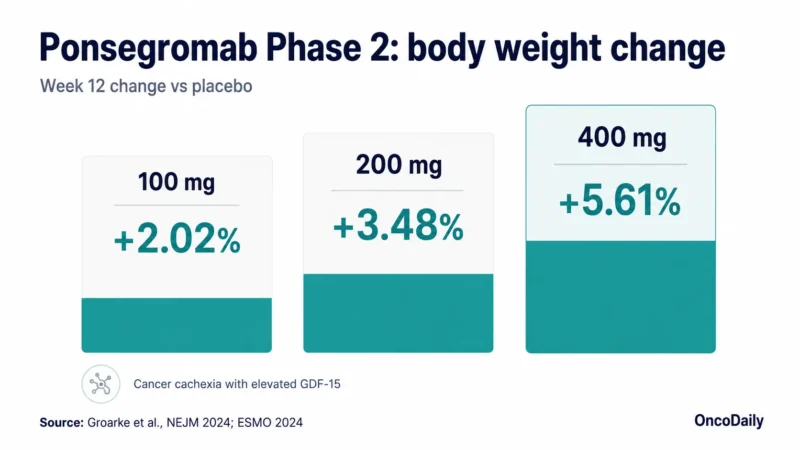
Figure. In the Phase 2 PROACC-1 trial, ponsegromab improved body weight compared with placebo at week 12, with the largest effect observed at the 400 mg dose.
Safety in the Phase 2 study appeared manageable. Pfizer reported no clinically significant adverse trends, and treatment-related adverse events occurred in 7.7% of patients receiving ponsegromab compared with 8.9% receiving placebo. This is encouraging, but larger studies are still needed to confirm safety, especially in frail patients receiving active cancer therapy.
The next major study is RIVER-mPDAC, a randomized, double-blind, placebo-controlled Phase 2b/3 trial in metastatic pancreatic ductal adenocarcinoma with cachexia. The trial evaluates ponsegromab plus first-line chemotherapy versus placebo plus chemotherapy. Planned chemotherapy options include gemcitabine/nab-paclitaxel or FOLFIRINOX/mFOLFIRINOX. The trial is expected to enroll approximately 1000 patients across its Phase 2b and Phase 3 parts (Roeland et al., 2026; ClinicalTrials.gov, NCT06989437).
The key clinical message is that ponsegromab has moved cancer cachexia from a mainly supportive-care problem toward a biologically targeted treatment strategy. However, it is still investigational, and Phase 2 weight-gain signals must be confirmed in larger trials with outcomes that matter to patients: function, treatment tolerance, quality of life, and possibly survival.
What Outcomes Matter Most?
For cachexia, body weight is important, but it is not enough alone. A meaningful treatment should ideally improve or preserve:
- Appetite and food intake
- Skeletal muscle mass
- Physical activity
- Fatigue
- Quality of life
- Ability to tolerate anticancer therapy
- Functional independence
- Survival or treatment-continuation outcomes, if proven
This is why ponsegromab’s Phase 2 signals in appetite, activity, and skeletal muscle index are clinically interesting. The larger question is whether these translate into durable functional benefit.
Which Patients May Be Considered In Trials?
Current trial populations focus on patients with cancer cachexia and elevated GDF-15. In PROACC-1, eligible patients had GDF-15 levels of at least 1500 pg/mL and had non-small cell lung cancer, pancreatic cancer, or colorectal cancer.
The ongoing RIVER-mPDAC study focuses specifically on metastatic pancreatic ductal adenocarcinoma with cachexia. This makes sense because pancreatic cancer is one of the cancers most strongly associated with cachexia and functional decline.
Safety And Monitoring
Ponsegromab has so far appeared generally well tolerated in early studies, but the target population is medically vulnerable. Patients with cachexia often have advanced cancer, poor nutritional reserve, fatigue, systemic inflammation, and concurrent chemotherapy exposure.
Monitoring should include:
- Body weight and weight trajectory
- Appetite and cachexia symptoms
- Skeletal muscle or body composition when available
- Physical activity or functional status
- Adverse events during chemotherapy
- Treatment-related reactions
- Overall tolerance of anticancer therapy
These measures help clinicians assess whether ponsegromab is providing meaningful benefit beyond weight gain alone, while also identifying treatment-related problems early in a medically fragile population.
Where Could Ponsegromab Fit Clinically?
If future trials are positive, ponsegromab could become a targeted supportive-care therapy for patients with cancer cachexia and elevated GDF-15. Its role would likely be alongside cancer-directed therapy, nutrition support, symptom management, and physical rehabilitation, not as a replacement for them.
The most likely early clinical use would be in cancers where cachexia is common and clinically damaging, especially pancreatic cancer, lung cancer, and colorectal cancer. However, approval and final positioning will depend on Phase 2b/3 results.
What’s Next For Ponsegromab?
The next major step is confirmation in larger registration-enabling trials. The RIVER-mPDAC study will be especially important because it tests ponsegromab in a high-cachexia-risk disease while patients are receiving first-line chemotherapy.
Future research should also clarify whether GDF-15 level can serve as a predictive biomarker, whether weight gain reflects true muscle preservation, and whether treatment improves chemotherapy tolerance, quality of life, and survival-related outcomes.
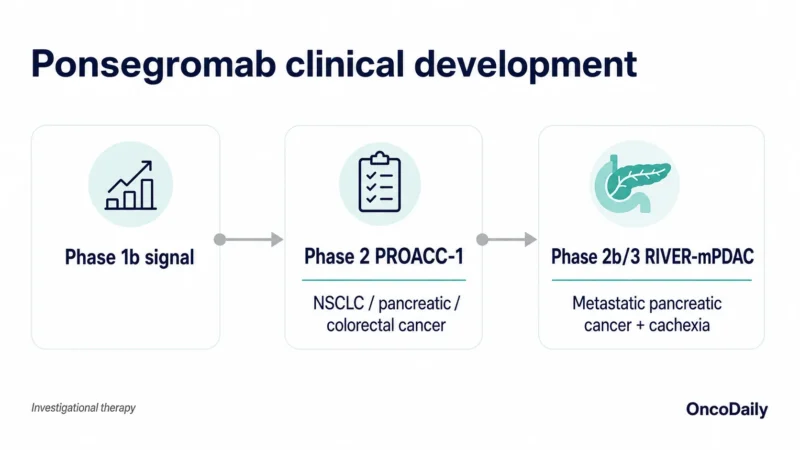
Figure. Ponsegromab has moved from early cancer-cachexia signals into Phase 2 PROACC-1 and the ongoing Phase 2b/3 RIVER-mPDAC study in metastatic pancreatic cancer with cachexia.
Read Akshaya Keerti’s article, “Ponsegromab: A New Hope for Managing Cancer Cachexia,” for another perspective on the emerging role of GDF-15–targeted therapy in cancer cachexia.
Mirna Antabian, MD
FAQ
Is Ponsegromab a Cancer Treatment?
Ponsegromab is not designed to directly kill cancer cells. It is being developed to treat cancer cachexia, a serious cancer-associated wasting syndrome. Its goal is to improve weight, appetite, activity, and possibly functional outcomes.
Is Ponsegromab Approved?
No. Ponsegromab is investigational and is available only through clinical trials at this stage.
What Cancers Has Ponsegromab Been Studied In?
The Phase 2 PROACC-1 trial included patients with non-small cell lung cancer, pancreatic cancer, and colorectal cancer. The ongoing b/3 RIVER-mPDAC trial focuses on metastatic pancreatic ductal adenocarcinoma with cachexia.
What Was The Main Phase 2 Result?
In the Phase 2 trial, ponsegromab improved body weight compared with placebo at 12 weeks, with the largest placebo-adjusted mean increase seen at the 400 mg dose. Improvements were also reported in appetite/cachexia symptoms, physical activity, and skeletal muscle index.
Why is GDF-15 Important?
GDF-15 is a circulating cytokine involved in appetite and body-weight regulation. In cancer cachexia, elevated GDF-15 may contribute to anorexia, weight loss, and muscle wasting. Ponsegromab blocks this pathway by binding circulating GDF-15.