
Trastuzumab rezetecan significantly prolonged progression-free survival compared with pyrotinib plus capecitabine in patients with previously treated HER2-positive unresectable or metastatic breast cancer, according to the prespecified interim analysis of the phase 3 HORIZON-Breast01 trial.
Median progression-free survival reached 30.6 months with trastuzumab rezetecan, compared with 8.3 months with pyrotinib plus capecitabine. The hazard ratio was 0.22, corresponding to a 78% relative reduction in the risk of disease progression or death at the time of the analysis.
At 12 months, 84.7% of patients receiving trastuzumab rezetecan remained progression free, compared with 35.5% in the control group.
The efficacy advantage was accompanied by a distinct safety profile characterized primarily by hematologic toxicity. Grade 3 or higher decreases in neutrophil, white blood cell, and platelet counts were more frequent with trastuzumab rezetecan. Interstitial lung disease was reported in four patients, or 3% of the investigational-treatment group.
The interim findings position trastuzumab rezetecan as a potential new treatment option, but longer follow-up is required to define the durability of benefit, overall survival, and long-term safety (Yao et al., HORIZON-Breast01).
What Did HORIZON-Breast01 Evaluate?
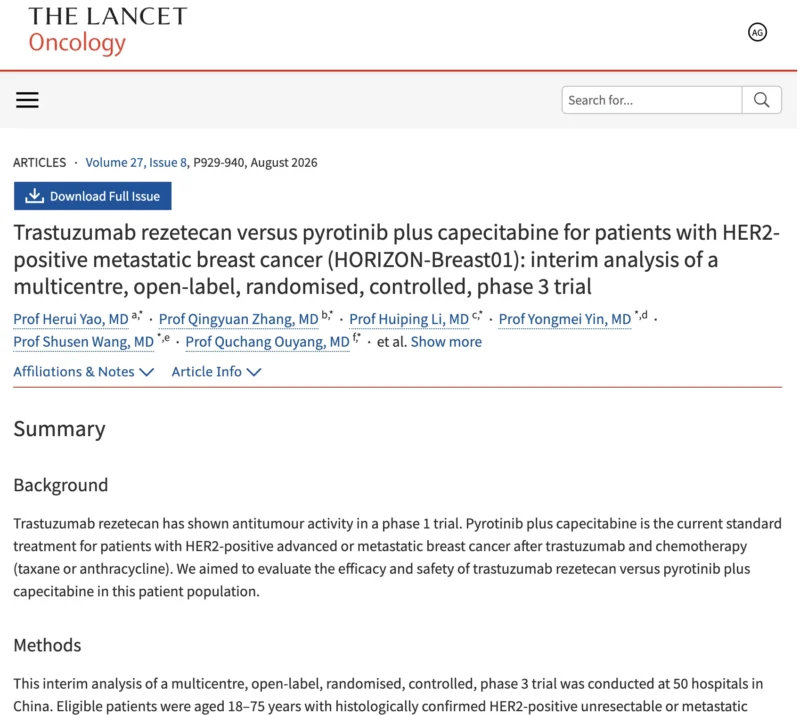
HORIZON-Breast01 was a multicentre, open-label, randomized, controlled phase 3 trial conducted across 50 hospitals in China.
Eligible patients were aged 18 to 75 years and had histologically confirmed HER2-positive unresectable or metastatic breast cancer. Patients were required to have measurable disease and an Eastern Cooperative Oncology Group performance status of 0 or 1.
Previous treatment requirements included either:
- A taxane and trastuzumab in the advanced-disease setting
- Disease progression within 12 months after neoadjuvant or adjuvant treatment containing an anti-HER2 monoclonal antibody and a taxane
Patients were randomly assigned in a 1:1 ratio to trastuzumab rezetecan or pyrotinib plus capecitabine.
Randomization was stratified according to hormone receptor status and the number of previous chemotherapy lines for metastatic disease.
The primary endpoint was progression-free survival assessed by blinded independent central review.
How Were the Treatments Administered?
Patients in the investigational group received intravenous trastuzumab rezetecan at 4.8 mg/kg on day 1 of each 21-day cycle.
Patients in the control group received:
- Oral pyrotinib at 400 mg once daily continuously
- Oral capecitabine at 1000 mg/m² twice daily on days 1–14 of each 21-day cycle
Protocol amendments temporarily changed the trastuzumab rezetecan dose to 6.4 mg/kg between November 29, 2022, and July 12, 2023.
The primary evaluation presented in the interim analysis focused on patients randomized to the 4.8 mg/kg trastuzumab rezetecan group and the control group.
Who Was Included in the Primary Analysis?
Between August 4, 2022, and August 9, 2024, investigators assessed 414 patients for eligibility.
Of these, 127 were ineligible, and 287 patients were included in the modified intention-to-treat population used for the primary analysis:
- 142 received trastuzumab rezetecan
- 145 received pyrotinib plus capecitabine
All participants were female, and the median age was 55 years.
Most patients—268 of 287, or 93%—self-reported as Han Chinese, while 19 patients reported another Chinese ethnicity. The geographic and demographic composition should be considered when assessing the wider applicability of the results.
How Large Was the Progression-Free Survival Benefit?
At the June 30, 2025, data cutoff, median follow-up was:
- 15.0 months with trastuzumab rezetecan
- 13.9 months with pyrotinib plus capecitabine
A total of 124 progression-free survival events had occurred:
- 37 events, or 26%, in the trastuzumab rezetecan group
- 87 events, or 60%, in the control group
Median progression-free survival was:
- 30.6 months with trastuzumab rezetecan
- 95% CI, 16.8 months to not reached
- 8.3 months with pyrotinib plus capecitabine
- 95% CI, 6.9–11.0 months
The hazard ratio was 0.22, with a 95% confidence interval of 0.15 to 0.34 and a P value below 0.0001.
The difference represents a 22.3-month separation in median progression-free survival at this interim analysis. However, the upper confidence limit for trastuzumab rezetecan had not been reached, indicating that the estimate could change with longer follow-up.
What Did the 12-Month Results Show?
The 12-month progression-free survival rate was:
- 84.7% with trastuzumab rezetecan
- 35.5% with pyrotinib plus capecitabine
The 95% confidence intervals were 77.0% to 90.0% and 26.8% to 44.2%, respectively.
This early separation supports the primary progression-free survival result and indicates that a substantially larger proportion of patients remained without progression at one year with trastuzumab rezetecan.
The supplied interim analysis did not report mature overall survival findings. The results therefore establish a progression-free survival advantage but do not yet demonstrate whether the treatment extends overall survival.
What Were the Main Grade 3 or Higher Adverse Events?
The most frequent grade 3 or higher treatment-related adverse events with trastuzumab rezetecan were hematologic.
Decreased neutrophil count
- Trastuzumab rezetecan: 54%
- Pyrotinib plus capecitabine: 9%
Decreased white blood cell count
- Trastuzumab rezetecan: 20%
- Control: 3%
Decreased platelet count
- Trastuzumab rezetecan: 11%
- Control: 1%
These findings show that the progression-free survival benefit was accompanied by a substantially higher burden of severe cytopenias.
The abstract does not provide detailed information on the timing, duration, clinical consequences, supportive treatment, dose modifications, or recovery from these events. Full safety data are needed to define how these toxicities were managed in practice.
Were Serious Adverse Events More Frequent?
Treatment-related serious adverse events occurred at similar rates:
13% with trastuzumab rezetecan
12% with pyrotinib plus capecitabine
This similarity should be interpreted alongside the marked difference in individual grade 3 or higher hematologic events.
A frequent laboratory or hematologic toxicity does not necessarily translate directly into a serious adverse event classification, but it can still require close monitoring, treatment interruption, dose modification, or supportive care.
Was Interstitial Lung Disease Reported?
Interstitial lung disease occurred in four patients, or 3%, receiving trastuzumab rezetecan.
The abstract does not report the severity, timing, management, or outcomes of these events. It also does not state whether any interstitial lung disease occurred in the control group.
Because interstitial lung disease can be clinically significant with antibody-drug conjugate therapy, complete grading and outcome data will be important when evaluating the overall benefit–risk profile of trastuzumab rezetecan.
Were Any Treatment-Related Deaths Reported?
Two adverse events led to death during the interim analysis.
One patient in the trastuzumab rezetecan group died from septic shock. Investigators considered this event unrelated to trastuzumab rezetecan.
One patient in the pyrotinib plus capecitabine group died from an unknown cause that was considered related to treatment.
The available abstract does not provide additional clinical details about these events.
What Does the Study Establish?
HORIZON-Breast01 establishes a substantial progression-free survival advantage for trastuzumab rezetecan over pyrotinib plus capecitabine in the population studied.
The hazard ratio of 0.22 and the difference in 12-month progression-free survival rates represent a strong efficacy signal.
However, the trial also identified a clearly different toxicity pattern. Severe neutropenia, leukopenia, and thrombocytopenia were more common with trastuzumab rezetecan, while interstitial lung disease occurred in 3% of treated patients.
Treatment selection therefore cannot be based on progression-free survival alone. The final benefit–risk assessment will require mature survival findings and a more detailed understanding of toxicity management.
What Questions Remain?
This was an interim analysis, and several clinically important questions remain unanswered in the supplied abstract.
Overall survival data were not reported. The durability of the 30.6-month median progression-free survival estimate also remains uncertain because the upper confidence limit had not been reached.
Further information is needed regarding:
- Objective response rate and duration of response
- Outcomes in patients with brain metastases
- Results according to hormone receptor status
- Outcomes by previous treatment exposure
- Dose reductions and treatment discontinuations
- Management and recovery of hematologic toxicities
- Grades and outcomes of interstitial lung disease
- Patient-reported outcomes and quality of life
The trial population was enrolled entirely in China, and most participants were Han Chinese. Additional data could help determine whether similar efficacy and safety results are observed across broader international populations.
The Bottom Line
The interim phase 3 HORIZON-Breast01 analysis showed that trastuzumab rezetecan significantly improved progression-free survival compared with pyrotinib plus capecitabine in previously treated HER2-positive unresectable or metastatic breast cancer.
Median progression-free survival was:
- 30.6 months versus 8.3 months
The hazard ratio was:
- 0.22; 95% CI, 0.15–0.34; p<0.0001
At 12 months, progression-free survival rates were:
- 84.7% versus 35.5%
The efficacy benefit was accompanied by more frequent grade 3 or higher neutropenia, leukopenia, and thrombocytopenia. Interstitial lung disease was reported in 3% of patients receiving trastuzumab rezetecan.
The results support trastuzumab rezetecan as a potential new treatment option in HER2-positive metastatic breast cancer, while mature survival and detailed safety findings remain necessary before defining its final role in treatment sequencing.
Reference
- Yao H, Zhang Q, Li H, Yin Y, Wang S, Ouyang Q, et al. Trastuzumab rezetecan versus pyrotinib plus capecitabine for patients with HER2-positive metastatic breast cancer: interim analysis of the multicentre, open-label, randomized, controlled phase 3 HORIZON-Breast01 trial. ClinicalTrials.gov identifier: NCT05424835.