
The SERENA-6 trial is moving ctDNA-guided treatment closer to routine clinical decision-making in hormone receptor-positive, HER2-negative advanced breast cancer.
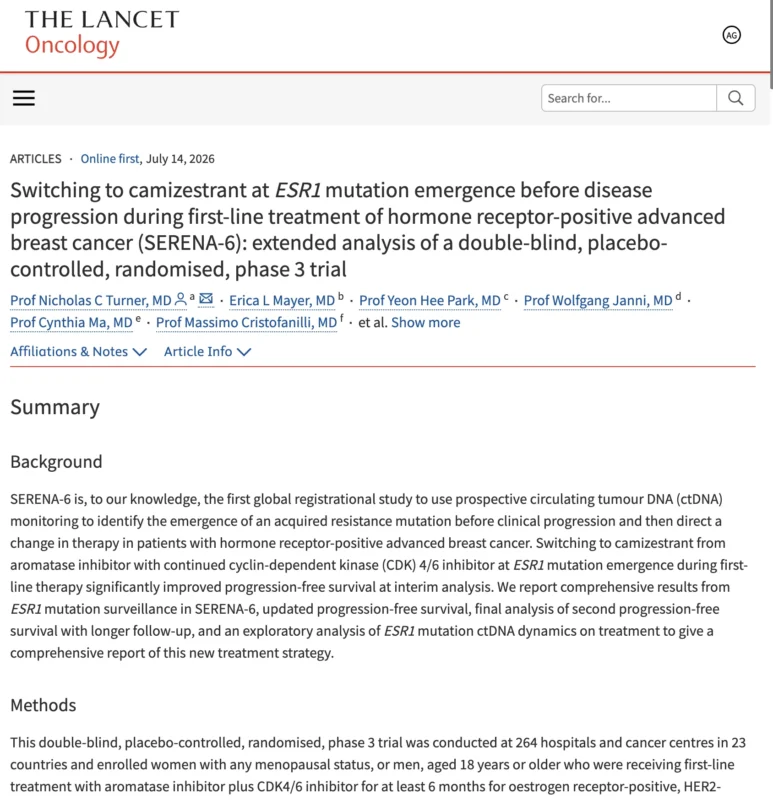
In an extended analysis published in The Lancet Oncology, switching from an aromatase inhibitor to camizestrant after detection of an emerging ESR1 mutation before radiological progression led to sustained improvement in progression-free survival and a statistically significant improvement in second progression-free survival.
The trial tested a specific clinical question: can resistance be detected molecularly before visible disease progression, and can treatment be changed early enough to extend benefit from first-line therapy?
The answer from SERENA-6 appears to be yes.
A ctDNA-Guided Strategy Before Progression
SERENA-6 is described as the first global registrational phase 3 study to use prospective circulating tumor DNA monitoring to detect an acquired resistance mutation before clinical progression and guide a treatment switch.
Patients were receiving first-line aromatase inhibitor plus a CDK4/6 inhibitor for estrogen receptor-positive, HER2-negative locally advanced or metastatic breast cancer.
During first-line therapy, patients underwent ctDNA testing for ESR1 mutations every 2 to 3 months, aligned with routine clinical assessments, using the Guardant360 CDx assay.
Patients with an ESR1 mutation detected in ctDNA and no radiological progression were randomly assigned to switch endocrine therapy to camizestrant 75 mg once daily while continuing the same CDK4/6 inhibitor, or to continue aromatase inhibitor plus CDK4/6 inhibitor.
This design is important because ESR1 mutations are a known mechanism of acquired endocrine resistance. SERENA-6 did not wait for progression. It tested whether treatment could be adapted at the molecular signal of resistance.
What the Trial Found
Between June 2021 and June 2024, 3,325 patients were screened, and 3,256 received at least one ESR1 mutation test during first-line therapy.
By screening closure, 548 patients had a positive ESR1 mutation test.
A total of 315 patients were randomly assigned: 157 to camizestrant plus CDK4/6 inhibitor and 158 to aromatase inhibitor plus CDK4/6 inhibitor.
After a median follow-up of 23.5 months, median progression-free survival was 16.8 months with camizestrant plus CDK4/6 inhibitor, compared with 9.2 months with continued aromatase inhibitor plus CDK4/6 inhibitor.
The hazard ratio was 0.45, with a nominal p<0.0001.
This confirms a sustained progression-free survival benefit, consistent with the prior interim analysis.
Second Progression-Free Survival Also Improved
The extended analysis also reported final second progression-free survival data.
Median second progression-free survival was 25.7 months with camizestrant plus CDK4/6 inhibitor versus 19.1 months with aromatase inhibitor plus CDK4/6 inhibitor.
The hazard ratio was 0.63, with p=0.0037.
This is clinically meaningful because second progression-free survival helps address an important concern in early-switch strategies: whether changing therapy before radiographic progression simply moves treatment earlier, or whether it truly improves the broader treatment course.
In SERENA-6, the benefit appeared to extend beyond the first progression event.
Safety Profile
The most common grade 3 or 4 adverse events were neutropenia and decreased neutrophil count.
Grade 3 or 4 neutropenia occurred in 27% of patients receiving camizestrant plus CDK4/6 inhibitor and 17% of patients continuing aromatase inhibitor plus CDK4/6 inhibitor.
Grade 3 or 4 decreased neutrophil count occurred in 23% and 19% of patients, respectively.
Serious adverse events were reported in 15% of patients in the camizestrant group and 19% in the aromatase inhibitor group.
Three deaths were considered by investigators to be possibly related to treatment: one in the camizestrant group and two in the aromatase inhibitor group.
Why SERENA-6 Matters
SERENA-6 is not simply another endocrine therapy trial.
It tests a new treatment model: molecular surveillance, early detection of resistance, and therapy switch before radiographic progression.
For HR+/HER2− advanced breast cancer, this could represent a shift from reactive treatment sequencing to adaptive treatment management.
The strategy may be especially relevant because many patients remain clinically stable when resistance begins to emerge at the molecular level. Waiting for radiographic progression may allow resistant clones to expand before the treatment plan changes.
SERENA-6 suggests that acting earlier may extend the value of first-line CDK4/6 inhibitor-based therapy.
What Still Needs Clarification
The trial supports switching endocrine therapy at ESR1 mutation emergence, but several questions remain.
Overall survival data are not yet the main message of this analysis. The long-term impact on subsequent treatment sequencing, quality of life, resistance evolution, access to serial ctDNA testing, and real-world implementation will need continued follow-up.
The strategy also depends on routine ctDNA monitoring every 2 to 3 months, which may not be equally available across health systems.
Still, the study provides strong evidence that ctDNA can be more than a prognostic tool. In this setting, it can guide an active treatment decision before visible progression.
The Bottom Line
The extended SERENA-6 analysis showed that switching to camizestrant plus continued CDK4/6 inhibitor at the time of ESR1 mutation emergence improved outcomes compared with continuing aromatase inhibitor plus CDK4/6 inhibitor.
Median progression-free survival was 16.8 months vs 9.2 months, and median second progression-free survival was 25.7 months vs 19.1 months.
These results support ctDNA-guided endocrine switching as a new strategy to extend first-line benefit in HR-positive, HER2-negative advanced breast cancer with emerging ESR1 mutations.
References
- Turner NC, Mayer EL, Park YH, Janni W, Ma C, Cristofanilli M, et al. Switching to camizestrant at ESR1 mutation emergence before disease progression during first-line treatment of hormone receptor-positive advanced breast cancer (SERENA-6): extended analysis of a double-blind, placebo-controlled, randomised, phase 3 trial. The Lancet Oncology. 2026.
- Bidard FC, Mayer EL, Park YH, et al. First-line camizestrant for emerging ESR1-mutated advanced breast cancer. New England Journal of Medicine. 2025;393:569-580.
- Bidard FC, Hardy-Bessard AC, Dalenc F, et al. Switch to fulvestrant and palbociclib versus no switch in advanced breast cancer with rising ESR1 mutation during aromatase inhibitor and palbociclib therapy (PADA-1): a randomised, open-label, multicentre, phase 3 trial. The Lancet Oncology. 2022;23:1367-1377.
- Jhaveri KL, Neven P, Casalnuovo ML, et al. Imlunestrant with or without abemaciclib in advanced breast cancer. New England Journal of Medicine. 2025;392:1189-1202.
- Kalinsky K, Bianchini G, Hamilton E, et al. Abemaciclib plus fulvestrant in advanced breast cancer after progression on CDK4/6 inhibition: results from the phase III postMONARCH trial. Journal of Clinical Oncology. 2025;43:1101-1112.