
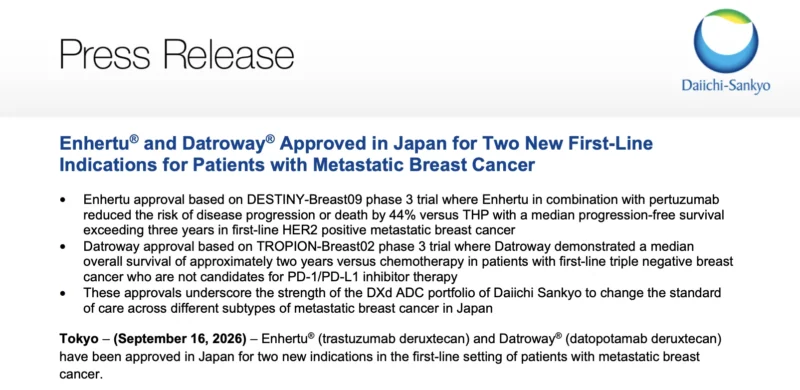
Japan has expanded the first-line treatment landscape for metastatic breast cancer with two new approvals involving DXd antibody–drug conjugates. On September 16, 2026, Japan’s Ministry of Health, Labour and Welfare approved trastuzumab deruxtecan (Enhertu) plus pertuzumab for adults with HER2-positive unresectable or recurrent breast cancer and datopotamab deruxtecan (Datroway) for adults with hormone receptor–negative, HER2-negative unresectable or recurrent breast cancer, representing triple-negative breast cancer.
The decisions are supported by two phase III trials addressing very different first-line populations. DESTINY-Breast09 demonstrated a major progression-free survival advantage for trastuzumab deruxtecan plus pertuzumab over taxane, trastuzumab, and pertuzumab in HER2-positive metastatic breast cancer. TROPION-Breast02, meanwhile, demonstrated both progression-free and overall survival improvements with datopotamab deruxtecan compared with chemotherapy in patients with metastatic TNBC for whom PD-1/PD-L1 inhibitor therapy was not an option.
Together, the approvals illustrate how rapidly antibody–drug conjugates are moving from later-line treatment into the initial management of metastatic breast cancer.
DESTINY-Breast09 Challenges a Long-Standing First-Line HER2-Positive Standard
For more than a decade, taxane plus trastuzumab and pertuzumab has been a foundational first-line treatment for HER2-positive metastatic breast cancer. DESTINY-Breast09 directly tested whether trastuzumab deruxtecan could improve on this established standard when combined with pertuzumab.
In the phase III trial, trastuzumab deruxtecan plus pertuzumab reduced the risk of progression or death by 44% compared with THP, with a hazard ratio of 0.56 (95% CI, 0.44–0.71; P<0.00001). Median PFS by blinded independent central review was 40.7 months versus 26.9 months, extending disease control by nearly 14 months.
The magnitude of the PFS improvement is particularly notable because the comparator is a highly active regimen rather than an outdated control. A median PFS exceeding three years in the investigational arm establishes a new benchmark for disease control in the first-line HER2-positive metastatic setting.
The Japanese approval applies to adults with HER2-positive unresectable or recurrent breast cancer and adds Japan to the growing number of jurisdictions in which the combination is available in first line. The source notes that trastuzumab deruxtecan plus pertuzumab is now approved in more than 40 countries and regions for first-line unresectable or metastatic HER2-positive disease.

Read About DESTINY-Breast09 Trial on OncoDaily
The Trial Was Designed Around Three HER2-Directed Strategies
DESTINY-Breast09 enrolled 1,157 patients globally and randomized participants 1:1:1 to trastuzumab deruxtecan plus pertuzumab, trastuzumab deruxtecan monotherapy with pertuzumab-matching placebo, or standard THP. Randomization was stratified by prior treatment history, hormone receptor status, and PIK3CA mutation status.
One important detail is that the trastuzumab deruxtecan monotherapy comparison remains blinded and continues to final PFS analysis.
That unanswered comparison could become clinically important. The current approval demonstrates that T-DXd plus pertuzumab is superior to THP for PFS, but it does not yet determine how much incremental benefit pertuzumab contributes when added to T-DXd.
If the monotherapy arm ultimately produces comparable disease control with lower treatment burden or toxicity, the optimal first-line architecture may require further refinement. For now, the positive randomized evidence supports the combination.
Safety Remains Central When T-DXd Moves Into First Line
Moving an ADC earlier means exposing patients to its toxicity profile for potentially prolonged periods.
In DESTINY-Breast09, the overall safety profile of trastuzumab deruxtecan plus pertuzumab was described as consistent with previous experience, with no new safety signals. The most frequently reported adverse reactions included nausea, diarrhea, alopecia, vomiting, and anemia.
Interstitial lung disease remains the adverse event requiring particular attention with trastuzumab deruxtecan. The Japanese release reports adjudicated ILD in 33.3% of the 39 Japanese patients treated with T-DXd plus pertuzumab.
That figure should be interpreted cautiously because it comes from a small national subgroup and should not be treated as an estimate for the global population. Nevertheless, it reinforces the importance of active pulmonary monitoring, early recognition of symptoms, and appropriate treatment interruption and corticosteroid management when ILD is suspected.
Japan’s prescribing information includes an ILD warning and recommends close clinical collaboration with respiratory specialists, baseline chest CT assessment, and ongoing surveillance for symptoms and radiographic abnormalities.
Datroway Creates a New First-Line Option for TNBC Without Immunotherapy
The second approval addresses a very different unmet need.
First-line immunotherapy combined with chemotherapy has improved outcomes for selected patients with metastatic TNBC. However, a substantial proportion of patients are not candidates for PD-1/PD-L1 inhibition because of biomarker status, previous immunotherapy exposure, comorbidities, access limitations, or other clinical factors.
TROPION-Breast02 specifically studied this population.
Datopotamab deruxtecan demonstrated a statistically significant and clinically meaningful improvement in both OS and PFS compared with investigator’s-choice chemotherapy. Median overall survival reached 23.7 months with Datroway versus 18.7 months with chemotherapy, representing a 5-month improvement and an OS HR of 0.79 (95% CI, 0.64–0.98; P=0.029).
Progression-free survival was 10.8 months versus 5.6 months, corresponding to a 43% reduction in the risk of progression or death with an HR of 0.57 (95% CI, 0.47–0.69; P<0.0001).
The OS result is particularly important. Many ADC trials initially establish benefit through response rate or PFS; TROPION-Breast02 demonstrated that moving TROP2-directed therapy into first line can translate into longer survival in this clinically difficult population.
TROPION-Breast02 Included Patients Often Underrepresented in First-Line Trials
TROPION-Breast02 enrolled 644 patients with previously untreated locally recurrent inoperable or metastatic TNBC for whom immunotherapy was not an option.
The population included patients with PD-L1–negative tumors, patients unable to receive immunotherapy because of previous exposure in early-stage disease or comorbidities, and patients for whom immunotherapy was not geographically accessible. Patients with de novo or recurrent disease were eligible regardless of disease-free interval, and individuals with poor prognostic features including stable brain metastases could also enroll.
The comparator was investigator’s-choice chemotherapy comprising paclitaxel, nab-paclitaxel, capecitabine, carboplatin, or eribulin.
This broad eligibility strengthens the clinical relevance of the result. Rather than testing Datroway only in a narrowly selected population, the trial addresses a group for whom first-line chemotherapy had historically remained the principal systemic option.

Read About TROPION-Breast02 Trial on OncoDaily
Datroway Introduces a Different Toxicity Profile Than Conventional Chemotherapy
Datopotamab deruxtecan is a TROP2-directed ADC carrying a topoisomerase I inhibitor payload. Its toxicity pattern differs from standard chemotherapy and requires its own supportive-care strategy.
In TROPION-Breast02, the most commonly reported adverse reactions with Datroway included stomatitis, nausea, alopecia, dry eye, and constipation.
ILD also remains a relevant class consideration. Across multiple Datroway clinical trials, the Japanese prescribing information cites ILD in 3.1% of treated patients. No ILD cases were reported among the 17 Japanese patients in TROPION-Breast02, but that subgroup is far too small to imply absence of risk.
The move into first line therefore changes rather than eliminates toxicity considerations. The balance shifts away from some conventional chemotherapy toxicities toward ADC-specific issues including stomatitis, ocular toxicity, and pulmonary surveillance.
Two Approvals, but Two Very Different Clinical Questions
Although Enhertu and Datroway belong to the same broad DXd ADC platform, these approvals should not be treated as one therapeutic story.
In HER2-positive metastatic breast cancer, the question is whether an ADC-based regimen can replace a highly successful dual-HER2 antibody plus taxane standard. DESTINY-Breast09 answers that question with a large PFS improvement in favor of T-DXd plus pertuzumab.
In metastatic TNBC, the problem is different. TROPION-Breast02 addresses patients without an immunotherapy option, for whom conventional chemotherapy remained the principal first-line treatment. Here, Datroway not only doubled median PFS relative to chemotherapy but also improved overall survival.
The shared theme is therefore not merely ADC expansion. It is the increasing ability to move biologically targeted payload delivery earlier in treatment and challenge therapies that were previously accepted as the default first-line backbone.
First-Line Breast Cancer Is Becoming an ADC Sequencing Problem
The success of these strategies creates another issue: what should happen after progression?
As ADCs move into first line, clinicians increasingly need to determine whether sequential ADC therapy remains effective, particularly when agents share topoisomerase I payloads.
The treatment trajectory may involve T-DXd followed by another ADC in HER2-positive or evolving HER2-expression disease, or Datroway followed by a different TROP2- or HER2-directed ADC in TNBC. Whether cross-resistance is driven primarily by antigen expression, internalization, linker biology, payload resistance, drug-efflux mechanisms, or tumor evolution remains incompletely understood.
Consequently, moving ADCs earlier improves immediate disease control but makes ADC sequencing one of the next major research priorities in metastatic breast cancer.
Japan’s Approvals Reflect a Broader Global Transition
The two approvals also illustrate how quickly the global breast cancer treatment landscape is shifting.
The press release reports that T-DXd plus pertuzumab is approved in more than 40 countries and regions for first-line HER2-positive unresectable or metastatic breast cancer, while Datroway is approved in more than 30 countries and regions for unresectable or metastatic TNBC when patients are not candidates for PD-1/PD-L1 inhibitor treatment.
The significance extends beyond regulatory expansion. The first-line setting is where treatment choices can have the greatest impact on the entire subsequent disease course.
Using an ADC first therefore requires a higher evidentiary threshold than introducing it after several prior therapies. DESTINY-Breast09 meets that challenge with a substantial randomized PFS benefit against THP, while TROPION-Breast02 adds the particularly important evidence of an OS improvement.
The Bottom Line
Japan’s September 16, 2026 approvals of Enhertu plus pertuzumab and Datroway mark two important expansions of ADC therapy into first-line metastatic breast cancer. For HER2-positive disease, DESTINY-Breast09 showed that T-DXd plus pertuzumab reduced the risk of progression or death by 44%, extending median PFS to 40.7 months compared with 26.9 months with THP.
For metastatic TNBC in patients who were not candidates for PD-1/PD-L1 inhibition, TROPION-Breast02 demonstrated an OS of 23.7 versus 18.7 months and PFS of 10.8 versus 5.6 months with Datroway compared with chemotherapy.
These approvals represent two different advances but point in the same direction: ADCs are no longer therapies reserved for later lines of metastatic breast cancer. They are increasingly redefining the first treatment decision.
The next challenge will be determining how to preserve their benefits across the entire treatment sequence, through better toxicity management, biomarker selection, and rational sequencing after resistance emerges.
Reference
- Daiichi Sankyo. Enhertu and Datroway Approved in Japan for Two New First-Line Indications for Patients with Metastatic Breast Cancer. September 16, 2026.