
The DESTINY-Breast09 analysis, presented at the 2026 ASCO Annual Meeting by Yeon Hee Park, MD, PhD, evaluated treatment duration and clinical outcomes according to best response in patients with HER2-positive advanced or metastatic breast cancer treated with first-line trastuzumab deruxtecan plus pertuzumab.
This exploratory analysis focused on the T-DXd + pertuzumab arm and asked an important clinical question: how do complete response, deep partial response, and less deep responses relate to long-term outcomes, treatment duration, and safety?
Study Background
In DESTINY-Breast09, first-line T-DXd plus pertuzumab previously demonstrated durable responses, higher complete response rates, and significantly improved progression-free survival compared with taxane plus trastuzumab plus pertuzumab in patients with HER2-positive advanced or metastatic breast cancer.
In the current analysis, investigators examined outcomes by best confirmed response to T-DXd + pertuzumab, with response categories including complete response, partial response, and stable disease or progressive disease. The slides further divided partial responses into deep PR, defined as at least 80% tumor reduction, and PR with less than 80% tumor reduction.
Patient Population And Response Groups
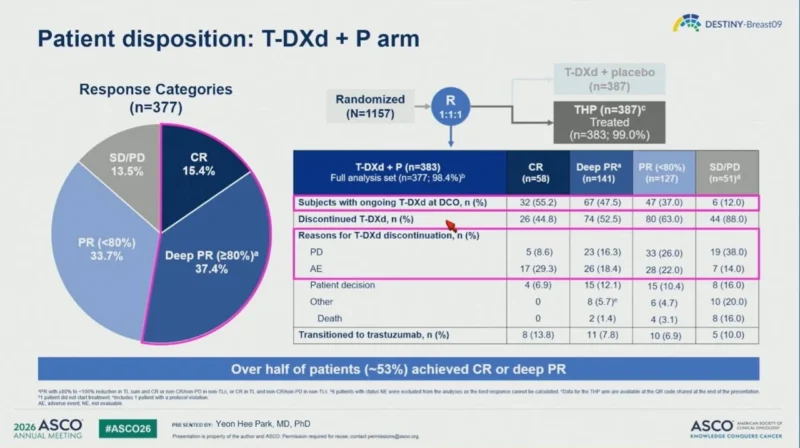
Among 377 evaluable patients treated with T-DXd + pertuzumab, 58 patients achieved complete response, representing 15.4% of the analysis population. Another 141 patients had a deep partial response, accounting for 37.4%, while 127 patients had a partial response with less than 80% tumor reduction, representing 33.7%. Stable disease or progressive disease was reported in 51 patients, or 13.5%.
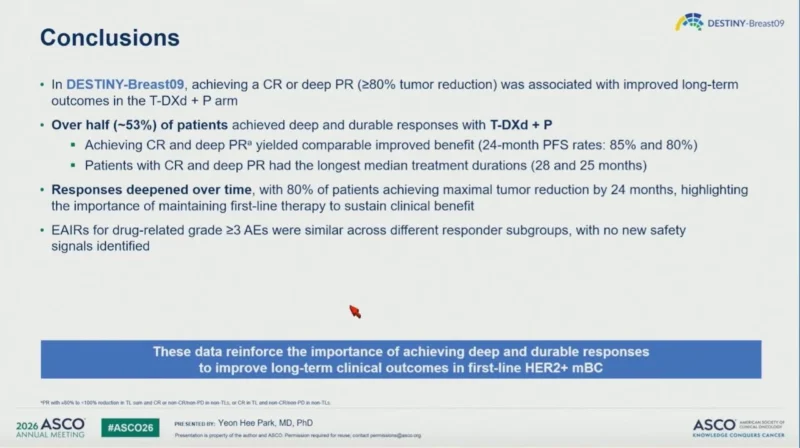
Together, complete response and deep partial response accounted for approximately 53% of patients, meaning more than half of evaluable patients achieved a deep and durable tumor response with T-DXd + pertuzumab.
Response Timing And Treatment Duration
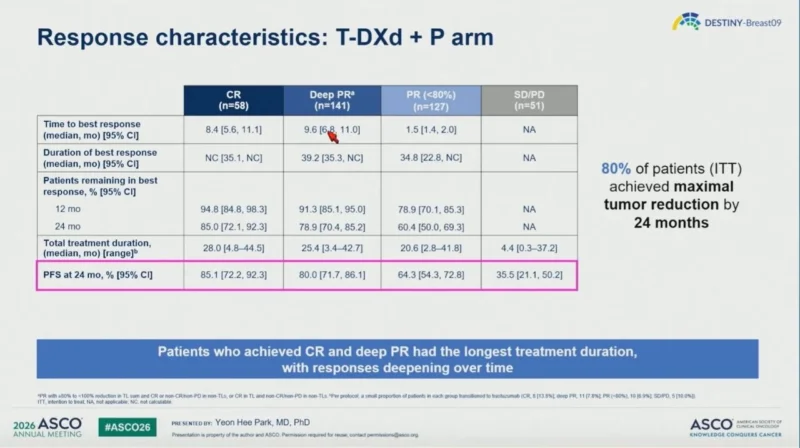
Responses continued to deepen over time. Median time to complete response was 8.4 months, while median time to deep partial response was 9.6 months. By contrast, the median time to partial response with less than 80% tumor reduction was 1.5 months.
The analysis also showed that patients with deeper responses remained on treatment longer. Median total treatment duration was 28.0 months among patients with complete response and 25.4 months among those with deep partial response. Patients with PR below 80% tumor reduction had a median treatment duration of 20.6 months, while those with stable disease or progressive disease had a much shorter median treatment duration of 4.4 months.
This pattern supports one of the key messages from the presentation: maximal tumor reduction may require sustained first-line treatment, and responses can continue to deepen over time.
Progression-Free Survival Outcomes
Progression-free survival outcomes were most favorable among patients with complete response or deep partial response.
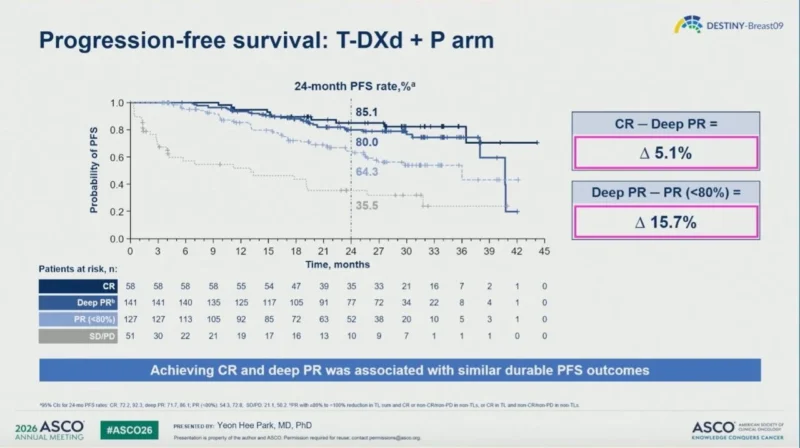
At 24 months, the PFS rate was 85.1% in patients with complete response and 80.0% in those with deep partial response. Patients with PR below 80% tumor reduction had a 24-month PFS rate of 64.3%, while those with stable disease or progressive disease had a 24-month PFS rate of 35.5%.
The difference between complete response and deep partial response was small, with a 5.1% difference in 24-month PFS rates. The difference between deep partial response and PR below 80% tumor reduction was larger, at 15.7%.
These findings suggest that achieving either complete response or deep partial response was associated with more durable disease control in the T-DXd + pertuzumab arm.
Safety Findings
Safety findings remained consistent with previously reported profiles of T-DXd and pertuzumab. Exposure-adjusted incidence rates of drug-related grade 3 or higher adverse events were similar across responder subgroups, and no new safety signals were identified.
In the abstract, adjudicated drug-related ILD or pneumonitis rates were similar across the complete response, partial response, and stable disease/progressive disease groups: 12.1%, 11.9%, and 12.2%, respectively. All ILD or pneumonitis cases in the complete response and partial response groups were grade 1 or 2. In the stable disease/progressive disease group, two grade 5 events were reported.
Clinical Meaning
This exploratory analysis of DESTINY-Breast09 reinforces the importance of depth and durability of response in first-line HER2-positive metastatic breast cancer. Patients who achieved complete response or deep partial response with T-DXd + pertuzumab had longer treatment duration and more favorable 24-month PFS outcomes than those with less deep responses or stable/progressive disease.
However, these findings are response-based and exploratory, so they describe associations rather than proving that deeper response itself directly causes better outcomes. Patients who remain on treatment longer also have more time to achieve deeper tumor reduction. Still, the analysis provides useful clinical context for interpreting response over time with first-line T-DXd + pertuzumab.
Key Takeaway
In DESTINY-Breast09, more than half of patients treated with first-line T-DXd plus pertuzumab achieved complete response or deep partial response. These deeper responses were associated with longer treatment duration and favorable 24-month PFS rates, supporting the value of sustained disease control in HER2-positive advanced or metastatic breast cancer.