
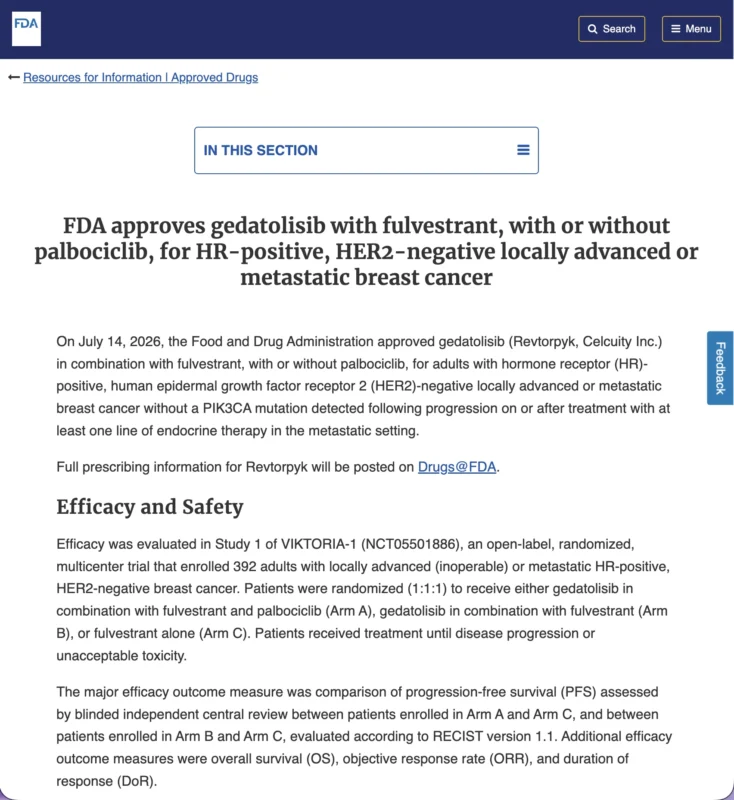
The U.S. Food and Drug Administration has approved gedatolisib in combination with fulvestrant, with or without palbociclib, for adults with hormone receptor-positive, HER2-negative locally advanced or metastatic breast cancer without a detected PIK3CA mutation after progression on or after at least one line of endocrine therapy in the metastatic setting. Gedatolisib will be marketed as Revtorpyk by Celcuity Inc.
The approval is supported by Study 1 of the phase III VIKTORIA-1 trial, which evaluated gedatolisib-based regimens in patients with HR-positive, HER2-negative, PIK3CA wild-type advanced breast cancer after progression on a CDK4/6 inhibitor and a nonsteroidal aromatase inhibitor.
Why This Approval Matters
HR-positive, HER2-negative breast cancer is the most common breast cancer subtype. In advanced disease, endocrine therapy combined with a CDK4/6 inhibitor is widely used in the first-line setting, but resistance eventually develops in most patients.
After progression on endocrine therapy and CDK4/6 inhibition, treatment selection becomes more complex. Some options are guided by biomarkers such as PIK3CA, AKT1, PTEN, or ESR1 alterations. This approval is important because it specifically applies to patients without a detected PIK3CA mutation, a population with fewer pathway-directed treatment options.
Gedatolisib targets the PI3K/AKT/mTOR pathway, also known as the PAM pathway. Unlike agents that inhibit a single component of this pathway, gedatolisib inhibits all four class I PI3K isoforms and both mTORC1 and mTORC2, aiming for broader pathway blockade.
VIKTORIA-1 Study Design
VIKTORIA-1 is a global, open-label, randomized phase III trial. Study 1 enrolled patients with HR-positive, HER2-negative, PIK3CA wild-type advanced breast cancer whose disease had progressed during or after treatment with a CDK4/6 inhibitor and a nonsteroidal aromatase inhibitor.
A total of 392 patients were randomly assigned in a 1:1:1 ratio to receive gedatolisib plus palbociclib and fulvestrant, gedatolisib plus fulvestrant, or fulvestrant alone. The primary endpoint was progression-free survival by blinded independent central review according to RECIST 1.1.
Patients in the fulvestrant group were allowed to cross over to a gedatolisib-based regimen after radiographically confirmed disease progression. This is important when interpreting overall survival, because crossover can dilute survival differences between treatment groups.
A Heavily Pretreated Endocrine-Resistant Population
The study population reflected a clinically challenging post-CDK4/6 setting.
All patients had received at least one prior CDK4/6 inhibitor, and 98% had received CDK4/6 inhibitor therapy in the advanced disease setting. The median duration of previous CDK4/6 inhibitor therapy was 20.4 months.
Visceral metastases were present in 80.4% of patients, and 58.2% had liver metastases. These features are relevant because they indicate a population with substantial disease burden.
Progression-Free Survival Improved With the Triplet
The gedatolisib triplet produced a statistically significant and clinically meaningful improvement in progression-free survival.
Median PFS was 9.3 months with gedatolisib plus fulvestrant and palbociclib, compared with 2.0 months with fulvestrant alone. The hazard ratio for disease progression or death was 0.24, corresponding to a 76% reduction in risk.
The objective response rate among patients with measurable disease was 31.5% with the triplet, compared with 1.0% with fulvestrant alone. Median duration of response was 17.5 months with the triplet.
The Doublet Also Improved PFS
Gedatolisib plus fulvestrant also significantly improved progression-free survival versus fulvestrant alone.
Median PFS was 7.4 months with the doublet, compared with 2.0 months with fulvestrant alone. The hazard ratio was 0.33, representing a 67% reduction in the risk of progression or death.
The objective response rate was 28.3% with gedatolisib plus fulvestrant, and median duration of response was 12.0 months.
The doublet option may be particularly relevant for patients in whom palbociclib continuation is not appropriate, although clinical decisions will depend on prior therapy, tolerance, comorbidities, and treatment goals.
Overall Survival Remains Immature
At the primary analysis, overall survival data were not mature.
The interim overall survival analysis showed numerical trends favoring gedatolisib-based therapy, but neither comparison crossed the prespecified statistical boundary. Median overall survival was 23.7 months with the triplet versus 18.5 months with fulvestrant alone, with a hazard ratio of 0.69. For the doublet, median overall survival was not reached versus 18.5 months with fulvestrant alone, with a hazard ratio of 0.74.
The FDA also noted that overall survival data were not mature at the time of the PFS analysis, with 25% deaths in the overall population.
Safety Profile
The safety profile differed between the triplet and doublet regimens, largely because palbociclib contributed to higher rates of neutropenia in the triplet arm.
Grade 3 or higher treatment-related adverse events in the triplet arm included neutropenia in 62.3%, stomatitis in 19.2%, rash in 4.6%, hyperglycemia in 2.3%, and diarrhea in 1.5%. In the doublet arm, grade 3 or higher treatment-related events included neutropenia in 0.8%, stomatitis in 12.3%, rash in 5.4%, hyperglycemia in 2.3%, and diarrhea in 0.8%.
Treatment discontinuation because of treatment-related adverse events was low, reported in 2.3% of patients receiving the triplet and 3.1% receiving the doublet. Serious treatment-related adverse events occurred in 10.8% and 9.2%, respectively.
The prescribing information includes warnings and precautions for stomatitis, dermatologic adverse reactions, hyperglycemia, and embryo-fetal toxicity.
Stomatitis and Hyperglycemia Need Attention
Stomatitis was the most common gedatolisib-associated toxicity in VIKTORIA-1. The trial required prophylactic use of a steroid-containing swish-and-spit regimen, and the authors reported that most first stomatitis events were grade 1, with improvement to a lower grade within the first two weeks for many patients.
Hyperglycemia, an expected toxicity with PI3K/AKT/mTOR pathway inhibition, was relatively uncommon compared with some other pathway inhibitors. Grade 3 hyperglycemia occurred in 2.3% of patients in both gedatolisib-containing arms.
Recommended Dose
The recommended dose of gedatolisib is 180 mg by intravenous infusion over 30 minutes once weekly on Days 1, 8, and 15 of each 28-day cycle, in combination with fulvestrant, with or without palbociclib, until disease progression or unacceptable toxicity.
In VIKTORIA-1, gedatolisib was given on the same schedule. Palbociclib was administered at 125 mg orally once daily for 21 days, followed by 7 days off, and fulvestrant was administered at 500 mg intramuscularly on Days 1 and 15 of cycle 1, then every 4 weeks.
Clinical Interpretation
The VIKTORIA-1 results support the PAM pathway as an actionable driver of resistance even in PIK3CA wild-type HR-positive, HER2-negative advanced breast cancer.
The magnitude of PFS benefit is notable, particularly for the triplet regimen. The trial also suggests that adding gedatolisib may help restore sensitivity to endocrine therapy and CDK4/6 inhibition after prior CDK4/6 inhibitor exposure.
However, several limitations matter. VIKTORIA-1 was open-label. The control arm was fulvestrant monotherapy, which may not reflect all contemporary second-line standards in every country. Overall survival data remain immature. ESR1 mutation status was not adequately assessed because plasma samples were not collected specifically for that purpose. The study also evaluated palbociclib as the only CDK4/6 inhibitor combined with gedatolisib, so the safety and efficacy of combinations with ribociclib or abemaciclib remain uncertain.
The Bottom Line
The FDA approval of gedatolisib adds a new treatment option for adults with HR-positive, HER2-negative locally advanced or metastatic breast cancer without a detected PIK3CA mutation after progression on endocrine therapy.
In VIKTORIA-1, gedatolisib plus fulvestrant and palbociclib improved median PFS to 9.3 months, compared with 2.0 months with fulvestrant alone. Gedatolisib plus fulvestrant improved median PFS to 7.4 months. Both regimens significantly reduced the risk of progression or death.
The approval expands targeted therapy options for PIK3CA wild-type disease, while longer follow-up and real-world experience will help define how gedatolisib fits into the increasingly complex treatment sequence for HR-positive, HER2-negative advanced breast cancer.
References
- U.S. Food and Drug Administration. FDA approves gedatolisib with fulvestrant, with or without palbociclib, for HR-positive, HER2-negative locally advanced or metastatic breast cancer. Published July 14, 2026.
- Hurvitz SA, Layman RM, Curigliano G, André F, Cristofanilli M, Kim SB, et al. VIKTORIA-1 trial of gedatolisib plus fulvestrant with or without palbociclib in hormone receptor-positive/HER2-negative/PIK3CA wild-type advanced breast cancer. Journal of Clinical Oncology. 2026;44:1108-1119. doi:10.1200/JCO-25-02643.
- Reuters. US FDA approves Celcuity’s breast cancer drug. Published July 14, 2026.