






Breast-conserving surgery has evolved far beyond tumor removal alone. For many patients, the goal is not only oncologic control but also preservation of breast shape, body image, and quality of life. This is where oncoplastic techniques have become increasingly important. Among these, chest wall perforator flaps have gained attention as a volume-preserving reconstructive option for selected patients undergoing breast-conserving surgery.
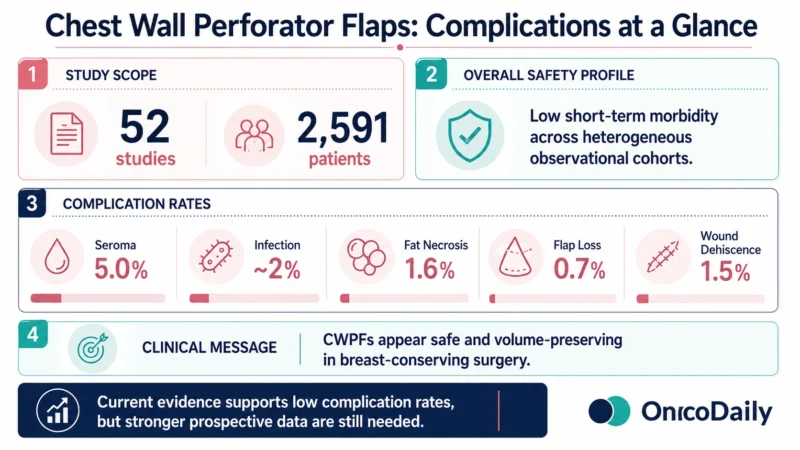
A new systematic review by Yadav et al. evaluated the clinical outcomes, complications, cosmetic results, oncologic reporting, and patient-reported satisfaction associated with chest wall perforator flaps in breast cancer surgery. The review included 52 studies and 2,591 patients, offering one of the broader summaries of this reconstructive approach to date (Yadav et al., 2026).
Why Chest Wall Perforator Flaps Matter
Chest wall perforator flaps are local or regional tissue flaps based on perforating vessels from the chest wall. In breast-conserving surgery, they can help replace volume after tumor excision, particularly when a standard lumpectomy might leave a visible defect or asymmetry. Their appeal lies in using nearby tissue while avoiding more extensive reconstructive procedures.
For patients, this can mean better breast contour, fewer visible deformities, and potentially higher satisfaction after surgery. For surgical teams, these flaps offer a practical option between simple closure and more complex reconstruction. However, as with many surgical innovations, enthusiasm has grown faster than the evidence base. The key question is whether these flaps consistently deliver low morbidity, good aesthetic outcomes, and acceptable oncologic safety.
What The Systematic Review Found
The review followed PRISMA methodology and searched PubMed, Embase, clinical trial registries, and grey literature through April 2025. Because of substantial heterogeneity across the included studies, the authors did not perform a meta-analysis. Instead, they summarized outcomes descriptively and assessed methodological quality using the MINORS criteria (Yadav et al., 2026).
Across the 52 included studies, complication rates were generally low. Seroma occurred in approximately 5.0% of patients, infection in around 2%, fat necrosis in 1.6%, wound dehiscence in 1.5%, and flap loss in only 0.7%. These rates suggest that chest wall perforator flaps are associated with favorable short-term surgical morbidity in the observational cohorts included in the review (Yadav et al., 2026).
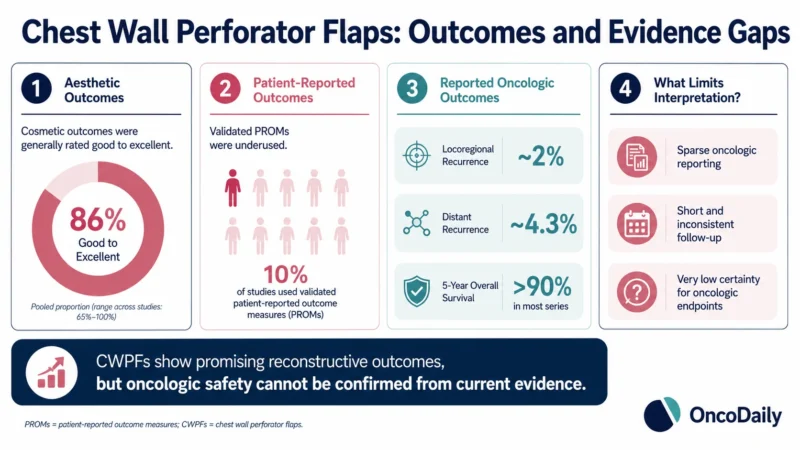
Cosmetic outcomes were also generally positive. When reported by patients or surgeons, results were often rated as good to excellent. This supports the clinical rationale for using these flaps in breast-conserving surgery, especially when the expected surgical defect could compromise cosmesis.
The Patient-Reported Outcomes Gap
One of the most important findings was not what the review found, but what it did not find consistently. Validated patient-reported outcome measures were underused across the literature. This is a major limitation because breast reconstruction and oncoplastic surgery are deeply patient-centered interventions.
A surgeon-rated “good” cosmetic outcome does not always capture how a patient feels about breast appearance, symmetry, comfort, scarring, or body image. In modern breast cancer care, validated tools are essential because they allow outcomes to be compared across studies and translated into meaningful shared decision-making.
The review therefore highlights a key weakness in the field: chest wall perforator flaps may be aesthetically promising, but the evidence still needs stronger patient-reported satisfaction data using standardized instruments (Yadav et al., 2026).
Oncologic Safety Remains The Most Important Unanswered Question
The authors were appropriately cautious about oncologic conclusions. Although some studies reported low locoregional recurrence of approximately 2% and distant recurrence of approximately 4.3%, only a minority of studies included oncologic outcomes, and follow-up was often short or inconsistent. Five-year overall survival exceeded 90% in most series that reported it, but the evidence was not strong enough to infer oncologic safety (Yadav et al., 2026).
This caution is important. Low recurrence rates in observational cohorts can be reassuring, but they do not prove that a technique is oncologically equivalent unless studies account for tumor biology, margin status, systemic therapy, radiotherapy, and follow-up duration. In breast cancer surgery, reconstruction must never compromise oncologic principles.
The review makes this point clearly: current evidence suggests favorable short-term morbidity and cosmetic outcomes, but the certainty of evidence for oncologic endpoints is very low. Prospective studies with standardized reporting of locoregional recurrence, disease-free survival, and overall survival are needed before stronger claims can be made (Yadav et al., 2026).
Clinical Meaning
For clinicians, this review supports chest wall perforator flaps as a valuable option in selected patients undergoing breast-conserving surgery, particularly when volume replacement is needed to maintain breast shape. The low reported rates of flap loss, fat necrosis, infection, and wound complications are encouraging.
However, the review also reminds us that the field needs better evidence. Future studies should not only report whether the flap survived or whether the breast looked acceptable to the surgeon. They should also measure what matters to patients: satisfaction, quality of life, body image, physical comfort, and long-term cosmetic stability after radiotherapy.
At the same time, oncologic endpoints must be systematically captured. The next generation of studies should include prespecified follow-up points, standardized recurrence definitions, and adjustment for tumor subtype and treatment factors. Without this, chest wall perforator flaps will remain a promising technique supported mainly by heterogeneous observational data.
Conclusion
Chest wall perforator flaps appear to offer a low-morbidity, cosmetically favorable reconstructive option for selected patients undergoing breast-conserving surgery. The systematic review by Yadav et al. strengthens the case for their use as part of modern oncoplastic breast surgery, while also exposing important evidence gaps.
The key message is balanced: these flaps are promising, but the current literature does not yet provide high-certainty oncologic evidence. To move from promising technique to standardized practice, the field needs prospective studies with validated patient-reported outcomes and robust long-term oncologic follow-up.
