
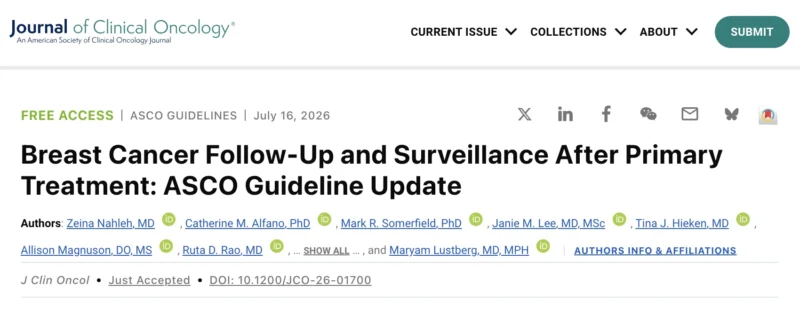
The American Society of Clinical Oncology has released an updated guideline on breast cancer follow-up and surveillance after primary treatment, introducing a more risk-adapted approach to post-treatment care for patients who have completed curative-intent therapy and have no clinical evidence of disease.
The guideline update, accepted for publication in the Journal of Clinical Oncology, was developed by an ASCO Expert Panel led by Zeina Nahleh, MD, and Maryam Lustberg, MD, MPH. It provides recommendations for follow-up intensity, mammography, blood-based biomarkers, and supplemental imaging after primary breast cancer treatment.
Moving Beyond One-Size-Fits-All Follow-Up
For decades, breast cancer follow-up has often followed a relatively uniform structure: regular clinical visits, annual mammography when breast tissue remains, and symptom-directed evaluation when needed.
The new ASCO update keeps the core principles of survivorship care but acknowledges that patients do not all carry the same risk of recurrence. The guideline therefore adopts a risk-stratified framework, dividing patients into low-, intermediate-, and high-intensity surveillance groups.
The goal is to better match follow-up care to recurrence risk, patient needs, patient preferences, oncology workforce limitations, and healthcare costs. The panel notes that risk-stratified survivorship models are increasingly being considered internationally as oncology systems face rising numbers of cancer survivors and limited specialist capacity.
Evidence Base Remains Limited
The guideline is important not only for what it recommends, but also for what it highlights: the evidence base for breast cancer surveillance remains thin.
ASCO’s review identified only one randomized controlled trial that informed the surveillance mammography recommendation. No randomized trials were found that directly evaluated different follow-up approaches by relapse risk among patients treated for early-stage breast cancer.
Because of this lack of high-quality evidence, many recommendations were generated through a formal modified Delphi consensus process. The full Consensus Panel completed three rounds of voting, and all recommendations met the required agreement threshold.
Low-Intensity Surveillance: Less Can Be Appropriate
The low-intensity surveillance group includes patients with ductal carcinoma in situ who are not receiving or are off endocrine therapy, patients with stage I hormone receptor-positive breast cancer after completing systemic therapy, and patients with TNBC or HER2-positive breast cancer at least five years from diagnosis.
For these patients, ASCO recommends an annual clinical visit, which may be conducted in person or virtually. Follow-up may be managed by survivorship clinics, oncology advanced practice providers, primary care clinicians, or gynecology clinicians.
For patients treated with breast-conserving surgery, annual mammography is recommended for the first three years after treatment. After that, surveillance mammography every one to two years is recommended for selected patients aged 50 years or older with low-risk features, including T1, low-grade, node-negative, ER-positive tumors, who remain recurrence-free three years after diagnosis.
The guideline still allows continued annual mammography for patients who prefer it after discussing potential benefits and harms with their clinician.
Mammo-50 Supports De-Escalation in Selected Patients
The mammography recommendation is partly informed by the Mammo-50 phase III noninferiority trial.
Mammo-50 enrolled women aged 50 or older who were recurrence-free three years after breast cancer surgery. Patients were assigned to annual mammography or less frequent mammography, which meant biennial mammography after breast-conserving surgery and triennial mammography after mastectomy.
At a median follow-up of 5.7 years, less frequent mammography was noninferior to annual mammography for recurrence-free interval, overall survival, and breast cancer-specific survival. Quality-of-life analyses also found no major differences between annual and less frequent surveillance groups.
Intermediate-Intensity Surveillance
The intermediate-intensity group includes several populations, such as patients with stage I TNBC or HER2-positive breast cancer within five years of diagnosis, stage II or III TNBC or HER2-positive breast cancer with pathologic complete response after neoadjuvant therapy, and patients receiving ongoing endocrine therapy.
For this group, ASCO recommends clinical follow-up with an oncology team or cancer survivorship clinic every 6 to 12 months for five to ten years after diagnosis. After five years, some patients may transition to low-intensity follow-up.
Annual surveillance mammography is recommended for patients treated with breast-conserving surgery. For unilateral mastectomy, annual contralateral mammography is recommended. For bilateral mastectomy, mammography is not recommended unless symptoms warrant evaluation.
High-Intensity Surveillance
The high-intensity surveillance group includes patients with higher-risk features, including TNBC or HER2-positive breast cancer with residual disease after neoadjuvant therapy within five years of diagnosis, inflammatory breast cancer within ten years of diagnosis, patients with germline mutations such as BRCA1/2 or PALB2, and patients with hormone receptor-positive breast cancer receiving endocrine therapy plus a CDK4/6 inhibitor.
For this group, ASCO recommends clinical follow-up with the oncology team every 3 to 6 months for up to ten years after diagnosis. Annual mammography is recommended when residual breast tissue remains, and routine chest wall examinations are suggested every six months.
Routine Blood Tests and Tumor Markers Are Not Recommended
ASCO does not recommend routine complete blood counts, chemistry panels, or tumor markers such as CEA, CA 15-3, or CA 27.29 for surveillance in asymptomatic patients after breast cancer treatment.
This recommendation is consistent with prior ASCO guidance and reflects the lack of evidence that routine blood testing improves outcomes in asymptomatic survivors.
ctDNA Remains Promising but Not Ready for Routine Surveillance
The guideline also addresses circulating tumor DNA.
ASCO states that ctDNA testing is not recommended for recurrence monitoring outside a clinical trial or clinical research setting. The panel acknowledges that detectable ctDNA can identify patients at higher risk of recurrence, but emphasizes that clinical utility has not yet been proven.
The key missing evidence is whether acting on ctDNA results by changing treatment improves patient outcomes. Until prospective data answer that question, routine ctDNA surveillance may create harm through anxiety, unnecessary treatment, cost, and uncertainty about how to respond to positive findings.
Supplemental Imaging: Shared Decision-Making Is Central
ASCO recommends that supplemental imaging with breast MRI may be offered based on shared decision-making for selected patients. Factors include germline mutation status, prior radiation exposure to breast tissue, age at diagnosis under 50, invasive lobular histology, dense breasts, cancers not detected by screening mammography, and other risk factors.
The guideline notes that there is no evidence to date that MRI surveillance improves overall survival in the post-treatment setting. However, MRI may reduce interval cancers in selected higher-risk patients.
Other supplemental imaging options, including contrast-enhanced mammography or ultrasound, may be considered for patients with dense breasts and other risk factors after discussing benefits and harms.
Routine imaging for distant metastases is not recommended in asymptomatic patients who have completed breast cancer treatment. This includes routine CT, PET, bone scans, liver ultrasound, or chest radiography in the absence of symptoms or abnormal clinical findings.
Patient Communication Matters
The guideline emphasizes shared decision-making and clear communication between clinicians and patients.
Important topics include the purpose of follow-up, recurrence risk, imaging choices, the lack of evidence for routine tumor markers or ctDNA monitoring, financial and insurance concerns, psychosocial support, survivorship planning, and fear of recurrence.
The panel also recognizes that de-escalating surveillance may feel uncomfortable for some patients and clinicians. The guideline frames risk-adapted care as part of the broader movement toward personalized oncology, similar to tailoring surgery, radiation, and systemic therapy.
The Bottom Line
ASCO’s updated breast cancer follow-up guideline shifts surveillance toward a more risk-based survivorship model.
Regular history, physical examination, and mammography remain central. However, visit frequency, imaging intensity, and the care team involved may vary depending on recurrence risk and patient needs.
The guideline discourages routine blood tests, tumor markers, ctDNA monitoring, and distant-metastasis imaging in asymptomatic patients outside appropriate clinical contexts.
The main message is practical: breast cancer survivorship care should be individualized, evidence-aware, and patient-centered, avoiding both under-surveillance for higher-risk patients and unnecessary testing for lower-risk survivors.
References
- Nahleh Z, Alfano CM, Somerfield MR, Lee JM, Hieken TJ, Magnuson A, et al. Breast Cancer Follow-Up and Surveillance After Primary Treatment: ASCO Guideline Update. Journal of Clinical Oncology. Accepted July 10, 2026. doi:10.1200/JCO-26-01700.
- Dunn JA, Donnelly P, Elbeltagi N, et al. Annual versus less frequent mammographic surveillance in people with breast cancer aged 50 years and older in the UK (Mammo-50): a multicentre, randomised, phase 3, non-inferiority trial. Lancet. 2025;405:396-407.
- Lockwood CM, Messersmith HJ, Kim AS, et al. Circulating Tumor DNA Testing in Solid Tumors and Lymphoma: ASCO Guideline. JCO Oncology Practice. 2026.