
SGO(The Society of Gynecologic Oncology) 2026 Annual Meeting delivered a wave of practice-changing data across ovarian, endometrial, and cervical cancers. Giuseppe Caruso, MD, PhD, medical oncologist at the European Institute of Oncology (IEO) in Milan, shared his main takeaways from the congress — and one theme stood above all: the rise of antibody-drug conjugates (ADCs) across every disease and every treatment setting. From first-line therapy to platinum-resistant recurrence, from the adjuvant space to maintenance, ADCs are rapidly redefining the treatment landscape in gynecologic oncology. But the advances extend far beyond ADCs — with landmark immunotherapy survival data, chemotherapy-free strategies, and the emergence of GLP-1 receptor agonists as a surprising new player. Here is a comprehensive breakdown of the key highlights.
Ovarian Cancer at SGO 2026 Congress Highlights: ADCs in Every Line of Therapy
ADCs Across All Settings
ADCs have infiltrated every treatment setting in ovarian cancer, with multiple trials reading out at SGO 2026:
- First-line (1L): TroFuse-021 and Destiny-Ovarian01 are evaluating ADCs in frontline therapy, particularly for HRD-negative patients who lack effective targeted options beyond bevacizumab.
- Platinum-sensitive recurrent OC (PSROC): A crowded and highly active space, with RAINFOL-04, GLORIOSA, TroFuse-022, FRAmework-01, TROY, and BNT-324 all exploring ADCs in patients who have already received a prior PARP inhibitor and may have diminished platinum sensitivity.
- Platinum-resistant recurrent OC (PRROC): BEHOLD-1 reported an impressive objective response rate (ORR) of 62%, and BNT-324 is also active in this space.
ROSELLA Trial — Final Overall Survival Results
The final OS data from the ROSELLA trial were presented at SGO 2026, confirming a 35% risk reduction in death and a 4.1-month extension in median overall survival for patients with platinum-resistant ovarian cancer. Together with the KEYNOTE-96 results, which already received FDA approval, these data establish a new standard of care in this notoriously difficult setting.

NRG-GY019 — Letrozole Falls Short in Low-Grade Serous OC
In low-grade serous ovarian cancer (LGSOC), the NRG-GY019 trial showed that letrozole alone failed to demonstrate non-inferiority compared to chemotherapy followed by letrozole. There may be a role for letrozole monotherapy in patients with no microscopic residual disease after surgery, but the community is now awaiting the LEPRE study results to better define the role of hormonal therapy in first-line LGSOC.
RAMP-201 — Long-Term Efficacy with Avutometinib
Long-term efficacy data from the RAMP-201 trial continued to support the avutometinib plus defactinib combination in LGSOC, with a duration of response (DOR) of 31 months and a progression-free survival (PFS) of 12.9 months (19.6 months in KRAS-mutant patients). This trial led to the FDA approval of avutometinib, and the phase III RAMP-301 trial is now underway to bring this combination to broader global clinical practice, including Europe.
Endometrial Cancer: Immunotherapy Milestones and the ADC Wave
Endometrial cancer stole the spotlight at SGO 2026 with landmark long-term immunotherapy data, emerging chemotherapy-free strategies, and a rapidly expanding ADC pipeline that mirrors the transformation already underway in ovarian cancer.
RUBY Trial — Astonishing 4-Year Survival Data
The updated 4-year outcomes of the RUBY trial were arguably the most striking results of the entire congress. The data showed a clear and sustained PFS and OS plateau, with:
- OS hazard ratio: 0.34
- 4-year overall survival: approximately 73%
These results were achieved despite approximately 70% crossover from the control arm to immunotherapy, powerfully reinforcing the message that dostarlimab-based immunotherapy belongs in the first-line setting for mismatch repair-deficient (dMMR) advanced endometrial cancer.
D-RT Study — A Chemotherapy-Free Option
For patients with stage III–IVA MMR-deficient endometrial cancer who achieve no residual disease after surgery, the D-RT study explored adjuvant dostarlimab combined with radiotherapy — a chemotherapy-free approach. This is consistent with the eagerly anticipated DOMENICA and KEYNOTE-C93 trials, which may further validate chemo-free adjuvant strategies in this molecular subgroup.
ADCs Across All Settings in Endometrial Cancer
Just as in ovarian cancer, ADCs are expanding across the entire endometrial cancer treatment continuum:
- Adjuvant: Destiny-Endometrial02
- First-line: Destiny-Endometrial01 and TroFuse-033
- Recurrent: BEHOLD-01 (ORR 67%) and BNT-323
GLP-1 Receptor Agonists — The “New Miracle Drug”
One of the most unexpected developments at SGO 2026 was the growing interest in GLP-1 receptor agonists (GLP-1 RAs) in endometrial cancer. These agents are now being explored for:
- Prevention of endometrial cancer in obese patients
- Treatment of endometrial cancer, including fertility-sparing options in combination with progestins for endometrioid histology
GOG-3039 — Abemaciclib Plus Letrozole
For advanced or recurrent endometrioid endometrial cancer with high hormone receptor expression, the GOG-3039 trial combining abemaciclib plus letrozole reported encouraging results:
- 6-month PFS: 57%ORR: 39%
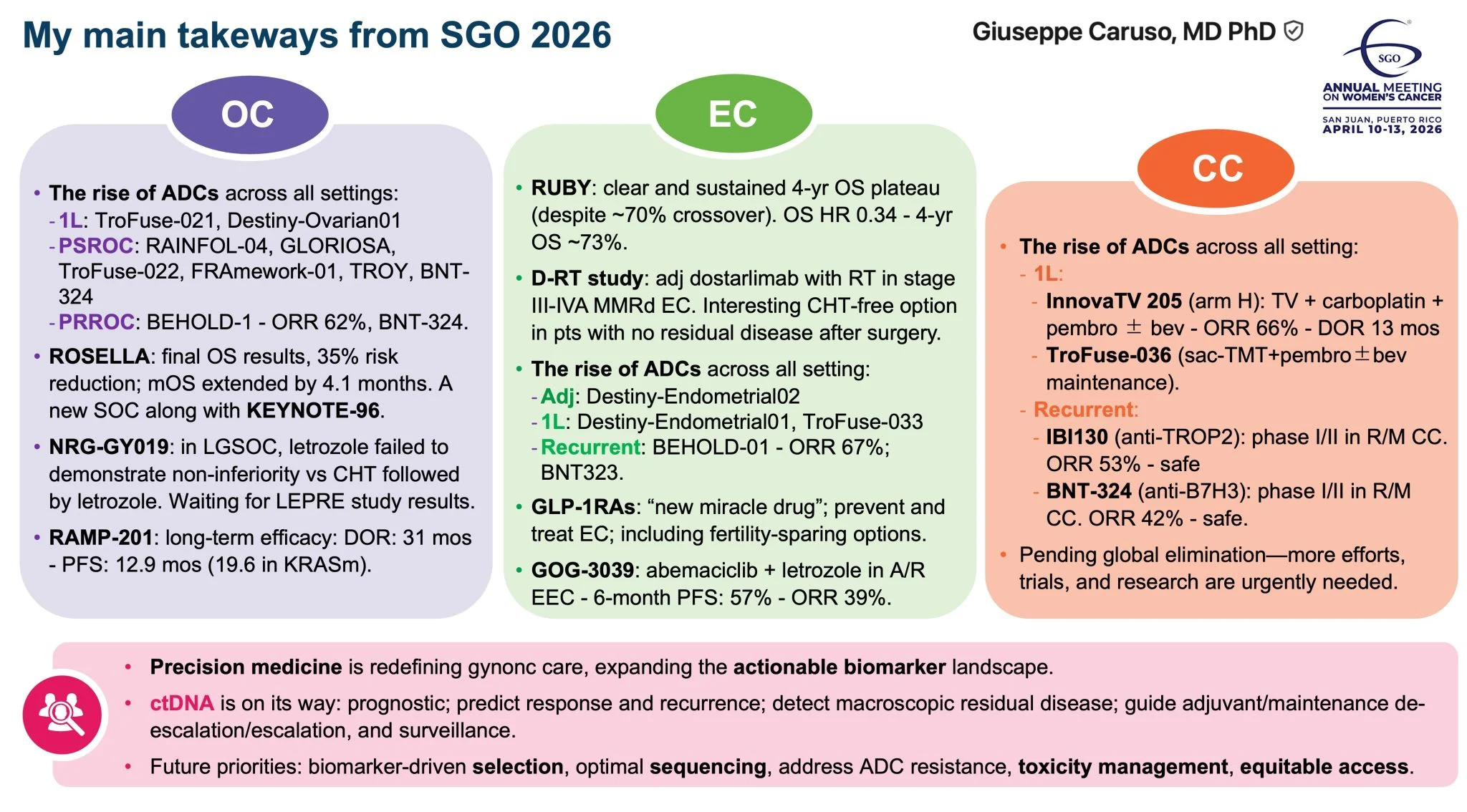
Source: Giuseppe Caruso LinkedIn
Cervical Cancer: ADCs on the Rise — But More Work Needed
While ovarian and endometrial cancers dominated the headlines, cervical cancer saw meaningful progress at SGO 2026 — with ADCs making their way into both frontline and recurrent settings and early-phase data signaling a promising new generation of targeted agents.
InnovaTV 205 — Tisotumab Vedotin in First Line
The InnovaTV 205 trial (Arm H) presented first-line data combining tisotumab vedotin (TV) with carboplatin, pembrolizumab, and with or without bevacizumab, demonstrating:
- ORR: 66%
- Duration of response: 13 months
TroFuse-036 — ADC-Based Maintenance
TroFuse-036 is evaluating sacituzumab tirumotecan (sac-TMT) combined with pembrolizumab, with or without bevacizumab, as a maintenance strategy in cervical cancer — a novel approach aimed at sustaining responses in this high-need population.
Novel ADCs in Recurrent/Metastatic Cervical Cancer
Two early-phase studies reported particularly promising signals:
- IBI130 (anti-TROP2): Phase I/II in recurrent/metastatic cervical cancer — ORR 53%, with manageable safety
- BNT-324 (anti-B7H3): Phase I/II in recurrent/metastatic cervical cancer — ORR 42%, with manageable safety
Despite these advances, Caruso emphasized that cervical cancer remains underfunded and under-researched relative to ovarian and endometrial cancers. More clinical trial efforts are urgently needed — even as the global community works toward the ultimate goal of cervical cancer elimination through HPV vaccination.
Overarching Themes: Precision Medicine, ctDNA, and Future Challenges
SGO 2026 made it clear that precision medicine and biomarker-driven therapy selection are no longer aspirational — they are becoming clinical reality in gynecologic oncology. The actionable biomarker landscape is expanding rapidly, with molecular profiling increasingly guiding treatment decisions.
ctDNA: From Prognostic to Predictive
Circulating tumor DNA (ctDNA) took center stage at SGO 2026 with an expanded role that now includes:
- Prognostic value for patient risk stratification
- Predictive value for treatment response and relapse
- Detection of microscopic residual disease after surgery
- Guiding adjuvant and maintenance therapy — enabling both de-escalation and escalation strategies
- Surveillance for early detection of recurrence
Future Priorities
As the field integrates these rapidly multiplying treatment options, Caruso highlighted several critical challenges ahead:
- Biomarker-driven patient selection — matching the right drug to the right patient at the right time
- Optimal sequencing — determining how to order ADCs, immunotherapy, PARP inhibitors, and chemotherapy across treatment lines
- ADC resistance — understanding and overcoming mechanisms of resistance, much as the field is doing with PARP inhibitors
- Toxicity management — developing expertise in the unique adverse event profiles of ADCs, bispecific antibodies, and novel combinations
- Equitable access — ensuring that these innovations reach patients beyond well-resourced academic centers and high-income countries
The Bottom Line
SGO 2026 delivered a resounding message: gynecologic oncology is entering a new era, driven by ADCs, durable immunotherapy responses, precision medicine, and innovative chemotherapy-free strategies. As Giuseppe Caruso concluded, “the future looks every day brighter” — but realizing this promise will require thoughtful integration, rigorous biomarker-guided decision-making, and a commitment to global access.
SGO 2026 Annual Meeting on Women’s Cancer — San Juan, Puerto Rico — April 10–13, 2026
Highlights by Dr. Giuseppe Caruso, MD, IEO, Milan, Italy