
Personalized financial navigation was associated with clinically meaningful improvements in financial distress across eight oncology practices, including rural settings.
Cancer costs can follow patients home: into the grocery budget, the overdue rent and the savings account emptied to keep treatment within reach. Among participants included in the LIFT trial’s final analysis, nearly two-thirds had reduced spending on essentials such as food, while 8.3% had stopped or refused cancer treatment because of cost.
Most had health insurance.
These findings expose a gap between having coverage and being able to afford cancer care. They also raise a practical question: once an oncology team identifies financial distress, what support should follow?
The Lessening the Impact of Financial Toxicity (LIFT) trial, published on October 16, 2026, in Journal of Clinical Oncology, evaluated a structured response. Trained financial navigators helped patients identify assistance, complete applications and track decisions over several months.
Among participants with baseline and follow-up assessments, financial well-being improved by an amount exceeding the study’s threshold for clinical significance.
Led by Stephanie B. Wheeler, with senior author Donald L. Rosenstein, the study extends evidence for financial navigation across different oncology settings-while leaving important questions about causality and long-term outcomes unresolved.
Financial Toxicity Was Already Changing Patients’ Lives
Financial toxicity encompasses the material hardship and psychological strain associated with paying for cancer care. In LIFT, these pressures were already affecting everyday spending and healthcare decisions before navigation began.
Among the 134 participants in the primary analysis:
- 64.9% had reduced spending on basics such as food.
- 61.9% had borrowed money from family, friends or a bank.
- 46.3% had skipped nonmedical bills, including rent.
- 40.3% had drawn on savings or retirement funds.
- 34.1% had been contacted by a debt collection agency because of cancer care.
- 23.9% had avoided treatment for another medical problem.
These figures describe a population specifically selected for moderate-to-severe financial distress. They are not prevalence estimates for all patients with cancer.
Nevertheless, they show the breadth of the burden: cancer-related costs were competing with food, housing and care for other health conditions.
Financial Navigation: Helping Patients Through the Process
Financial assistance can exist without being easy to obtain. The paper describes barriers including limited awareness, fragmented resources, burdensome eligibility requirements and detailed applications.
LIFT embedded trained navigators within participating practices to help patients work through these obstacles. Navigators included social workers, financial counselors and oncology nurse navigators.
An initial 45-60-minute assessment reviewed each patient’s financial goals, insurance coverage, assets, debts and potential eligibility for support. Navigators then provided personalized application assistance and tracked progress.
Check-ins generally occurred every two to three weeks, by telephone or in person. When possible, appointments were coordinated with oncology visits to reduce additional travel.
Support continued until patients achieved their initial financial assistance goals, received decisions on all submitted applications or reached seven sessions, whichever occurred first.
The median intervention duration was five months, and 75% completed follow-up surveys within eight months of baseline. Some applications were processed quickly, while others-including applications for public insurance or disability benefits-could take months.
A Study Designed for Everyday Oncology
LIFT was a pragmatic, single-arm, hybrid type II implementation-effectiveness trial, examining both patient outcomes and delivery of the intervention.
It was conducted at four rural and four nonrural oncology sites in North Carolina, including comprehensive cancer centers, community hospital cancer programs, an integrated cancer center and a teaching hospital.
Adults were eligible if they understood English, were within five years of a cancer diagnosis or living with advanced disease, and had a FACIT-COST score of 22 or lower, indicating moderate-to-severe financial toxicity.
Of 258 people who consented, 233 screened positive for financial toxicity, 205 completed comprehensive intake and 179 received financial navigation. The primary analysis included 134 participants with paired baseline and follow-up measurements.
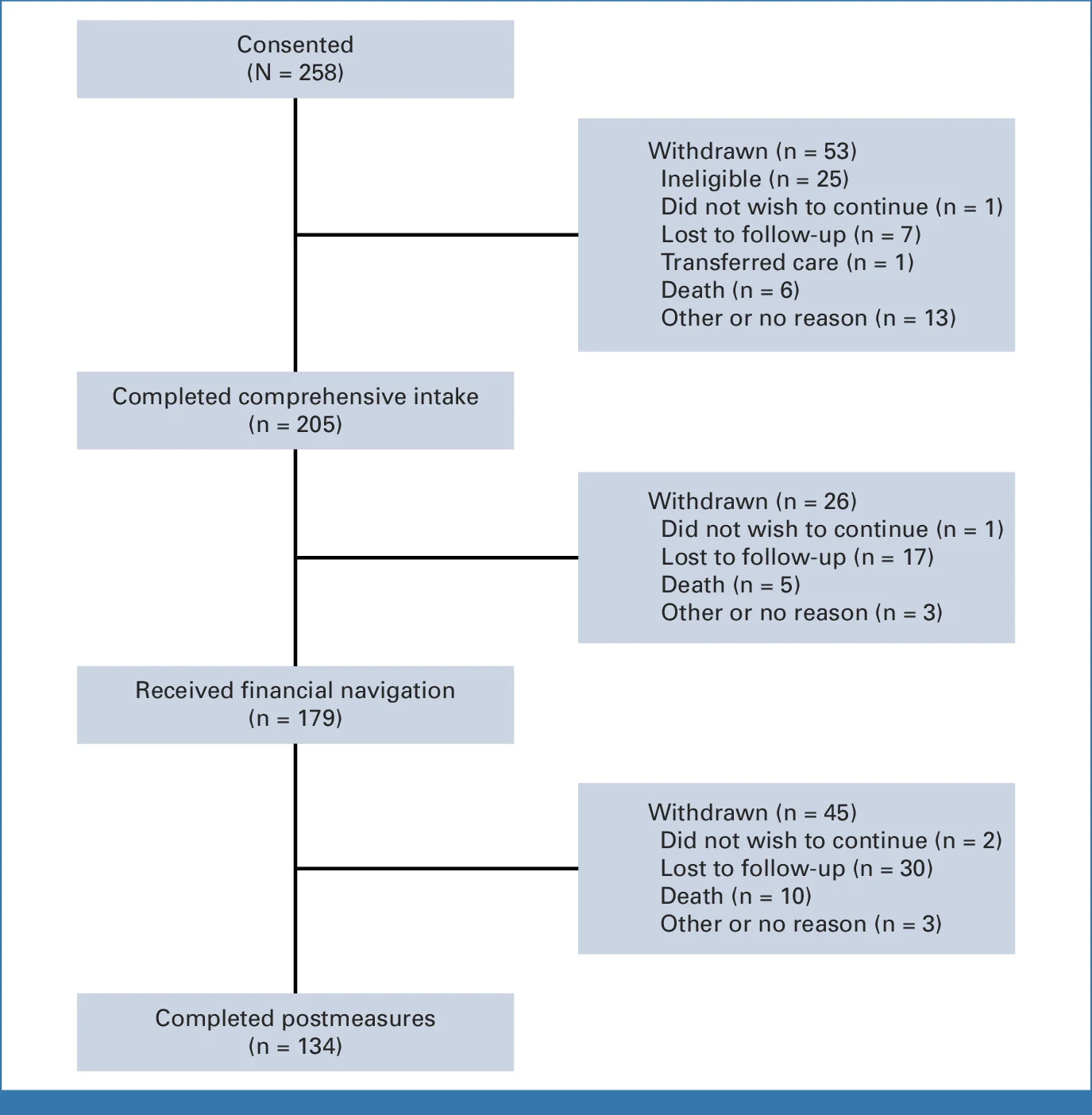
Participant flow through the LIFT trial. Of 258 individuals who consented, 205 completed comprehensive intake, 179 received financial navigation and 134 completed post-intervention assessments. Reasons for attrition are shown at each stage. Source: Stephanie B. Wheeler et al. Effectiveness of a Multisite Oncology Financial Navigation Intervention: The Lessening the Impact of Financial Toxicity Clinical Trial. J Clin Oncol 0, JCO-26-00617 DOI:10.1200/JCO-26-00617
Participants in the analytic sample had a mean age of approximately 53 years. Women accounted for 65.7%, 33.6% were non-Hispanic Black and 39.6% lived in rural ZIP codes. Breast cancer, leukemia or lymphoma, and lung cancer were the most common diagnoses.
An Eight-Point Improvement in Financial Well-Being
The primary outcome was change in FACIT-COST, a validated patient-reported measure scored from 0 to 44, with higher scores indicating less financial toxicity.
Mean scores increased from 6.6 at baseline to 14.7 at follow-up, an average improvement of 8.1 points. The change was statistically significant and exceeded the five-point increase considered clinically meaningful.
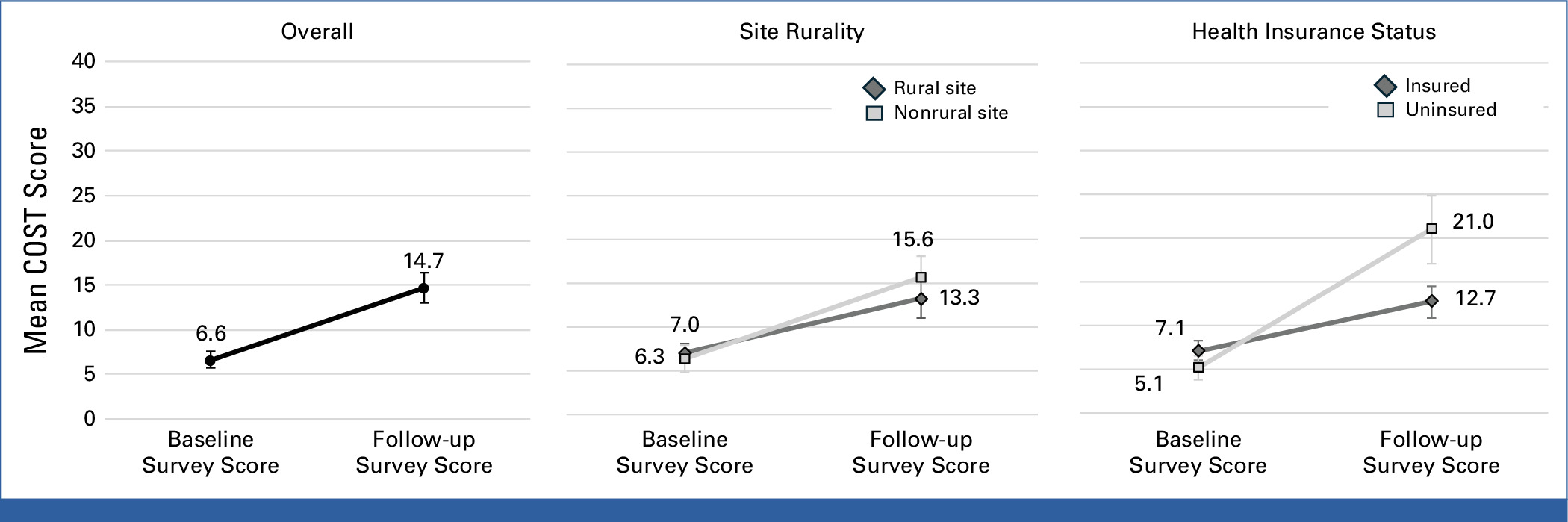
Change in patient-reported financial toxicity following financial navigation. Mean COST scores are presented at baseline and follow-up, overall and stratified by practice rurality and insurance status. Higher scores indicate less financial toxicity. Follow-up timing varied, with most participants completing the intervention within eight months. Source: Stephanie B. Wheeler et al. Effectiveness of a Multisite Oncology Financial Navigation Intervention: The Lessening the Impact of Financial Toxicity Clinical Trial. J Clin Oncol 0, JCO-26-00617 DOI:10.1200/JCO-26-00617
The upward trajectories in the figure show improved average financial well-being among participants assessed before and after navigation. The overall change was large enough to cross the paper’s benchmark for clinical relevance.
However, improvement did not mean financial hardship had disappeared. The mean follow-up score remained below the score of 22 used to identify eligibility at enrollment.
The figure also shows change over time rather than a comparison against untreated patients. It cannot establish how much of that change was attributable to navigation itself.
Improvements Extended to Rural Practices
At rural sites, mean COST scores increased from 7.0 to 13.3, an improvement of 6.3 points. At nonrural sites, scores increased from 6.3 to 15.6, an improvement of 9.3 points. Both within-group changes were statistically significant.
These findings describe the rurality of the treating practice, which is distinct from where patients live. Separate analyses based on patients’ residences also found significant improvements among rural and nonrural residents.
The results broaden the settings in which financial navigation has been evaluated. They suggest that a locally embedded approach can be delivered beyond major urban cancer centers, although the study was not designed to establish equivalent effectiveness between rural and nonrural practices.
Insurance Did Not Remove the Need for Support
Approximately three-quarters of participants with available insurance information were insured at intake, despite meeting eligibility criteria for substantial financial distress.
In exploratory analyses, mean COST scores improved by 5.6 points among insured participants and 15.9 points among uninsured participants.
The larger numerical improvement among uninsured participants warrants further investigation. These groups were not randomized, and the uninsured subgroup was smaller, so the findings do not establish that insurance status determined the intervention’s effect.
The improvement observed among insured participants nevertheless reinforces the baseline findings: having health insurance does not necessarily protect a household from the financial consequences of cancer.
From Identified Need to Practical Assistance
LIFT recorded 260 financial assistance applications and referrals among participants in the analytic sample.
Charitable foundation applications were documented for 50.0% of participants, applications for Supplemental Security Income or Social Security Disability Insurance for 35.1%, Medicaid enrollment support for 28.4% and transportation assistance for 21.6%.
Other support involved charity care, insurance subsidies, housing and pharmaceutical manufacturer assistance programs.
These activities demonstrate how financial screening was connected to practical help. However, applications and referrals should not be interpreted as confirmed awards or as a measured monetary value of assistance received.
High Satisfaction, but Continuing Financial Worries
Among 112 participants who completed the patient-experience survey, 89.3% were satisfied with LIFT.
Most reported that the intervention helped them understand what financial assistance was available (86.6%) and how to apply (83.9%). Nearly nine in ten said it addressed issues important to them.
Among respondents to the recommendation question, 93.6% would recommend LIFT to others.
Yet 61.6% reported fewer financial worries, and 31.3% wished there had been more appointments. These findings show that patients could value navigation highly while still facing unresolved financial pressures.
Why Selecting Patients With Financial Distress May Matter
LIFT enrolled people who already had moderate-to-severe financial toxicity. The authors identify this targeted approach as a potentially important feature of the results.
In their discussion, they contrast LIFT with the randomized CAFÉ trial, which did not restrict enrollment according to baseline financial distress and found stable COST scores over time in both intervention and control groups.
This comparison raises a hypothesis: financial navigation may provide greater benefit when directed toward patients with substantial existing hardship.
It is not a direct comparison between trials and does not overcome LIFT’s lack of a control group. Nevertheless, it supports further evaluation of screening-based approaches that match the intensity of navigation to patients’ financial needs.
What the Results Can-and Cannot-Establish
LIFT provides evidence that financial navigation is feasible across diverse oncology practices and is associated with clinically meaningful improvements in patient-reported financial distress.
Its principal limitation is the absence of a randomized comparison group. Participating practices were unwilling to accept control or delayed-intervention assignment because of the perceived urgency of patients’ needs and anticipated benefits of navigation.
Consequently, natural changes in financial circumstances, attention from study staff and reporting effects could have contributed to the observed improvement.
Attrition and variable follow-up timing also affect interpretation. All sites were in one state, and eligibility was limited to English-speaking patients.
The study did not establish whether improvements persisted over longer periods or translated into better treatment completion, healthcare utilization or survival.
Making Financial Support Part of Cancer Care
Delivering LIFT required dedicated resources. Navigators completed approximately 17 hours of initial training, with additional training, technical assistance and peer learning. Participating practices received $20,000 annually to help offset navigator costs.
Wider implementation will therefore require attention to staffing, reimbursement and integration into routine oncology workflows. The authors planned a subsequent analysis of costs, cost-effectiveness and implementation differences.
They also emphasize that navigation must accompany broader reforms addressing the material burden and administrative complexity of cancer care.
LIFT offers a concrete model for the moment a patient says that cancer is becoming unaffordable: assess the financial problem, connect the patient with trained support and follow the assistance process through to a decision. The remaining challenge is to determine how sustainably that model can be delivered-and whether the financial improvements endure.
Original research: Wheeler SB, Waters AR, Murray CR, and colleagues. Effectiveness of a Multisite Oncology Financial Navigation Intervention: The Lessening the Impact of Financial Toxicity Clinical Trial. Journal of Clinical Oncology. Published online October 16, 2026. doi:10.1200/JCO-26-00617. All findings reported above come from this study.
You can also read: Financial Toxicity in Cancer Care: A Global Call for Submissions.