ASCO 2026 brought together the global oncology community for several days of practice-changing research, clinical discussions, and scientific updates across cancer care. Lung cancer once again had a strong presence, with important data and expert reflections covering non-small cell lung cancer, small cell lung cancer, targeted therapies, immunotherapy, antibody-drug conjugates, perioperative treatment, and emerging biomarkers.
To capture some of the most interesting conversations from the meeting, we selected 20 lung cancer posts from ASCO 2026 not to miss. These posts highlight key studies, expert insights, and meaningful moments shared by oncology professionals during one of the most important cancer meetings of the year.
20 Posts Not To Miss From ASCO 2026
“Some experiences stay with you long after the meeting ends — ASCO2026 is one of those.
Grateful to be part of it in my role leading thought leader engagement across thoracic oncology in the US West, and especially grateful to work with Bridget McFadden, my US East counterpart.
A few takeaways that stood out:
ALK+ NSCLC, Crown — the 7-year data continues to redefine what long-term outcomes can look like for patients and remains a true milestone.
Colorectal, BREAKWATER — important data reinforcing the impact of targeted combinations in BRAF V600E disease and continuing to shape first-line treatment approaches.
Broader Pfizer portfolio — meaningful advances across prostate cancer with TALZENNA plus XTANDI, and continued momentum in next-generation lung therapies, from ADCs to novel combinations.
And you can’t forget the pancreatic data that brought a rare standing ovation — a powerful moment that captured both the progress being made and the urgency that still exists for patients.
The conversations — across many planned meetings and advisory boards, with a few unexpected run-ins that turned into especially welcome and meaningful surprises.
The team — the collaboration, preparation, and execution behind the scenes are what truly make moments like this possible.
Now catching my breath, catching up on rest, recharging, and already thinking about how we translate this momentum forward for patients.
Grateful for the experience and the shared purpose.”
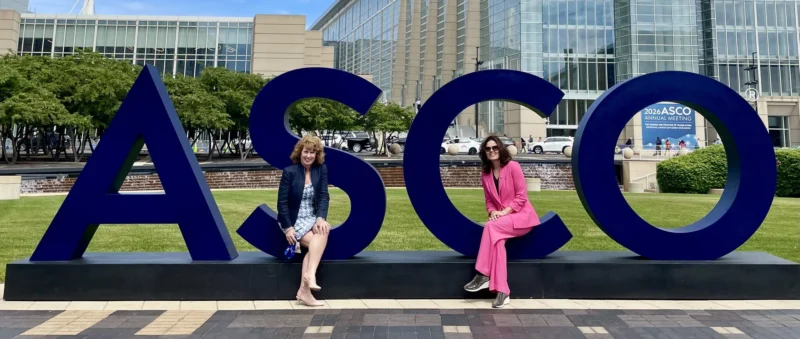
“Two days into ASCO in Chicago, and it has already been an incredibly productive week for Lung Cancer Europe.
Over the last two days, we have held 10 meetings with pharmaceutical partners, including seven meetings in a single day.
Along the way, we’ve covered 14,000 steps on day one and 19,000 steps on day two — a reminder that patient advocacy can be as physically demanding as it is rewarding.
What has been particularly encouraging is the level of interest from our partners in Lung Cancer Europe’s future plans and ambitions.
We have received exceptionally positive feedback on our inaugural Lung Cancer Europe Conference held earlier this year, with many attendees describing it as one of the most impactful and professionally delivered patient advocacy events they have attended.
We have also been delighted to hear such strong feedback regarding our first-ever advisory board programme.
Several companies commented on the quality of the discussions, the calibre of participants, and the value of the insights shared.
Many have already expressed interest in repeating the experience at our 2027 conference in Warsaw.
It was equally encouraging to hear that every partner we met with is keen to attend next year’s conference.
We also shared our plans for a new poster session, which will provide an opportunity for member organisations from across Europe to showcase innovative projects, best practices, and initiatives that are making a real difference to people affected by lung cancer and their families.
With two more days of meetings ahead, we are excited about the opportunities still to come and the partnerships that will help us continue driving meaningful change for the lung cancer community across Europe.
And, in between meetings and shuttle journeys, we’ve had the chance to admire some of Chicago’s remarkable architecture.
The scale, creativity, and individuality of the city’s buildings have genuinely taken our breath away.
Thank you to all our partners for your time, your insights, and your continued commitment to improving outcomes for people affected by lung cancer.”
Debra Montague:
“Five days. Seventeen meetings. More than 71,000 steps. And countless conversations focused on improving outcomes for people affected by lung cancer.
As we conclude a highly productive week at ASCO 2026 in Chicago, I am leaving inspired by the enthusiasm, commitment, and willingness to collaborate that we encountered throughout the congress.
Over the course of the meeting, we held 17 discussions with pharmaceutical and industry partners, sharing Lung Cancer Europe’s priorities, future plans, and vision for strengthening the voice of people affected by lung cancer across Europe.
It was particularly encouraging to hear from so many organisations that are eager to deepen their engagement with our community.
Several companies expressed interest in hosting advisory boards alongside our second European Patient Conference next year, recognising the value of bringing patient perspectives directly into the development of future programmes, services, and treatments.
We were also delighted to share plans for a new poster session at our next conference, showcasing innovative projects, initiatives, and best practices from patient organisations across Europe.
The response was overwhelmingly positive, with many partners excited about the opportunity to learn from and support the outstanding work being undertaken by our members.
There was also considerable interest in our growing portfolio of digital resources and educational initiatives, reflecting the increasing importance of accessible, patient-centred information and support.
What stood out most throughout ASCO was the recognition that meaningful progress is only possible through partnership.
Whether with patients, advocates, researchers, clinicians, policymakers, or industry, collaboration remains at the heart of everything we do.
Thank you to everyone who took the time to meet with us.
We return to Europe energised, encouraged, and more determined than ever to ensure that every person affected by lung cancer has access to the best possible care, treatment, and support.”
“Changing first-line treatment options for cancer patients away from chemotherapy is important for many reasons, including toxicity and the effects on aging.
Here are two studies presented at ASCO providing targeted treatment in first-line NSCLC lung cancer patients.
EGFR exon 20 insertions, which account for about 4% to 12% of EGFR-mutant NSCLC, have resisted conventional EGFR TKIs.
Median progression-free survival was about 3 months longer in the sunvozertinib arm — 10.3 months versus 7.5 months with chemotherapy, with a hazard ratio of 0.65 and P<0.001.
The confirmed objective response rate was 58.9% versus 31.1%, and the median duration of response was 11.2 versus 7.1 months.
The WU-KONG28 trial was published online on May 29 in The New England Journal of Medicine.
Sac-TMT differs from other ADC agents through its bifunctional linker and membrane-permeable payload, which enable a bystander effect that can kill adjacent tumor cells that may not express TROP2.
The phase 3 OptiTROP-Lung05 open-label trial, conducted at 68 hospitals in China, randomly assigned 413 patients with PD-L1 tumor proportion score of at least 1% to receive sac-TMT 4 mg/kg every 2 weeks plus pembrolizumab 400 mg every 6 weeks, or pembrolizumab alone.
All patients had locally advanced or metastatic NSCLC without EGFR or ALK alterations.
At a median follow-up of 10.5 months, median PFS was not reached in the sac-TMT arm versus 5.7 months with pembrolizumab alone, with a hazard ratio of 0.35 and P<0.0001.
Twelve-month PFS rates were 62% versus 29%, and the objective response rate was 70% versus 42%.
The OptiTROP-Lung05 trial was published in The Lancet.”
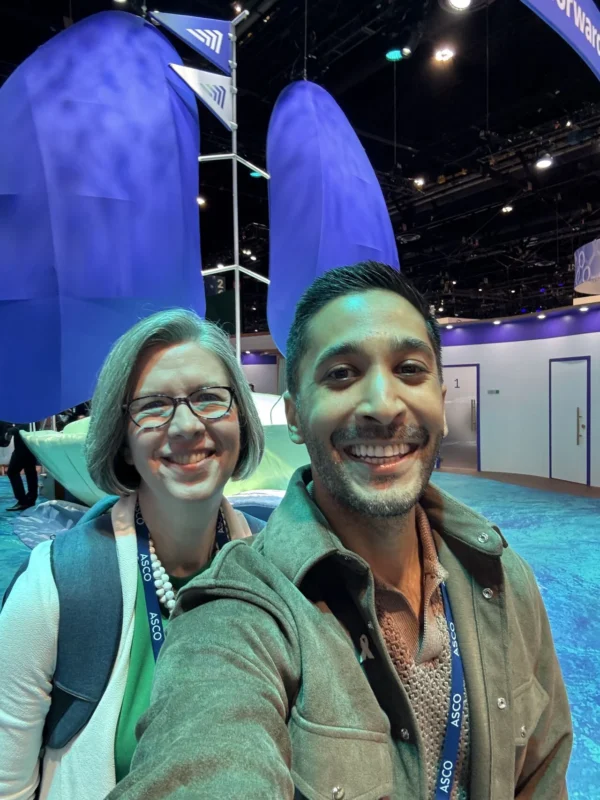
“One of my favorite ASCO26 moments.
Running into Dr. Eric Singhi in the Exhibit Hall and getting pics on ‘The Lung Boat.’
A fun ASCO twist on a classic tune, celebrating new advances, good energy, and memorable moments in lung cancer care.”
“Each year I come to ASCO with a sense of excitement and curiosity.
And even after attending for decades, that feeling hasn’t faded.
What continues to make this meeting so special is that there is always something new to learn, a fresh perspective to consider, and another reminder of just how quickly oncology continues to evolve.
It is also a chance to reconnect with longstanding colleagues and friends, while meeting new voices and new talent helping shape the future of cancer care.
This year, I found myself reflecting on how far we’ve come.
Twenty years ago, many of the advances we now discuss as real-world possibilities felt more like distant ambitions.
Progress in areas such as KRAS-targeted innovation is a powerful example of that shift — once something we could only really dream about, now a reality with meaningful potential for patients.
It’s moments like these that remind me how fortunate I am to work in oncology.
It is an incredibly dynamic field, where scientific ambition, collaboration, and innovation can translate into real impact for patients.
What makes this work even more meaningful is the opportunity to do it with exceptional colleagues whose dedication and focus on patients drive progress forward every day.
ASCO continues to be a powerful reminder not only of how much progress has been made, but of how much possibility still lies ahead.”
“ASCO2026 — time for exciting new data and time to connect with the global lung cancer family.
LungenClinic Grosshansdorf GmbH, Deutsches Zentrum für Lungenforschung, nNGM Lungenkrebs, Nationales Netzwerk Genomische Medizin, and American Society of Clinical Oncology.”
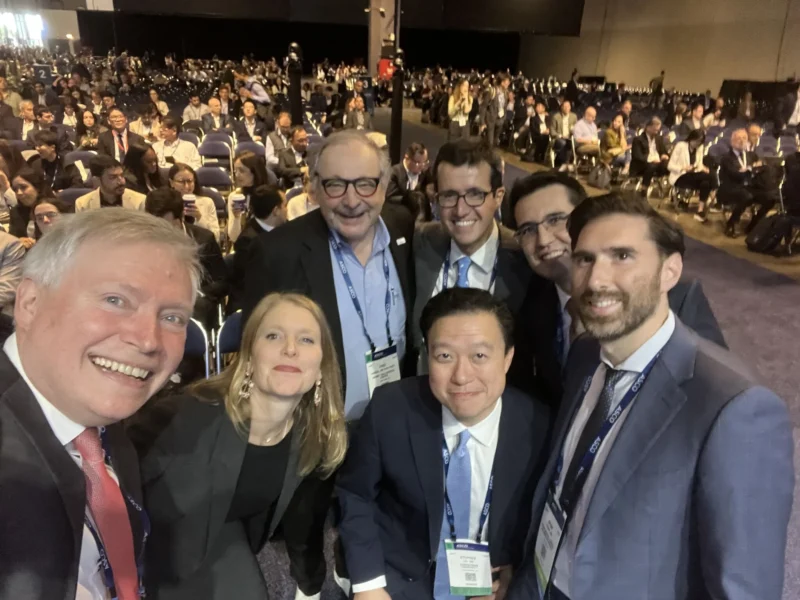
“Hot pathology takes from ASCO26.
What better way to enjoy a congress than being with like-minded colleagues.
Meet the 2 ESP Alumni who attended ASCO26 in Chicago just a few days ago.
João Lobo and Alessandro Gambella were European Society of Pathology ambassadors, both past awardees of the ESP Academy.
Under the supervision of Catarina Eloy, they will be preparing the ‘Highlights from ASCO 2026’ session at the ESP Congress.
We will have much to discuss, including but not limited to:
Huge news about RAS inhibitors for pancreatic cancer — a true game-changer.
PARP inhibitors for prostate cancer.
Promising news for triple-negative breast cancer.
New options for squamous cell carcinomas of the lung and head and neck.
Opportunities for HE to shine with the help of AI.
And of course, commentaries from pathology and oncology KOLs who will be sharing their own insights.
If you are a healthcare professional working in pathology and cancer, you are more than welcome to join us in Stockholm and the ‘Highlights from ASCO 2026’ session.
Secure your slot at the best pathology congress.”
“On this World No Tobacco Day, one message feels more urgent than ever: lung cancer is no longer a disease exclusively linked to smoking.
Yesterday, the latest edition of ASCO Daily News highlighted the growing challenge of lung cancer in never-smokers, a biologically distinct disease increasingly associated with environmental exposure, molecular drivers, and evolving risk factors.
And today at ASCO2026, the spotlight turns to one of the most anticipated lung cancer plenary presentations: the HARMONi study from Akeso, a potential milestone that could reshape the global NSCLC landscape.
Two powerful reminders in less than 24 hours:
Prevention still matters.
Biology matters even more.
Innovation in lung cancer is becoming truly global.
The future of thoracic oncology will depend not only on reducing tobacco exposure, but also on understanding the molecular complexity of lung cancer beyond smoking history.”
“Important perspective from Darrin Crisitello coming out of ASCO.
Lung cancer screening has clear clinical value, but real-world participation remains a major challenge.
From a product and commercialization perspective, that gap is exactly why continued innovation in early detection and screening follow-up is so important.
Mercy BioAnalytics presented two studies at ASCO evaluating blood-based approaches for lung cancer screening and lung nodule triage using biospecimens from the National Lung Screening Trial repository.
Exciting work from the Mercy team and collaborators as we continue advancing minimally invasive approaches that may help improve earlier detection and clinical decision-making.”
“Thrilled to share the latest clinical update from SystImmune’s DLL3-targeted ADC, BL-M14D1, presented at ASCO 2026 today.
In a heavily pre-treated small cell lung cancer population, we observed:
Objective response rate: 62%.
Median progression-free survival: 7.2 months.
These data highlight compelling anti-tumor activity in a setting where patients have long faced limited options.
Importantly, the results support our plan to advance rapidly into a global registrational study in first-line extensive-stage SCLC, with the goal of bringing a new treatment option to patients who urgently need better therapies.
This progress reflects the power of the ADC platform and the dedication of our teams, investigators, and patients who make these advances possible.
Read the full press release here.”
“Excited to share our latest research presented at the American Society of Clinical Oncology.
We used interactive geospatial mapping to identify ‘screening deserts’ for lung cancer across Maryland, areas where disease burden is high but access to low-dose CT screening is low.
By integrating data on 6,446 lung cancer cases with federally designated Health Professional Shortage Areas and Medically Underserved Areas, we built interactive county-level maps that reveal exactly where mobile screening programs are needed most.”
“Leaving the American Society of Clinical Oncology annual meeting this year, I’m reflecting on the science, the conversations, and the patients at the center of both.
New data in EGFR-mutated non-small cell lung cancer and advanced head and neck cancer offered encouraging signs of progress in settings where unmet need remains high.
As someone who loves to run when traveling for meetings, I’ve always found that conferences like ASCO have a rhythm of their own.
There’s the early start, the steady pace, the long stretches of listening and learning, and the moments that push you to look up and think about where the field is headed.
Running has taught me that progress rarely happens all at once.
It comes from consistency, resilience, and the belief that even difficult miles can move you closer to something meaningful.
That’s how I’m thinking about this year’s ASCO: not as a finish line, but as another mile marker on the road ahead.
We are running into the future of cancer care with more insight, more questions, and, importantly, more reason to keep going for patients.”
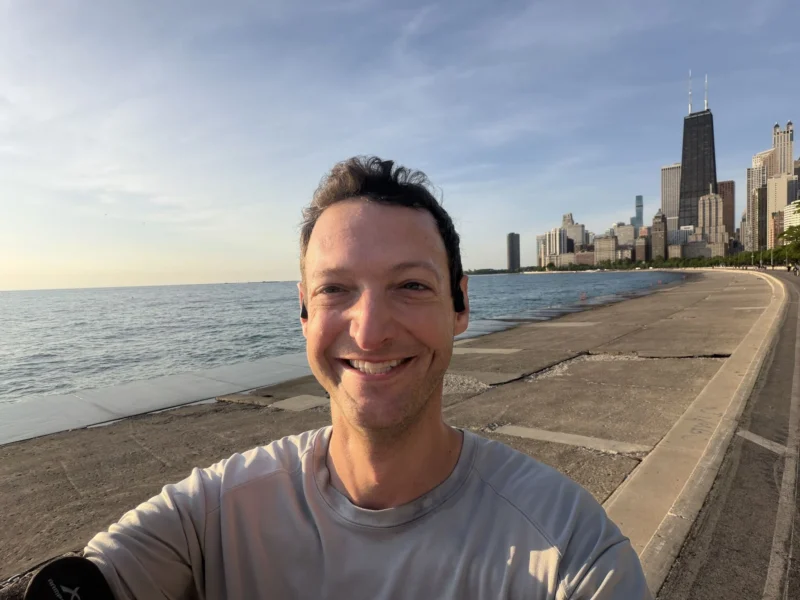
“Another Sunday at ASCO.
10 years ago, here in Chicago, I had the privilege to meet a woman who had enrolled in an early clinical trial for a cancer immunotherapy.
Her story, moving from despair to hope with all the uncertainties of an experimental drug, gave me so much more energy than an encouraging waterfall plot.
Returning to the same halls a decade later, science has evolved at an incredible pace.
But the most powerful data point isn’t on a slide; it’s the knowledge that this woman is still here, spending this weekend with her family.
It’s a grounding reminder that in oncology, behind every data set is a person waiting for more time.
While these long-term outcomes aren’t yet the reality for every patient, they underscore what is possible.
For many of us working in this area, the most rewarding part is witnessing the ‘tail of the curve’ — those moments where we transition from incrementally extending survival to seeing long-term remission become a reality.
That hope is what drives our work at Roche, particularly in a space as complex as lung cancer.
We have built our strategy to meet patients across the entire spectrum of lung cancer, from small cell lung cancer to non-small cell lung cancer, including both actionable genomic alterations and non-actionable genomic alteration types.
While our research is rooted in a deep understanding of biology, we don’t do this in a vacuum.
It takes the entire ecosystem, collaborating with healthcare professionals, patients, and partners, to successfully bring a new treatment to patients.
Whether you are in Chicago or following the debate online, let’s connect.
I’m looking forward to discussing how we can continue to push the boundaries of what’s possible, making exceptional stories the new normal.”
“Highlight 8 of lung data from ASCO26:
Can we vaccinate against lung cancer?
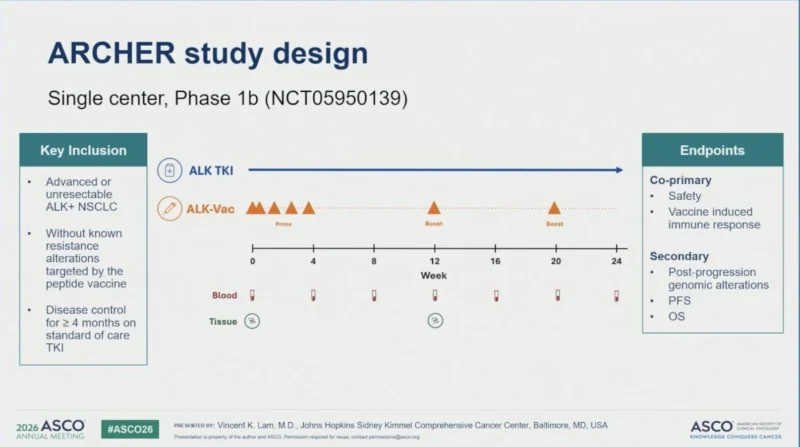
ARCHER: peptide vaccine in ALK-positive NSCLC.
Although ALK inhibitors are highly effective, resistance develops, often due to de novo mutations.
We know these common acquired mutations to second-generation ALK inhibitors, including G1202R, F1174X, L1196M, and L1196M, among others.
Could vaccination against these delay or prevent mutations, prolonging response to ALK inhibitors?
Fascinating concept.
Phase 1b, single centre.
Peptide vaccine versus the 7 most common resistance mutations.
Vaccination in the first month of ALK inhibitor treatment, with boosters at 3 months and 6 months.
ALK inhibitors included alectinib, brigatinib, or lorlatinib.
Toxicity:
Vaccination side effects were common but only grade 1-2, including chills, flu-like symptoms, and fatigue.
No cytokine release syndrome.
Activity:
93% mounted an immune response against at least 1 antigen.
33% mounted a response against all antigens.
Immune response was CD4-positive with Th17 and Th17.1.
Different mutations had different immunogenicity.
Only 1 case of progression, driven by KRAS G12D mutation.
My thoughts:
Very interesting study. Proof of concept, as opposed to demonstration of clinical effectiveness. Clearly, this is not ready for routine clinical use.
ALK is a good model, given excellent expected results with ALK inhibitors and known resistance mutations. But the concept is applicable to a wide range of lung cancers.
No concerns regarding toxicities.
Tiny numbers, with 15 patients, and too early in follow-up to determine whether there is any clinical benefit.
I love the concept of predicting resistance and proactively tackling that before it develops, as opposed to waiting for resistance and then having to manage it.”
Katie Bodell:
“What an adventure ASCO 2026 was.
Walking the halls of ASCO26 felt less like attending a conference and more like embarking on an expedition — navigating cutting-edge science, celebrating hard-won progress, and meeting the brilliant minds who are reshaping what’s possible in lung cancer.
Every conversation reminded me why this work matters:
Researchers translating bold ideas into therapies that will reach patients sooner than we ever thought possible.
Clinicians sharing real-world insights on biomarker testing, targeted therapies, and the next wave of treatment options.
Advocates, survivors, and industry partners standing shoulder-to-shoulder in the belief that lung cancer outcomes can — and will — keep improving.
A heartfelt thank you to our industry sponsors whose generosity and partnership make Lung Cancer Foundation of America’s mission possible.
From funding transformative research grants to amplifying patient education and advocacy, your commitment is the engine behind the progress we celebrated this week.
We simply could not do this work without you — and the lung cancer community is better for your investment in it.
I left ASCO energized by the data, but I left hopeful because of the people.
The scientists who refuse to settle. The young investigators chasing the next breakthrough. The sponsors who believe in the mission. The patient voices that keep all of us grounded in the ‘why.’
The progress is real. The momentum is building. And the future for lung cancer patients is brighter because of every one of you.
Onward.
P.S. And an extra thank you to Labcorp for making me look like an explorer.”

“ASCO Annual Meeting 2026 delivered one of the most important days in oncology in years.
A few standouts:
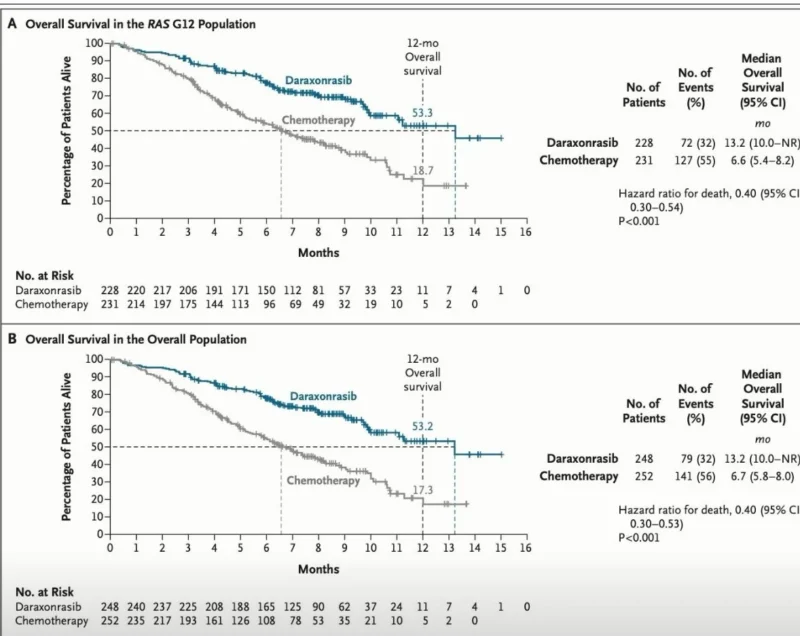
The biggest news of the day may have been pancreatic cancer. In a simultaneous The New England Journal of Medicine publication, daraxonrasib doubled overall survival in second-line PDAC — 13.2 versus 6.7 months, with a hazard ratio of 0.40.
In a disease where decades of ‘progress’ have often meant survival gains measured in weeks, seeing a hazard ratio start with 0.4 almost feels unreal.
For KRAS-targeted therapy to generate this magnitude of benefit in pancreatic cancer is a genuine watershed moment.
Apalutamide before and after surgery produced a 9x increase in pathologic complete response in prostate cancer, potentially rewriting a perioperative paradigm that has barely changed in a century.
Selpercatinib reduced recurrence risk by 83% in RET-positive early lung cancer, with zero deaths in the treatment arm — another reminder that broad molecular testing at diagnosis is now essential.
A bispecific antibody beat PD-1 inhibition on overall survival in squamous NSCLC — the first phase III validation of the PD-1/VEGF strategy.
And abemaciclib delivered the first-ever positive phase III trial in dedifferentiated liposarcoma.
And there’s still more ahead.
BREAKWATER is redefining frontline BRAF-mutant colorectal cancer, while VIKTORIA-1 could reshape the post-CDK4/6 breast cancer landscape.
Add a flood of ADC, bispecific, and precision oncology data still to come, and ASCO 2026 is beginning to feel like a true oncology inflection point.”
Written by Nare Hovhannisyan, MD